


The European Union has been holding extended talks this week in Brussels with Chinese Foreign Minister Wang Yi, focusing on trade and international concerns like the war in Ukraine, ahead of a scheduled EU-China summit later this month.
Simultaneously, EU member states are locked in internal negotiations over the stance they’ll present to the United States before a temporary pause on US-imposed tariffs, announced by President Donald Trump in April, expires next week.
Meanwhile in Washington, Trump has announced just his third international trade agreement since the launch of his “Liberation Day” tariffs on April 2 — this one with Vietnam. It’s particularly notable as it’s the first such deal in the Indo-Pacific region and involves an economy deeply tied to China.
This flurry of diplomacy and deal-making highlights how complex and fast-moving the global landscape of trade and strategic relations has become. While the chaos in Washington and the conflicts in Ukraine and Gaza dominate headlines, other powerful geopolitical forces are also shaping international relations.
For Australia, these shifting dynamics underscore that Trump isn’t the only influence it must navigate. The broader environment is marked by increasing competition, particularly between the US and China, who are both aggressively pursuing trade and influence across Africa, Europe, Southeast Asia, and beyond.
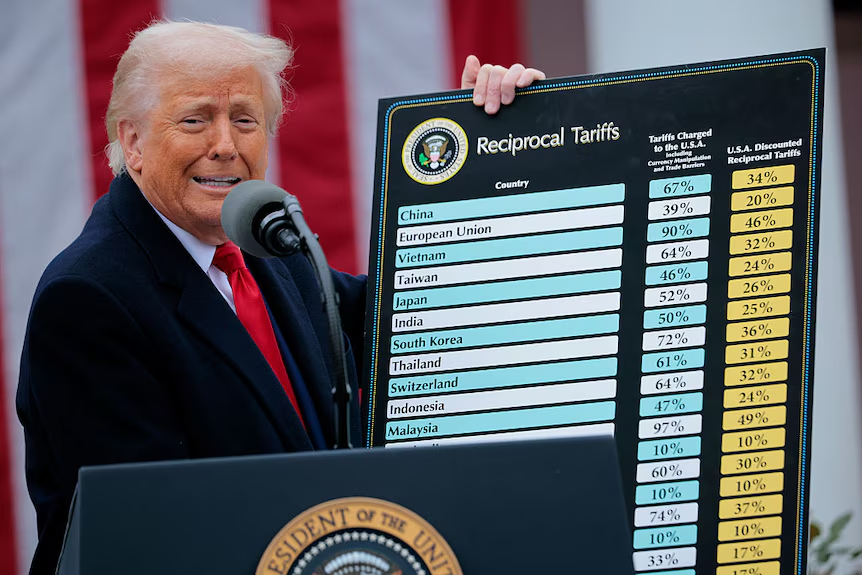
Vietnam’s new deal with the US is a case in point. Although hit hard by April’s tariffs — facing a 46% rate — Vietnam has now secured a cut to 20% on its major exports to the US, such as textiles and electronics. Trump also claimed the agreement would allow American goods to enter Vietnam tariff-free, though specific terms remain undisclosed.
However, the deal includes a significant condition: a 40% tariff on trans-shipped goods, clearly aimed at curbing Chinese products routed through Vietnam. This presents a major complication for Vietnam, which is heavily economically intertwined with China and serves as a key manufacturing hub.
China is closely monitoring the deal. Its Ministry of Commerce said it is assessing whether the agreement harms Chinese interests and has warned it will take “countermeasures” if needed. The Vietnam agreement has also prompted Beijing to issue quiet warnings to other regional partners about entering into similar deals with Washington.
Reports suggest the US plans to pressure over 70 countries to scale back trade ties with China — with even key allies like Japan coming under threat. The result has been a wave of new strategic maneuvering, with China responding by increasing engagement in the region. In April, President Xi Jinping signed over 45 cooperation agreements during visits to Cambodia, Malaysia, and Vietnam, covering everything from agriculture to tech and infrastructure.
The broader picture is one of escalating competition. From Latin America to Africa — where the US is countering Chinese influence in mineral-rich regions — the global economic map is being redrawn. China, meanwhile, continues to offer incentives, such as lifting tariffs on imports from almost all African countries.
Despite perceptions that Trump might retreat from global affairs, his administration is deeply involved — with trade policy often taking precedence over broader geopolitical strategy.
This global reshuffling has significant implications for Europe. The continent’s vast market is highly coveted by both the US and China. Although the idea of Europe choosing sides in a binary trade bloc scenario alarms many, the tangled nature of today’s deals suggests such a split is unlikely in the near term. Still, the pressures are growing.
European Commission President Ursula von der Leyen recently said there isn’t enough time to reach a comprehensive trade agreement with the US before next week’s deadline. Yet with Trump threatening 50% tariffs — particularly worrying for Germany’s auto sector — pressure is mounting for at least a temporary solution.
Geopolitical and security considerations also weigh heavily, especially with the ongoing war in Ukraine and concerns about US disengagement from NATO.
According to the South China Morning Post, Wang Yi told EU foreign policy chief Kaja Kallas that China does not want Russia to lose the war in Ukraine, fearing it would allow the US to pivot its focus entirely to countering Beijing.
Implications for Australia
All of this provides important context for Australia. While the US has remained relatively quiet on Australia’s specific position, it doesn’t guarantee a stable future. Canberra will likely face renewed pressure from Beijing over any perceived alignment with US trade or security moves that China views as hostile.
But the disruption in global trade also opens doors. Australia will need to think creatively and strategically about how to navigate these evolving relationships.
Prime Minister Anthony Albanese is expected to address these issues in an upcoming speech honouring former PM John Curtin — widely considered the architect of Australia’s US alliance.
In a notable shift in tone, Albanese will present the alliance not as an obligation but as a product of Curtin’s independent leadership. He will stress that Curtin’s historic decision to “look to America” was driven by a sober assessment of Australia’s regional security needs — not blind allegiance.
The alliance, Albanese will say, is a cornerstone of Australian foreign policy, but one that must be interpreted through the lens of national interest and strategic reality. Curtin gave Australia “the confidence and determination to think and act for ourselves,” and today’s world demands that same mindset.
“Australia cannot predict or control the challenges we’ll face,” the PM is expected to say. “But we can choose how we respond.”
The complexity of the current global order brings risks — but also significant opportunities for a country willing to engage with the world as it is.
