


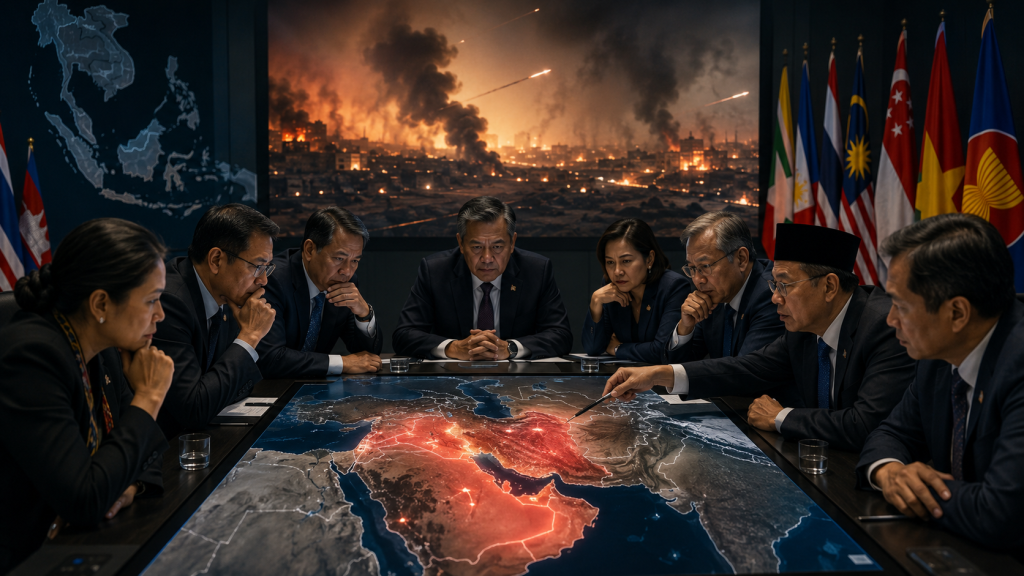
Southeast Asian nations have raised alarm over the escalating Middle East conflict, warning that continued fighting could threaten energy supplies, disrupt global shipping routes and create economic challenges for countries across the region.
Foreign ministers from ASEAN’s 11 member states discussed the growing crisis during meetings in Manila, where regional security, economic stability and diplomatic cooperation were major topics.
Although ASEAN is already dealing with several regional challenges, including Myanmar’s ongoing civil conflict and rising tensions in the South China Sea, the renewed confrontation between the United States and Iran dominated discussions.
In a joint statement, ASEAN foreign ministers expressed deep concern over the impact of the violence on civilians, international trade and global energy markets.
The bloc called on all parties involved to exercise maximum restraint, avoid further escalation and return to diplomatic negotiations.
A key concern for ASEAN is the security of the Strait of Hormuz, one of the world’s most important energy shipping routes.
The narrow waterway connects the Persian Gulf with the Gulf of Oman and the Arabian Sea and serves as a critical passage for oil and liquefied natural gas exports from the Middle East.
A significant portion of global energy shipments travels through the strait, much of it supplying Asian economies.
ASEAN officials warned that any prolonged disruption could push energy prices higher, increase shipping costs and create additional pressure on regional economies.
Many Southeast Asian countries depend heavily on imported fuel from the Middle East.
Nations such as the Philippines, Thailand and Singapore rely on overseas supplies of crude oil and refined petroleum products, meaning any interruption in Gulf shipments could quickly affect petrol prices, electricity costs, transportation expenses and manufacturing operations.
Even ASEAN countries with domestic energy production remain exposed because they are connected to international markets and may rely on imported fuels in certain sectors.
The ministers’ concerns reflect growing recognition that the conflict is no longer a distant geopolitical issue.
Rising energy prices could affect inflation, government subsidy programmes, household budgets and business costs throughout Southeast Asia.
The Philippines has previously raised concerns about energy security as tensions around the Strait of Hormuz affected fuel availability.
Regional governments have also been exploring ways to strengthen emergency reserves and improve cooperation during potential supply shortages.
ASEAN members have discussed creating stronger regional mechanisms that would allow countries to support each other during major energy disruptions.
However, establishing an effective emergency-sharing system remains complicated because ASEAN economies have different energy resources, storage capacities, infrastructure networks and national policies.
Some countries have significant domestic production, while others depend almost entirely on imports.
Officials would need to determine how emergency supplies would be distributed, transported and priced during a regional crisis.
The urgency of these discussions has increased after Iran threatened greater control over the Strait of Hormuz and Yemen’s Iran-aligned Houthi movement announced actions targeting maritime traffic connected to rival states.
Several commercial vessels have reportedly changed routes due to fears of attacks, blockades and further military escalation.
Longer shipping routes increase delivery times, insurance expenses and transportation costs, even when ships avoid direct attacks.
ASEAN ministers stressed that strategic waterways must remain open and secure under international law.
They warned that using important shipping routes as tools of political pressure could damage global stability.
The bloc’s concerns extend beyond the Middle East.
ASEAN also wants to protect freedom of navigation in important Asian waterways, including the Strait of Malacca and disputed areas of the South China Sea.
A prolonged energy shock could weaken economic growth across Southeast Asia.
Higher fuel costs increase expenses for airlines, logistics companies, fishing industries, manufacturers and public transport operators.
Businesses may pass these additional costs to consumers, increasing inflation and reducing household purchasing power.
Governments could respond through fuel subsidies, tax reductions or price controls, but such measures may place additional pressure on public finances.
Lower-income ASEAN economies would face greater difficulty managing prolonged increases in energy prices.
Higher inflation could also complicate monetary policy decisions.
Central banks that had planned to reduce interest rates to support economic growth may be forced to maintain tighter policies if energy costs continue rising.
Higher rates can help control inflation and support currencies but also increase borrowing costs for households and businesses.
The conflict therefore creates a difficult economic environment for Southeast Asian policymakers, combining risks of slower growth, higher prices and financial market volatility.
The Manila meetings brought together ASEAN ministers with representatives from major global powers, including the United States, China, India, Russia, Japan and Australia.
US Secretary of State Marco Rubio and Chinese Foreign Minister Wang Yi participated in discussions, while Russian Foreign Minister Sergei Lavrov also attended the regional gathering.
The presence of competing global powers highlighted ASEAN’s role as a diplomatic platform during periods of international tension.
Rubio warned Asian leaders about Iran’s threats toward the Strait of Hormuz and argued that no country should be allowed to restrict international shipping through critical waterways.
He said the United States remained committed to Southeast Asia despite increased military attention being focused on the Middle East.
ASEAN, however, maintained a more cautious position.
The organisation traditionally avoids taking sides in conflicts involving major powers and instead focuses on dialogue, restraint and international law.
Because ASEAN members have different relationships with the United States, China, Russia and Iran, reaching consensus requires careful diplomacy.
Some members maintain close security ties with Washington, while others have stronger economic relationships with Beijing or political connections elsewhere.
As a result, the bloc’s statement focused on the consequences of the conflict rather than directly blaming any individual country.
ASEAN previously called on Washington and Tehran to pursue negotiations and maintain ceasefire arrangements.
However, renewed fighting has raised doubts about whether diplomatic efforts can achieve a lasting solution.
The Middle East crisis is unfolding alongside other major challenges facing ASEAN.
The South China Sea remains a major security concern after renewed tensions between China and the Philippines.
A recent confrontation near the Second Thomas Shoal led to accusations from both sides, with Manila reporting injuries to one of its naval personnel.
Several ASEAN members, including the Philippines, Vietnam, Malaysia and Brunei, have overlapping maritime claims with China.
Beijing claims sovereignty over much of the South China Sea, despite a 2016 international arbitration ruling that rejected the legal basis for many of those claims.
ASEAN and China have continued negotiations over a proposed code of conduct designed to reduce the risk of conflict.
However, disagreements remain over whether the agreement should be legally binding and how disputes should be handled.
Myanmar’s continuing political crisis was another major issue discussed during the Manila meetings.
The country has been in conflict since the military takeover in 2021, which removed the elected government and triggered widespread fighting.
ASEAN’s Five-Point Consensus called for an end to violence, dialogue between opposing sides, humanitarian assistance and the appointment of a special envoy.
However, progress has been limited as fighting continues and humanitarian conditions worsen.
The Myanmar crisis has highlighted the limitations of ASEAN’s traditional principles of consensus and non-interference.
Critics argue that these principles make it difficult for the organisation to respond strongly when domestic conflicts create wider regional problems.
The Middle East crisis presents a different challenge because ASEAN has limited influence over decisions made by Washington, Tehran and other major actors.
Its main role is diplomatic coordination, economic cooperation and providing a platform where competing powers can communicate.
The Manila meetings demonstrated ASEAN’s importance as a regional diplomatic forum.
Countries with opposing strategic interests continue to participate because Southeast Asia remains a vital centre of global trade and maritime activity.
ASEAN is attempting to maintain relationships with multiple global partners while avoiding becoming caught in major-power competition.
The bloc’s response to the Middle East conflict reflects this balancing approach.
ASEAN leaders called for an end to violence, protection of civilians, secure shipping routes and a diplomatic solution without fully aligning with any side.
The immediate priority for Southeast Asian governments is protecting energy security.
Countries are expected to review strategic fuel reserves, diversify suppliers and accelerate investments in renewable energy and regional power networks.
However, these solutions will take years to develop.
In the short term, ASEAN economies remain vulnerable to developments in the Gulf region and any disruption around the Strait of Hormuz.
The bloc’s warning is therefore both a diplomatic message and an economic alert.
For Southeast Asia, a prolonged Middle East conflict could mean higher living costs, weaker currencies, increased government spending pressures and slower economic growth.
ASEAN’s ability to reduce those risks will depend on how effectively member states cooperate, prepare emergency plans and strengthen long-term energy security.
