


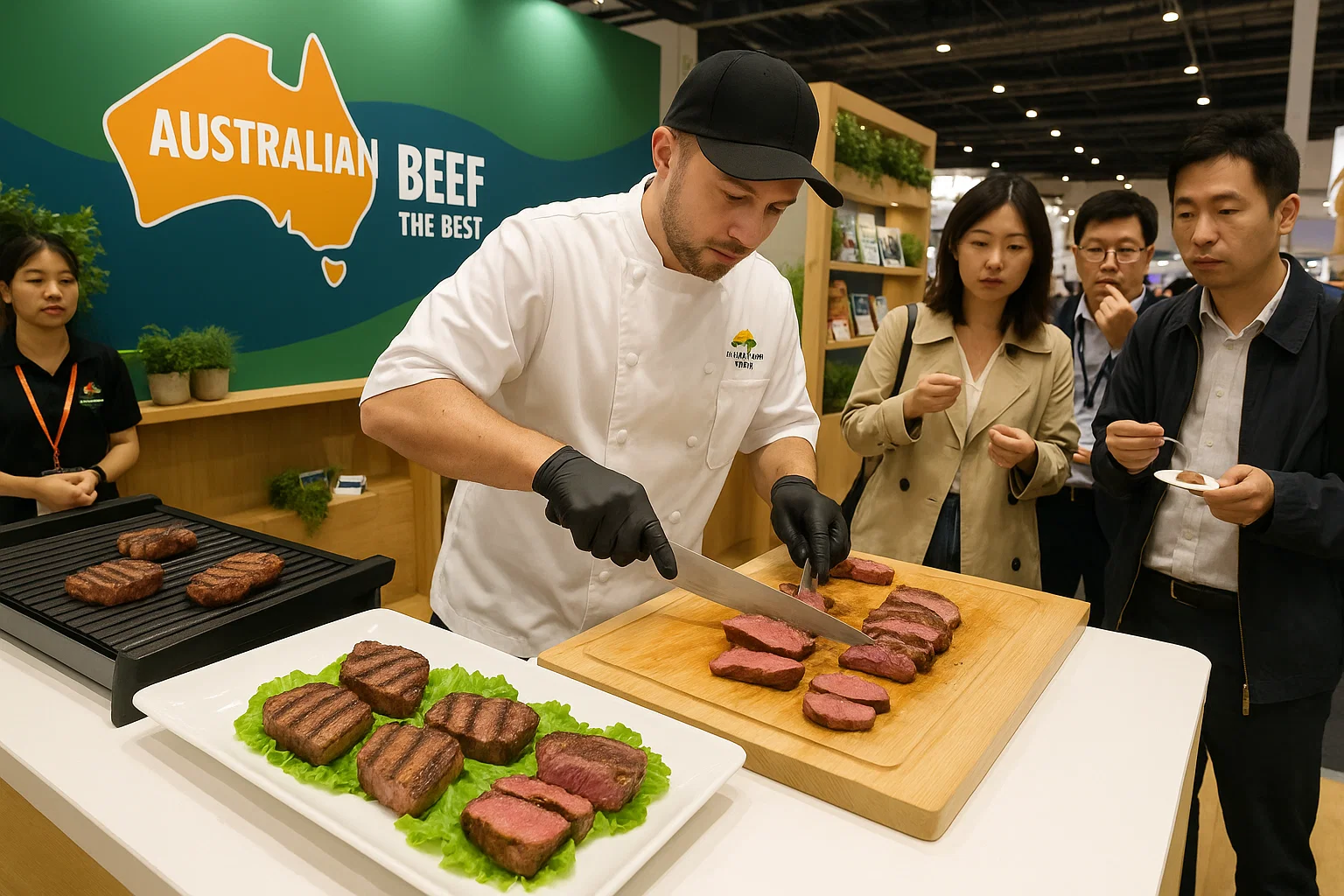
At one of the world’s largest food trade exhibitions in Shanghai this week, Australian beef took the spotlight.
With exports to China climbing rapidly in 2025, demand for Australian grain-fed beef is especially high. Murray Davis, Meat and Livestock Australia’s (MLA) regional manager for Greater China, said Australia is currently dominating the high-end segment of China’s beef market.
“Australia is front and centre in China, leading the premium beef category,” Davis said.
He noted that while the United States has historically been Australia’s main competitor, ongoing trade tensions between China and the U.S. have significantly reduced American beef imports, giving Australia a competitive edge.
“Given the current trade friction, the U.S. is largely absent, placing Australia in a strong position to supply premium meat to Chinese consumers,” he added.
Australia’s Strong Showing at Shanghai’s SIAL Food Show
At the SIAL food show in Shanghai, one of the largest events in the global food and beverage industry, Australia’s beef pavilion was bustling with buyers.
“We had 300 square metres of space and were constantly busy,” Davis said. “Right next to us, the U.S. pavilion was quiet, with few staff present — a stark contrast.”
Despite a recent 90-day easing of tariffs between the U.S. and China, the trade rift was still apparent at the expo.
Davis, who is based in Shanghai, acknowledged China’s current economic challenges — including lower consumer confidence, falling property values, and a sluggish stock market — but emphasized the country’s continued importance to Australia.
“Even with these headwinds, it’s still a 200,000-tonne-a-year beef market for Australia and will remain a vital one,” he said.
AACo Reports Strong Financial Results
Australia’s largest cattle producer, the Australian Agricultural Company (AACo), also reported encouraging financial results this week. The company recorded a $58.4 million operating profit for the financial year, a 14% increase from the previous year. Total revenue rose 15% to $389.9 million.
CEO David Harris described it as a strong performance during a globally uncertain period.
Despite the lingering effects of the U.S.’s 10% tariff, North America remains AACo’s second-largest market for branded beef.
“There’s been lots of dialogue around the tariff, but demand is strong and domestic U.S. supply is low — it presents great short- to mid-term opportunities for us,” Harris said.
While AACo exports some beef to China, Harris said it’s not a core market for the company. However, China’s demand does impact supply dynamics in other regions.
“We’re not heavily invested in China, but when China pulls volume from other markets, that benefits us globally,” he said.
Beef Production Booming in 2025
Australia is on pace to reach record beef production in 2025. According to new data from the Australian Bureau of Statistics (ABS), 2.2 million head of cattle were processed in the first quarter of the year — a 20% increase compared to the same period in 2024.
This surge in supply has been driven in part by drought conditions, which have led to increased cattle movements into saleyards across the country.
