


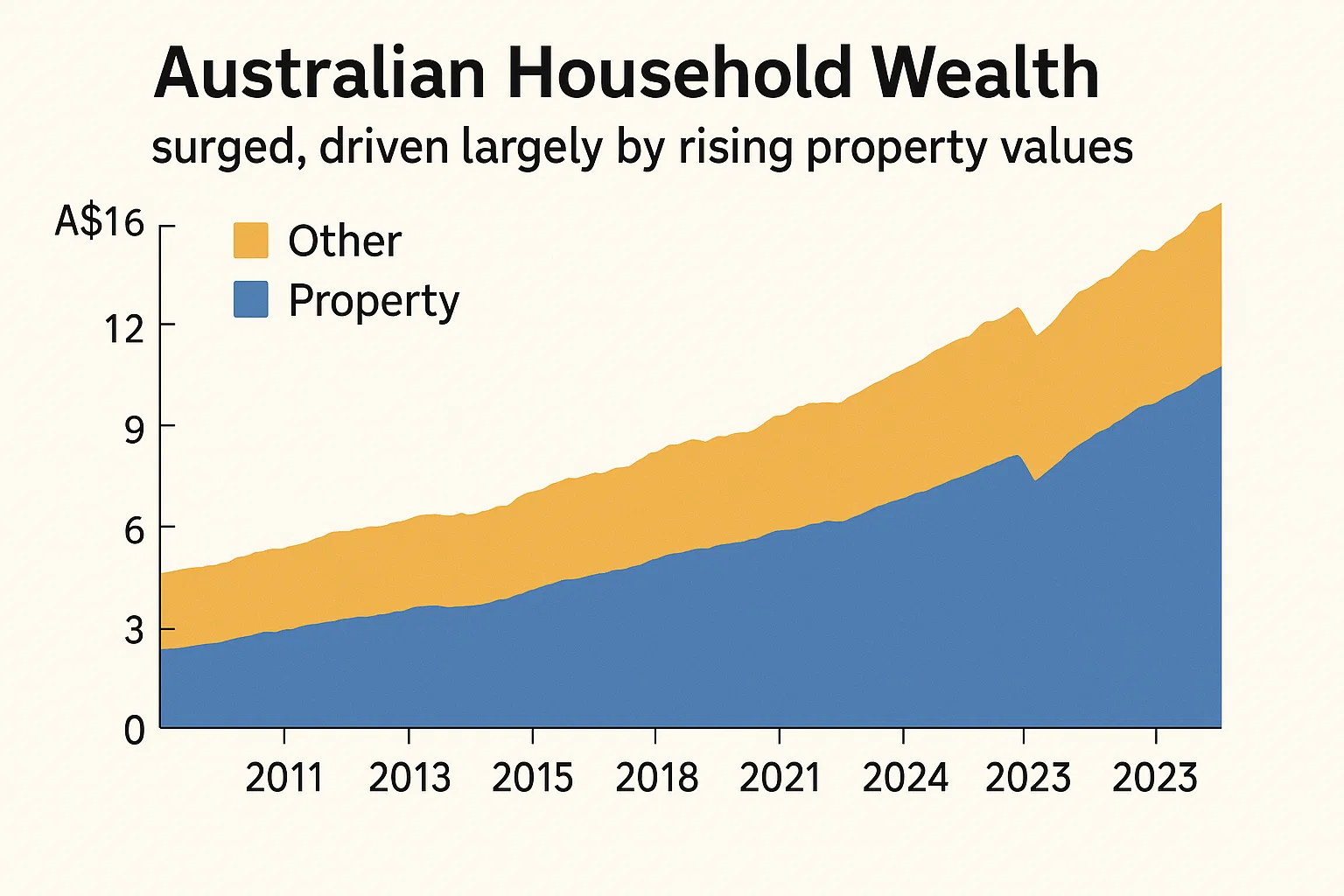
Australia’s household wealth experienced a significant boost in the March quarter, largely driven by increases in residential property and land values.
According to new data from the Australian Bureau of Statistics, net household wealth grew by $125.3 billion, bringing the total to $17.3 trillion. A key contributor was the continued rise in housing prices, which increased by 0.7% during the quarter.
Although property prices have now risen for eight consecutive quarters, annual growth has eased to 4.2%, down from 8.0% in March 2024.
During the same period, household borrowing climbed by 1.4% ($42.4 billion), slightly offsetting overall wealth growth by 0.2 percentage points.
Total credit demand reached $136.1 billion in the March quarter, including $25.9 billion from households, $45.9 billion from private non-financial corporations, and $45.5 billion from government borrowing.
ABS head of finance statistics, Dr. Mish Tan, said credit growth is expected to continue.
“The RBA’s rate cut in February — the first since November 2020 — provided some mortgage relief for households in the March quarter,” she said. “We anticipate the broader effects of this cut, along with another in May, will become clearer in housing and credit data later in the year.”
The impact of the May rate cut will be reflected in the next quarter’s figures.
Meanwhile, household deposits grew by 1.7% ($29.5 billion), contributing 0.3 percentage points to the overall increase in wealth.
In contrast, superannuation balances dropped by 0.4% ($16.4 billion), reducing household wealth growth by 0.1 percentage point. This decline was attributed to weaker domestic and global equity markets.
“Superannuation assets fell for the first time since the September 2022 quarter, as global market volatility affected share prices,” Dr. Tan explained.
