


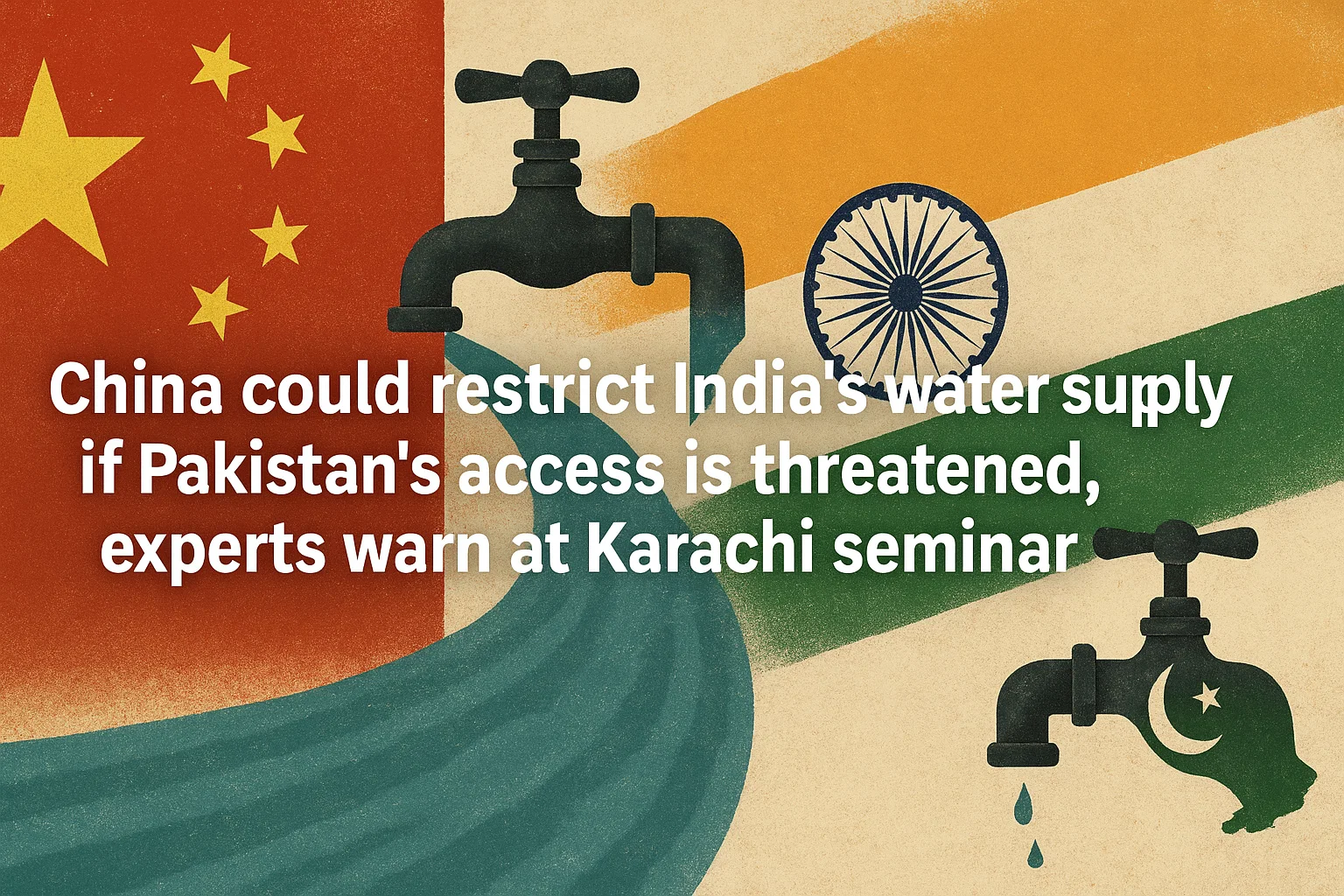
China Could Restrict India’s Water If Pakistan Is Cut Off, Experts Warn at Karachi Seminar
KARACHI: A seminar hosted by the Pakistan Institute of International Affairs (PIIA) on Saturday explored escalating tensions between Pakistan and India, with speakers warning that China could block water supplies to India if New Delhi disrupts flows to Pakistan.
PIIA chairperson Dr Masuma Hasan opened the session by stressing the importance of including diverse perspectives, particularly those of young researchers, on the current Pakistan-India conflict. She recounted key developments, including India blaming Pakistan — without credible evidence — for the April 22 Pahalgam attack, which she said was a result of Indian intelligence failure.
Following that, India suspended the 1960 Indus Waters Treaty, prompting Pakistan to halt the Simla Agreement of 1972. India then launched “Operation Sindoor” on May 7, and Pakistan responded on May 10 before a ceasefire was brokered by U.S. President Donald Trump.
During the session, research assistant Mohammad Usman presented on “Water Assets and Resources,” warning that if India were to cut off Pakistan’s water supply, it could flood its own northern regions. While such a move would be technically and financially demanding, it could severely affect Pakistan’s agriculture during dry seasons by reducing crop yields.
He also highlighted the concept of “weaponising water,” where an upstream country suddenly releases large volumes of water to flood the downstream nation. In the India-Pakistan dynamic, India holds that upper-hand. However, in the case of China and India, China is the upper riparian state — particularly in relation to the Brahmaputra River — and could similarly restrict India’s access to water, he noted.
Syeda Maliha Sehar discussed the “Political and Military Interests” behind the conflict, noting that Pakistan’s defence strategies—enhanced through its partnership with China—showed technological maturity. She argued that Pakistan’s use of Chinese-origin systems neutralised Indian surveillance capabilities and shifted perceptions, portraying Pakistan as strategically capable and not merely reactive.
Researcher Safa Rehmat presented on “Cyber Warfare and Digital Espionage,” pointing out that both Indian and Pakistani intelligence agencies have developed advanced cyber capabilities, including hacking, data breaches, and online misinformation campaigns.
Syed Shahryar Shah, speaking on the “War of Narratives,” emphasized that public perception has become as influential as the actual conflict. “The physical conflict lasted days, but the narrative battle continues,” he said.
On the issue of Kashmir, researcher Asif Ali said Indian authorities have intensified crackdowns, detaining or questioning around 2,800 Kashmiris in the wake of the Pahalgam incident.
In another presentation, Safa Rehmat addressed “Media, Misinformation and Public Opinion,” citing several false reports from both sides. These included Indian media falsely claiming an attack on Karachi port using images of Philadelphia, and a report about Pakistan’s army chief being captured. On Pakistan’s side, there were unverified claims about capturing an Indian female air force pilot and Indian troops allegedly raising white flags in surrender.
Saad Asad Brohi spoke on “Regional and Global Responses,” while the audience raised key points about the broader dimensions of modern conflict — including economic and political factors — and stressed the need for improved governance in Pakistan.
One audience member ironically thanked Indian Prime Minister Narendra Modi, saying his actions had helped unify Pakistan.
