


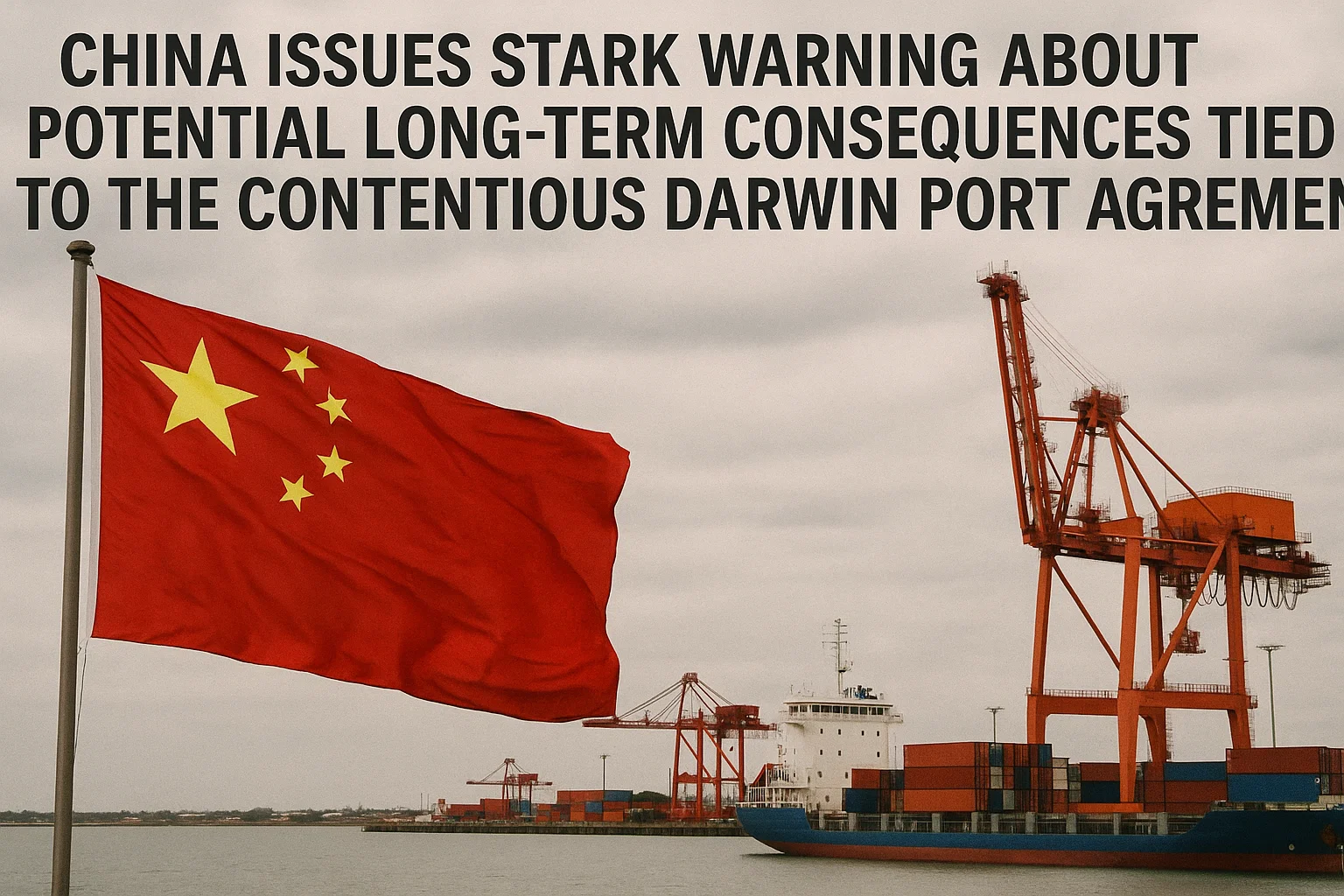
China has issued a stern warning to Australia over its plans to reclaim control of the strategically significant Darwin Port, cautioning that such a move could lead to long-lasting negative consequences.
An editorial published by the Chinese Communist Party-run Global Times warned that any effort to “politicise” the issue or reclaim the port under the guise of national security would seriously damage China-Australia relations. The warning comes amid renewed scrutiny of the 2015 deal, in which the Northern Territory government leased the port for 99 years to Landbridge Group, a private Chinese firm, for $506 million.
At the time, the agreement sparked immediate geopolitical concern. The White House objected to not being consulted, especially as U.S. Marines stationed in the Northern Territory rely on the port. Australia’s regional neighbours also raised questions, considering Australia’s own warnings against accepting Chinese infrastructure investments.
Ten years on, both major Australian political parties campaigned in the 2025 federal election on promises to take back the port. The strategic shift follows significant military upgrades in northern Australia, including $160 million in enhancements to RAAF Base Darwin, part of a broader regional defence build-up in response to China’s growing military assertiveness.
The Global Times editorial argued that reclaiming the port would mark a troubling move from commercial cooperation to military escalation, framing it as part of a broader U.S.-led “de-Sinicisation” campaign intended to facilitate American militarisation in the Indo-Pacific region.
According to the Chinese narrative, the port only became a national security concern after U.S. objections were raised in 2015, reportedly by then-President Barack Obama during an APEC meeting with then-Prime Minister Malcolm Turnbull. China’s companies, including Landbridge, are subject to Communist Party oversight and must share data with government agencies upon request, further complicating the strategic picture.
National security experts like John Coyne from the Australian Strategic Policy Institute have emphasised Darwin’s importance due to its proximity to key maritime routes and regional allies. Coyne describes the port as a vital asset in a contested Indo-Pacific.
Originally touted as part of China’s Belt and Road Initiative, the port’s strategic location and commercial significance made it a key node in China’s envisioned global trade network. About 4.5 million tonnes of cargo pass through the port each year, along with major exports of oil and gas.
In 2015, Australia’s Foreign Investment Review Board, led by then-Treasurer Scott Morrison, did not scrutinise the deal. The Defence Department raised no objections, and Trade Minister Andrew Robb praised the lease as a symbol of strengthened Australia-China economic ties. Robb later joined Landbridge as an advisor shortly after resigning from Parliament.
Now, both Prime Minister Anthony Albanese and former opposition leader Peter Dutton support regaining control. Albanese has pledged to transfer the lease to an Australian operator, while Dutton has proposed nationalising the port outright. However, U.S.-linked equity firm Cerberus Capital has reportedly shown interest, raising concerns about foreign influence from another angle.
Beijing has responded strongly. The Global Times warned that forcibly taking back the port would damage investor confidence and violate rule-of-law principles. The editorial portrayed Landbridge’s lease as a lifeline for the Northern Territory, noting the company turned the port from loss-making to profitable, invested over $83 million in upgrades, and contributed to regional development.
Terry O’Connor, non-executive director of Landbridge Australia, said no formal communication had occurred with the Australian government, but welcomed supportive remarks by Chinese ambassador Xiao Qian. Xiao reaffirmed that the lease was obtained legally through a transparent bidding process.
Xiao also criticised the idea of repossessing the port now that it is profitable, calling it “morally inappropriate.” The Global Times editorial warned that such a move would undermine global investor confidence in Australia—particularly in sectors like infrastructure and energy that rely on long-term certainty.
The article concluded by stressing that the port’s future represents a test of Canberra’s strategic wisdom: whether it will continue fostering trade or become entangled in geopolitical tensions.
With global dynamics shifting—Xi Jinping now serving an unprecedented third term and U.S. President Donald Trump pursuing an aggressive “America First” agenda—security experts argue that Darwin can no longer be viewed solely as an economic opportunity. Instead, it has become a strategic necessity.
“Darwin’s development is no longer optional—it’s a national obligation,” Coyne said. “Australia must ensure the north is secure, commercially viable, and strategically aligned.”
