


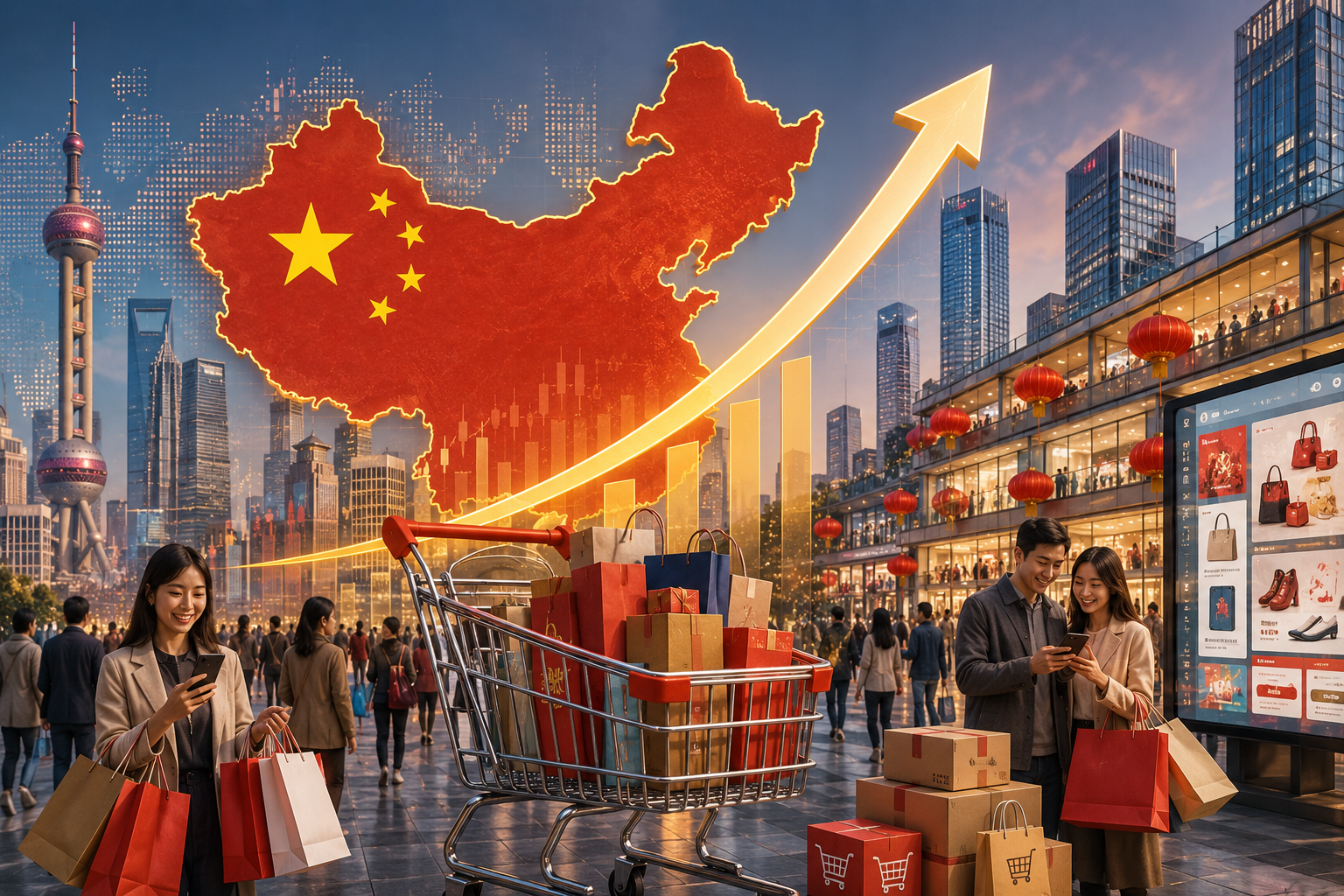
China has introduced its first five-year plan dedicated specifically to expanding consumer spending, setting a target of around 60 trillion yuan, or US$9 trillion, in annual retail sales by 2030.
The target implies average annual retail-sales growth of about 3.7 per cent over the next five years. That would represent a slowdown from the roughly 5 per cent yearly growth recorded between 2021 and 2025, reflecting weaker momentum in the country’s goods-consumption market.
Under the plan, Beijing aims to increase household incomes and substantially raise the share of household consumption in the overall economy. Consumer spending currently accounts for about 40 per cent of China’s economic output, a relatively low level compared with many developed countries.
The programme was approved by China’s State Council and released on Monday, July 13. It seeks to make domestic consumption a stronger and more reliable source of economic growth at a time when the country continues to depend heavily on manufacturing, investment and exports.
A major part of the strategy focuses on expanding spending on services rather than relying mainly on purchases of physical goods. Priority sectors include elderly care, childcare, healthcare, education, culture, tourism and sport.
Chinese authorities said the overall size of the consumer market should continue expanding through 2030, while household consumption’s contribution to economic growth is expected to increase significantly. The government also wants services to represent a larger share of average household expenditure.
Services accounted for 46.1 per cent of per-capita consumer spending in China during 2025. Although that proportion has been rising and services spending has grown faster than goods consumption in recent years, it remains well below the approximately 70 per cent recorded in the United States.
Tourism is another important element of the plan. Beijing intends to encourage greater tourism-related spending by expanding visa-free entry arrangements, increasing the number of countries covered by those policies and adding more direct international flights.
The government plans to improve flight connections with Europe, the United States and nations involved in the Belt and Road Initiative. These measures are expected to attract more foreign visitors while also supporting airlines, hotels, restaurants, retailers and entertainment businesses.
China will also promote newer forms of consumer activity, including digital services, artificial intelligence-powered products, environmentally friendly consumption, experience-based spending and purchases made by international visitors.
The plan acknowledges that weak household demand remains one of the most significant challenges facing the Chinese economy. Industrial output and exports have remained comparatively strong, but domestic spending has been constrained by the prolonged property downturn, uncertain employment prospects and concerns about household financial security.
Economists have repeatedly argued that stronger income growth and improvements to China’s welfare system are necessary to persuade families to spend more and save less. Many households maintain high savings because they remain concerned about healthcare, education, retirement and possible job losses.
In response, the government has pledged to make the social-security system more efficient, sustainable and dependable. Policymakers hope stronger public support will improve household confidence and create more stable expectations about future living costs.
Authorities also plan to strengthen consumers’ purchasing power by encouraging higher wages, helping households earn more income from property and investments, expanding public services and directing more government resources towards programmes that benefit consumers.
The plan calls for the removal of what Beijing described as unreasonable restrictions affecting consumption. These could include limits or administrative barriers involving vehicle purchases, housing transactions and approvals for concerts, festivals and other entertainment events.
Fiscal and financial policies will also be adjusted to provide more direct support to households. The government said greater attention should be given to livelihood-related expenditure, consumer benefits and infrastructure that supports commercial and service activity.
By placing household spending at the centre of its economic programme through 2030, Beijing is seeking to reduce China’s reliance on exports and industrial investment. However, the relatively modest retail-sales growth target suggests officials recognise that transforming the country into a consumption-led economy will be a gradual process rather than an immediate shift.
