


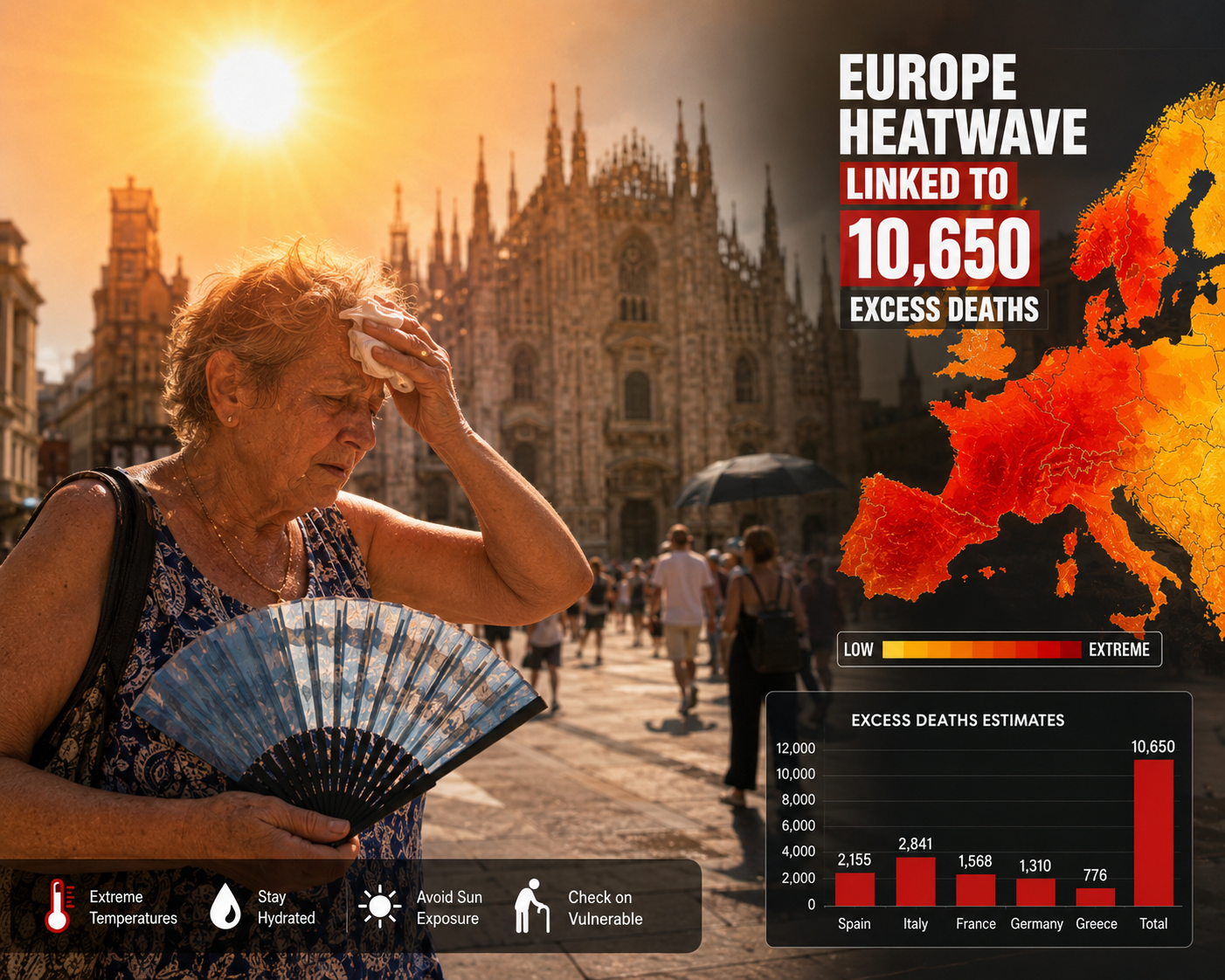
European countries recorded approximately 10,650 more deaths than normally expected during a record-breaking heatwave in late June, with older people accounting for the overwhelming majority of the increase.
The figures were compiled by EuroMOMO, a mortality-monitoring network supported by the European Centre for Disease Prevention and Control and the World Health Organization. Its data showed that more than 9,000 of the excess deaths involved people aged 65 or older.
The sharp rise occurred during the week of June 22–28, when extreme temperatures affected France, Spain, Britain, Belgium and several other western European countries.
Excess mortality refers to the number of deaths recorded above the level normally expected for a particular place and period. The figure therefore includes deaths from all causes and does not mean that every additional death was officially classified as heat-related.
However, experts said the scale and timing of the increase strongly suggested that extreme temperatures were the leading factor. Lasse Vestergaard, a chief physician at Denmark’s Statens Serum Institut, which hosts EuroMOMO, described such a large mortality increase at that time of year as highly unusual.
Scientists said there were no known major events, including a significant COVID-19 outbreak, that could otherwise explain the sudden rise in deaths.
The contrast with the weeks before the heatwave was particularly striking. Across the same 27 countries, combined mortality during the previous eight weeks had averaged about 500 deaths per week below normal levels.
Researchers cautioned that EuroMOMO’s estimates remain provisional and could be revised as national authorities provide more complete mortality information.
Extreme heat can cause fatal heatstroke and dehydration, while also worsening existing heart, lung and other chronic medical conditions. Older adults are especially vulnerable because they may have underlying health problems, reduced ability to regulate body temperature or limited access to cooling.
The late-June heatwave placed substantial pressure on communities and public services. Schools were closed in some areas, electricity supplies were disrupted and temperature records were broken in France, Spain and the United Kingdom.
EuroMOMO does not publish a country-by-country breakdown of its weekly excess-death total. However, it identified France and Belgium as the only European countries to record “very high” excess mortality during the final week of June.
Belgium’s public health institute, Sciensano, said the country experienced its highest level of excess mortality during any heatwave since comparable records began in 2000.
Researchers have increasingly linked Europe’s intensifying heatwaves to human-driven climate change. Scientists said the extreme temperatures experienced in late June would have been virtually impossible without global warming, which is increasing both the frequency and severity of heat events.
A separate study estimated that about 2,700 people died from heat-related causes in England and Wales during heatwaves in May and June.
Researchers from Imperial College London, the UK Met Office and the London School of Hygiene & Tropical Medicine estimated that approximately 42 per cent of those deaths were associated with the additional heat produced by human-caused climate change.
The findings highlight the growing public-health consequences of extreme temperatures across Europe, where many homes, hospitals and public buildings were not designed for prolonged periods of intense heat.
Health authorities have repeatedly advised people to remain hydrated, avoid strenuous activity during the hottest parts of the day and regularly check on older relatives, neighbours and medically vulnerable people during heatwaves.
The late-June mortality figures are expected to intensify calls for stronger heat-response plans, improved early-warning systems, cooler urban spaces and better protection for elderly and high-risk residents.
Although researchers cannot yet attribute every excess death directly to the heatwave, the unusual scale of the increase and the absence of another major health emergency indicate that extreme heat was likely the principal cause.
