


After Losing $109K to a Scam, Louis May Welcomes Long-Overdue Bank Reform
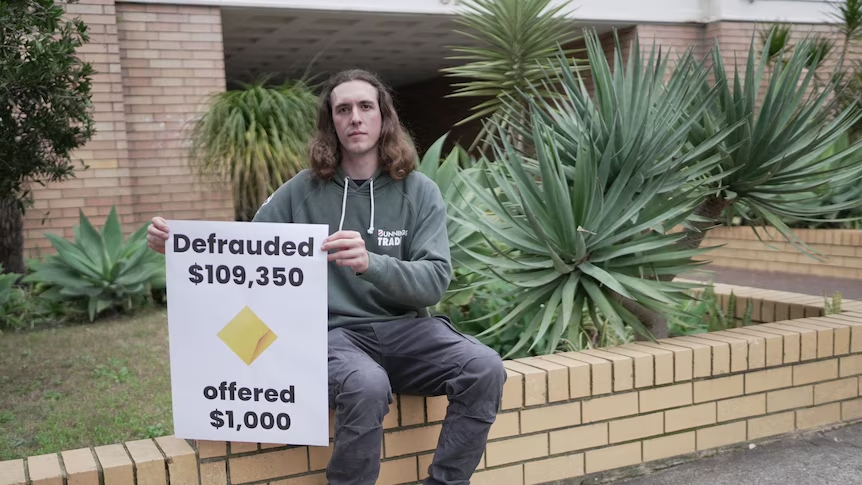
In July last year, 24-year-old Sydney tradesman Louis May lost his $109,000 first home deposit to scammers posing as his conveyancer.
The scam began with a convincing email requesting property settlement, complete with bank account details and a fake PEXA (Property Exchange Australia) form. Trusting the message, Mr. May transferred two payments. Just two days later—on what was supposed to be the day he received his apartment keys—his bank contacted him, asking for the settlement funds.
“It was the most horrible feeling I’ve ever had,” he recalled.
“I was on two phones at once, trying to sort it all out. I couldn’t figure out what had gone wrong—I was calling the police, the bank, the lawyers—anyone who could help.”
Once he spoke to his conveyancer and realised what had happened, he immediately alerted the bank. But the money was already gone.
Now, the banking industry is introducing new technology designed to fix the vulnerability scammers exploited.
The system, known as Confirmation of Payee, is intended to help reduce scam-related losses by alerting customers when the name on a payment doesn’t match the account details provided.
The tool specifically targets payment redirection and invoice scams—like the one that tricked Mr. May—that cost Australians over $152.6 million in the past year.
According to the Australian Banking Association (ABA), major and mid-sized banks will implement the system throughout July, while all remaining deposit-taking institutions—including credit unions—are expected to follow by year’s end.
Technology Comes Too Late for Louis
While it’s a step forward, consumer advocates and scam victims argue Australia has been too slow compared to other countries. They also criticise that the system still places the responsibility for verifying payments on the customer.
For Louis May, Confirmation of Payee was introduced too late—and he’s unsure if it would have even prevented his scam.
He took his case to the Australian Financial Complaints Authority (AFCA), which reviewed how the bank handled his transactions. AFCA noted that the bank processed his payment using only BSB and account numbers, and warned him to double-check the information.
Before sending a $100,000 transfer, Mr. May even received a warning from the bank:
“Scammers sometimes use new accounts to avoid detection — speak to the payee to check it’s really them requesting the payment and confirm the BSB and account number.”
A Commonwealth Bank spokesperson added that before transferring the funds, Mr. May contacted the bank to increase his transfer limit. At that time, the bank discussed potential scam risks and displayed a NameCheck alert warning of possible fraud.
Mr. May acknowledged he saw and accepted the warning but said he still trusted the email, believing it came from his conveyancer.
“I didn’t want to risk losing the apartment or messing up the settlement,” he said.
“I’d never done such a large transfer before. I honestly thought the bank would protect me.”
AFCA ultimately ruled the bank’s actions and warnings were sufficient and declined to require compensation. Although the bank attempted to recall the funds on the day the scam was reported, the money could not be recovered.
Industry Responds to Surging Scam Losses
According to the ABA, Australian banks have invested over $100 million in Confirmation of Payee technology.
Adrian Lovney, from Australian Payments Plus—the group that developed the system—described it as a “simple but powerful” tool that adds a crucial layer of protection for everyday banking.
An advertising campaign under the slogan “Check the name. Spot the scam.” is being launched to educate customers on how the tool works.
ABA CEO Anna Bligh noted that scam losses in Australia have dropped 33% between 2023 and 2024, from $476.8 million to $318.8 million, but warned that losses spiked in the first five months of 2025, rising from $114.8 million to $147.1 million year-over-year.
How the System Works
When customers make a payment to a new BSB and account number, the system checks if the entered name matches the bank’s data.
- If it’s a full match, the correct name is shown for confirmation.
- If it’s a close match (e.g., “John Smyth” instead of “John Smith”), the system displays the similar name for verification.
- If it doesn’t match at all, a warning is displayed.
For privacy reasons, the actual account name isn’t shown unless it’s a business or government account.
Customers then decide whether to proceed with the payment.
Scam Victim Advocacy Calls for More Change
Louis May’s mother, Alex Brooks, has since become a vocal advocate for scam victims, launching a podcast and taking on a leadership role with Scam Victim Alliance.
While she welcomed Confirmation of Payee, she criticised banks for continuing to push liability onto customers.
“It’s still the customer who has to decide whether to go ahead with a flagged payment,” she said.
“Banks are using these systems to shift all the responsibility onto consumers.”
How Australia Stacks Up Globally
The Confirmation of Payee rollout was discussed at a global anti-scam roundtable in June, where Australia’s progress was compared to other nations.
Although Australia fares better than the U.S., it still lags behind the U.K., where Confirmation of Payee has been in place since 2020. Since October, U.K. banks have also been required to reimburse scam victims up to £85,000 (A$177,530), with the cost split between sending and receiving banks—unless a customer was found grossly negligent.
Robert Harris from fraud detection firm Feedzai noted that 86% of fraud victims in the U.K. have been reimbursed, and contrary to expectations, the number of claims has actually dropped since the rule change.
Meanwhile, Australian banks currently reimburse only 2–7% of scam losses, according to ASIC data.
Consumer Action Law Centre CEO Stephanie Tonkin called on regulators to adopt a U.K.-style model in Australia.
“Right now, victims are absorbing billion-dollar losses. It’s unacceptable,” she said.
Victims can still pursue compensation if a bank failed in its responsibilities—but proving that can be difficult.
The ABA defends the current system, saying a U.K.-style model could weaken Australia’s broader “whole-of-scam-chain” approach.
“This model doesn’t motivate other industries like telcos or social media platforms to step up their scam protections,” an ABA spokesperson argued.
A Systemic Flaw Behind a Multi-Billion-Dollar Industry
Ken Gamble, chairman of cybercrime investigation firm IFW Global, called the lack of payee verification a “fundamental flaw” that helped scams evolve into a billion-dollar industry.
“I can’t believe it took this long for banks to fix this,” he said.
He explained that many scams—such as fake term deposit schemes—rely on victims thinking they’re sending money to their own accounts when they’re not. Without name verification, victims are kept in the dark.
Mr. Gamble welcomed biometric identity checks for new bank accounts but warned this wouldn’t stop the use of “money mules”—people who unknowingly allow scammers to use their bank accounts.
Banks say they’ve boosted intelligence-sharing efforts to detect mule activity more effectively.
The Scam-Safe Accord: A Broader Response
Confirmation of Payee is part of the banking sector’s broader Scam-Safe Accord, launched in 2023 following a surge in scam activity.
Other completed initiatives under the accord include:
- Sharing intelligence between banks
- Delaying payments to unfamiliar recipients
- Blocking payments to high-risk destinations such as crypto exchanges
According to the ABA, 90% of retail customers are now protected by enhanced warnings and transaction delays.
The Personal Cost
For Louis May, the financial and emotional toll has been immense.
He began saving for his home deposit at age 19, while working as an apprentice electrician.
Though his family helped him settle on the apartment, the financial setback left him unable to renovate or move in.
“I was working almost every day, just trying to afford the strata fees,” he said.
“It’s something that stays with you—you have to learn to put it out of your mind just to keep going.”
