


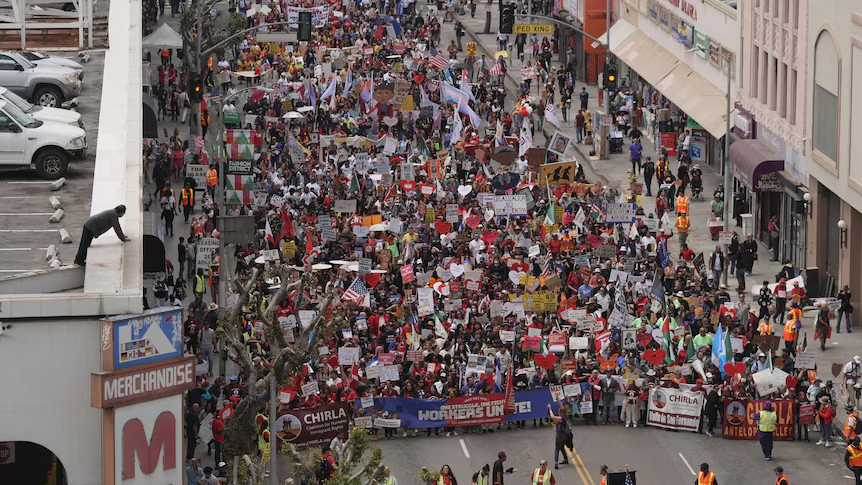
Hundreds of thousands of people around the world participated in May Day demonstrations to voice opposition to U.S. President Donald Trump’s policies, particularly his aggressive trade tariffs and immigration enforcement.
In the United States, organizers framed International Workers’ Day as a broad protest against what they view as the Trump administration’s attack on labor rights, federal workers, and diversity efforts. Rallies took place in numerous cities, including a major gathering outside the White House in Washington, D.C.
In Philadelphia, Senator Bernie Sanders addressed demonstrators outside City Hall before the crowd took to the streets. Some protesters staged a sit-in with signs reading “Workers over billionaires,” leading to arrests and detainment by police.
Thousands marched in downtown Los Angeles, displaying signs like “Immigrants make America great” and “Migration is beautiful.” Service Employees International Union President April Verrett condemned efforts to divide people using fear and misinformation, and speakers called on lawmakers to protect both labor and immigrant communities.
In Atlanta, several hundred gathered in a park near the state Capitol, including retired employees of the Centers for Disease Control and Prevention (CDC), which is facing significant staffing cuts under Trump’s budget plans.
“We’re here for our colleagues who were laid off without cause,” said retiree Deblina Datta. “Without the CDC, public health will suffer.”
New York City saw two major events: a rally of lawyers observing “National Rule of Law Day” criticizing the Trump administration’s treatment of the legal system, followed later by a May Day march featuring union members and LGBTQIA+ activists protesting Trump’s immigration policies. The recent arrest of Palestinian activist and Columbia graduate student Mahmoud Khalil was cited as evidence of growing repression.
“This is about all of us,” said Veronica Salama from the New York Civil Liberties Union. “Our struggles are connected.”
European Protests Condemn U.S. Influence
In Europe, May Day protests took aim at what French union leaders called the “Trumpisation” of global politics, including U.S. military and trade pressures. French political figure Jean-Luc Mélenchon accused the U.S. of dragging Europe into conflict and economic dependence.
German union leaders warned that extended working hours and rising nationalism were threatening hard-won labor protections. In Switzerland, demonstrators marched against fascism and war, amid growing concerns about the global right-wing resurgence.
Spain also saw mass protests across major cities, with calls for a shorter workweek and criticism of far-right influence. “Trump’s rise marked a global turning point,” said Madrid worker Ángel López.
Asian Workers Rally Against Economic Impact
In Asia, concerns focused on the economic effects of Trump’s policies. Taiwan’s President Lai Ching-te highlighted U.S. tariffs while promoting domestic job initiatives.
In the Philippines, activist Mong Palatino said Trump’s tariff policies were harming local industries. Roughly 2,500 Taiwanese workers marched in Taipei, calling for government action to protect jobs.
“We need real plans to defend labor rights,” said union leader Carlos Wang.
May Day protests also took place in Manila, Jakarta, and Türkiye, where demonstrators additionally protested the jailing of Istanbul’s opposition mayor, Ekrem Imamoglu.
