


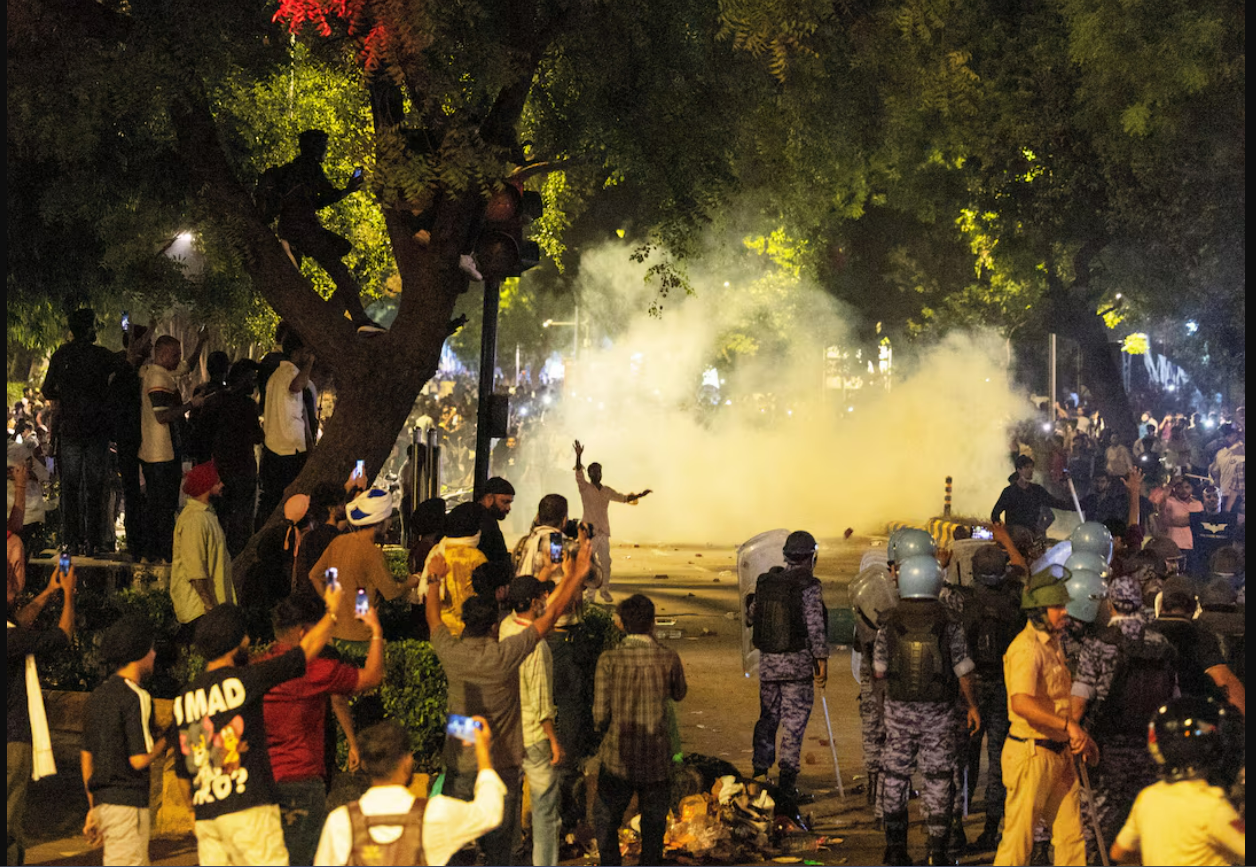
Fresh clashes broke out between youth demonstrators and police in central New Delhi on Wednesday night as protesters intensified their demand for the resignation of Education Minister Dharmendra Pradhan over alleged examination paper leaks affecting millions of students.
More than 10,000 people reportedly gathered at Jantar Mantar, where members and supporters of the self-styled Cockroach Janta Party, or CJP, have been holding demonstrations for nearly a month.
The protest remained largely peaceful during the day, with participants waving Indian flags, chanting slogans and demanding accountability for repeated failures in the country’s examination system. Tensions escalated later in the evening when the growing crowd spilled onto nearby roads and came into confrontation with security personnel.
Police used tear gas and batons to disperse sections of the gathering after some demonstrators allegedly threw stones and plastic bottles at officers. Several police personnel were injured and taken to hospital, according to reports citing Delhi Police.
Videos circulated on social media appeared to show small groups of protesters confronting officers as tear gas was fired and police attempted to clear the area. The authenticity and full context of all the footage could not be independently confirmed.
The latest unrest came two days after tens of thousands of young protesters marched towards Parliament despite restrictions on public gatherings. Police and paramilitary forces blocked the procession, using tear gas and baton charges as demonstrators attempted to advance through central Delhi.
The movement began as an online satirical campaign involving only a few hundred young people but has since developed into one of the most significant youth-led challenges faced by Prime Minister Narendra Modi’s government since it took office in 2014.
At the centre of the protests are allegations that examination paper leaks in May affected around two million students. Demonstrators accuse the government of failing to protect the integrity of major public examinations and demand that the education minister accept responsibility.
CJP founder Abhijeet Dipke told supporters that the demonstrations would continue until Dharmendra Pradhan stepped down.
Dipke said the protesters were prepared to remain on the streets for as long as necessary, arguing that government assurances and proposed reforms were not enough without political accountability.
The prolonged demonstrations have also disrupted the monsoon session of Parliament, with opposition parties supporting many of the protesters’ demands and repeatedly challenging the government over examination irregularities, unemployment and the future of young Indians.
The Congress-led opposition has made the resignation of the education minister a central demand. Congress leader Rahul Gandhi has participated in demonstrations near Parliament and outside the prime minister’s residence.
Gandhi said opposition leaders would meet on Thursday to determine their next strategy inside Parliament, insisting that the demand for Pradhan’s resignation could not be withdrawn or compromised.
In response to growing pressure, the government has already held an initial round of discussions with CJP representatives. Officials have assured protest leaders that their concerns will be examined and have proposed parliamentary debate and reforms aimed at strengthening the examination process.
However, protest organisers say the government’s response has failed to address responsibility for the leaks or provide sufficient guarantees that similar incidents will not occur again.
Security measures were tightened across central New Delhi following Wednesday’s clashes. The Delhi Metro Rail Corporation announced the temporary closure of 16 stations in and around the central district on Thursday because of security concerns.
It was the second major shutdown of metro stations during the week, highlighting the disruption caused by the expanding protest movement.
The rapid rise of the CJP reflects broader dissatisfaction among young Indians over limited employment opportunities, intense competition for government positions and repeated allegations of corruption or malpractice in recruitment and entrance examinations.
For the opposition, the protests have created a major opportunity to pressure Modi’s Bharatiya Janata Party, which has traditionally relied heavily on support from younger voters.
Although the BJP has continued to perform strongly in several state elections, Modi’s party failed to secure an outright parliamentary majority in the 2024 national election and has since depended on coalition partners to govern.
With protesters refusing to leave the streets and opposition parties preparing further action in Parliament, the controversy surrounding examination leaks is developing into a wider political confrontation over accountability, employment and the government’s relationship with India’s younger generation.
