


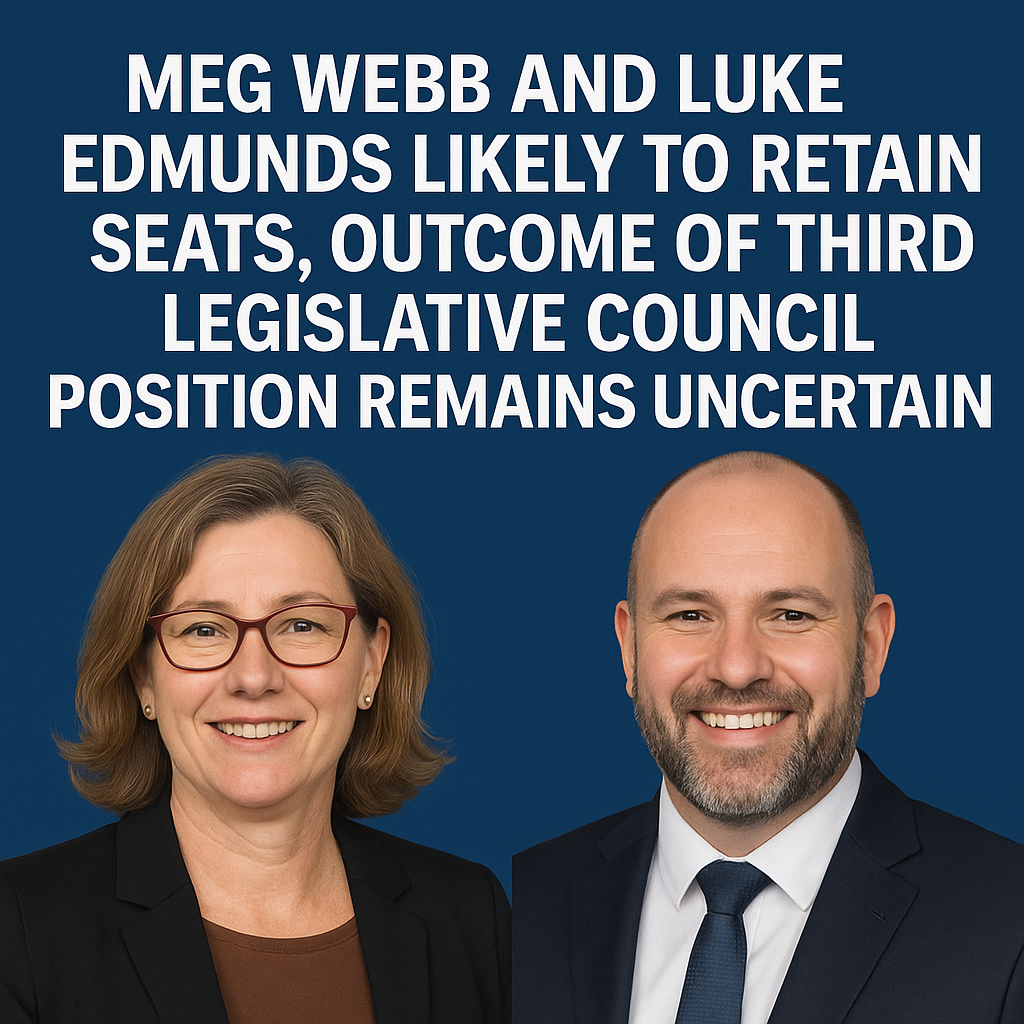
Two sitting members of Tasmania’s Legislative Council are likely to retain their seats, while the outcome of a third seat remains uncertain.
Elections took place on Saturday in three of the Council’s 15 divisions.
Political analyst Kevin Bonham indicated that the southern electorates of Nelson and Pembroke would stay with their current representatives: independent Meg Webb and Labor’s Luke Edmunds.
Dr Bonham said Ms Webb secured a commanding lead and may win outright on primary votes alone. Mr Edmunds also held a strong lead, with a substantial primary vote margin that no other candidate is expected to overcome.
“It’s not a great result for the Liberal Party,” Bonham added, suggesting that the party’s challenges extend beyond the federal level.
According to the Tasmanian Electoral Commission (TEC), Ms Webb had secured 51 per cent of first-preference votes in Nelson. She called the result a strong endorsement for an independent Upper House and a demand for greater political transparency and integrity.
“There’s clear support for independent representation and a different approach to politics in Tasmania,” Webb said.
Roughly 1,800 early votes in Nelson remain uncounted. Meanwhile, Mr Edmunds led Pembroke with nearly 44 per cent of first preferences. He said he was thrilled with the result and proud of the support Labor received.
In Montgomery, located in the northwest, the contest remains open following the retirement of Liberal MLC Leonie Hiscutt. Her son, Casey Hiscutt, running as an independent, leads with about 32 per cent of first-preference votes. He is followed closely by Liberal candidate Stephen Parry at 29 per cent and the Greens’ Darren Briggs at 21 per cent.
Electoral Commissioner Andrew Hawkey said preferences would be crucial in deciding Montgomery, with Hiscutt and Parry nearly tied.
Casey Hiscutt expressed cautious optimism, noting that he spent election night with his mother and reflected on his family’s long-standing involvement in the Legislative Council. His great uncles also previously served as independents for the region.
He said he chose to run independently to uphold the Legislative Council’s role as a house of review, free from party influence.
Dr Bonham predicted Hiscutt would likely win unless Parry performs unusually well with preferences. If elected, Hiscutt would join nine other independents in the Upper House, posing potential challenges for the government when independents diverge from party lines.
Bonham also noted the influence of the Hiscutt name in the region, though said Casey Hiscutt’s support for the proposed stadium project might have shifted some votes to the Greens and Shooters, Fishers and Farmers party.
Vote counting will resume Monday, with pre-poll, provisional, and out-of-division votes added. Postal votes are scheduled to be counted on Thursday.
Despite wet weather, Hawkey said Saturday’s voting went smoothly and turnout appeared strong across all divisions. He also noted that 66 voters with print disabilities used the newly expanded telephone voting service.
Legislative Council members serve six-year terms, with elections held for two or three divisions each year in a staggered cycle.
