


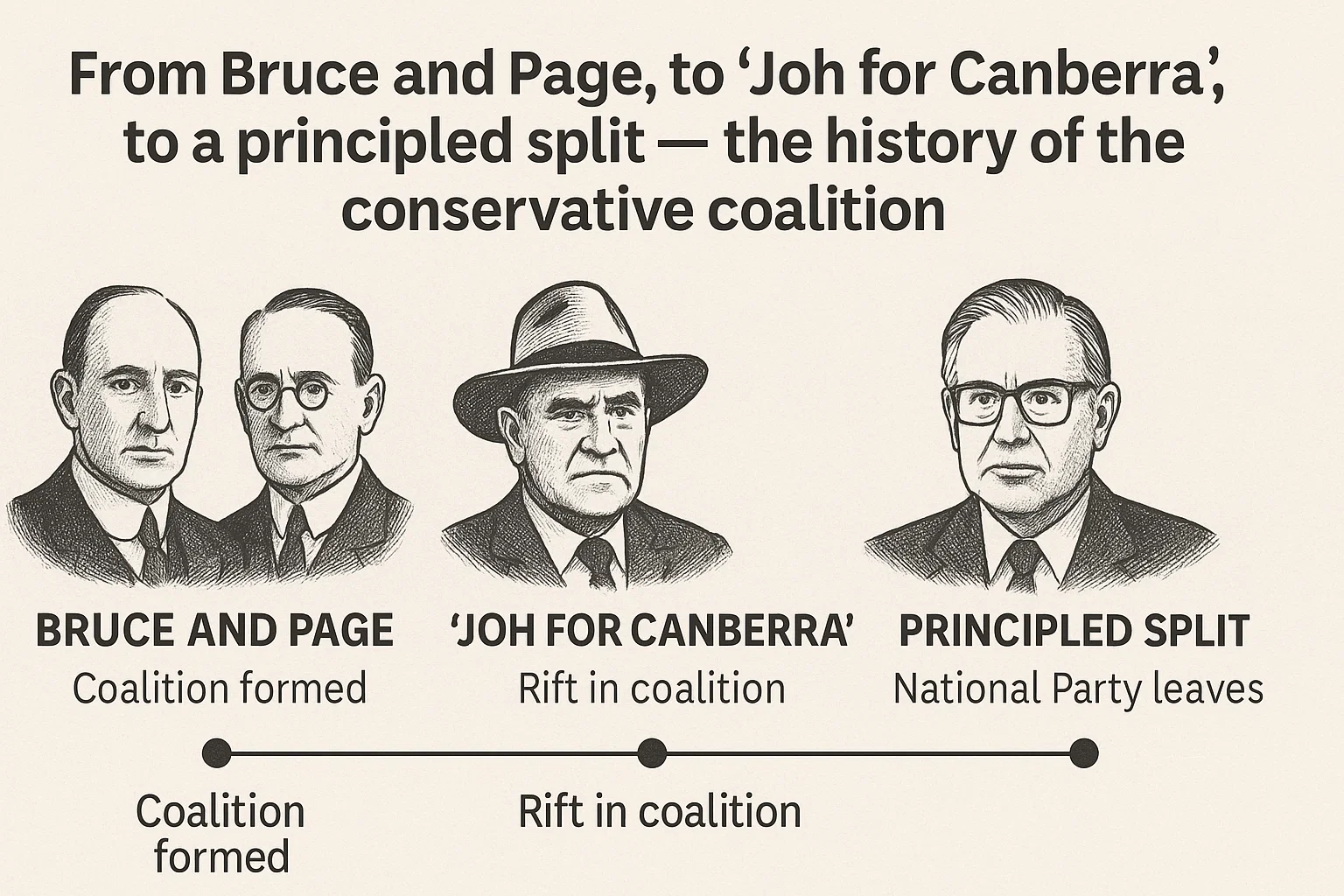
The long-standing partnership between the Liberal and National parties has reached its end, with Nationals leader David Littleproud announcing that his party will no longer remain in coalition with the Liberals. This marks a significant break in a political alliance that has largely shaped Australian federal politics for over 100 years.
While this isn’t the first time tensions have caused a split, the separation brings renewed focus to the evolving relationship between the city-based Liberals and the regionally focused Nationals.
The origins of this partnership date back to 1922, when the then Country Party, representing rural voters, gained influence after a tightly contested election. Party leader Earle Page struck a deal with the Nationalists, later the Liberal Party, becoming deputy prime minister under Stanley Bruce in 1923. This agreement established the first formal coalition, where the two parties retained their individual identities but governed together.
According to ANU historian Stephen Wilks, this arrangement gave the Country Party ongoing relevance by preserving its autonomy while ensuring a voice in government—a rare feat among early 20th-century agrarian protest movements.
A History of Breakups and Reunions
The coalition faced its first major breakdown in 1929 when former prime minister Billy Hughes led several Nationalist MPs to vote against their own party. This led to an election loss and temporarily ended the alliance. However, by 1949, the parties reunited under Liberal leader Robert Menzies, launching a period of political dominance that has lasted for much of the past century.
Over the decades, regional demographics changed significantly. In 1911, around 60% of Australians lived outside cities; by 2006, that figure had dropped to about 40%. Mechanisation in agriculture and the decline of traditional rural industries also shifted the Nationals’ voter base.
In response, the Country Party rebranded several times—becoming the National Country Party in the 1970s, and eventually The Nationals—to appeal to a broader audience. But tensions with the Liberals remained, particularly over economic and infrastructure policies.
The most dramatic rupture came in the 1980s during the “Joh for Canberra” campaign, when Queensland Premier Joh Bjelke-Petersen attempted a tilt at federal politics. Though the effort failed, it split the Coalition and helped Labor’s Bob Hawke secure another term.
From Unity to Fracture Again
The Coalition rebounded in 1996 under John Howard, with Nationals leader Tim Fischer as his deputy. The alliance weathered controversial reforms, including gun control and the introduction of the GST, partly due to a shared threat from rising populist forces like Pauline Hanson’s One Nation.
However, internal strains re-emerged. The rise of Barnaby Joyce in 2016 intensified the divide, particularly over climate policy. Joyce’s support for fossil fuels and opposition to renewables contributed to leadership instability and failed climate initiatives, such as Malcolm Turnbull’s national energy guarantee.
By 2022, although the Nationals had aligned with the Liberals on a net-zero target for emissions, the Coalition lost power in a decisive election. The Liberals suffered major losses in urban electorates to independents, while the Nationals mostly held their ground.
Nuclear Energy and the Final Straw
After the 2022 defeat, David Littleproud became Nationals leader and championed nuclear power as an alternative to widespread renewable energy projects in regional areas. Liberal leader Peter Dutton backed this plan in 2024, proposing seven nuclear plants, but the policy struggled to gain public support and was a key issue in the Coalition’s crushing 2025 loss.
While the Liberals lost 14 seats, including that of their leader, the Nationals retained almost all their electorates. Littleproud himself won by one of the largest margins in the country.
The fallout led to growing tensions between the parties, particularly over issues like nuclear power, supermarket regulation, regional infrastructure, and mobile services. With negotiations to renew the Coalition agreement stalling, Littleproud, alongside Kevin Hogan and Bridget McKenzie, publicly announced the Nationals’ decision to break away.
“We Will Sit Alone on Principle”
Littleproud stated, “The National Party will sit alone on a principle basis.” McKenzie added that policies they fought for, and campaigned on just weeks earlier, were being disregarded by the Liberals.
The decision surprised political observers. ANU expert Linda Botterill noted that while splits have happened before, it was unusual for the Nationals to initiate one. She pointed out that although the party only received 3.6% of the national vote, the Coalition had allowed it an outsized voice in federal politics.
Now outside of the Coalition, the Nationals could potentially face competition from Liberal candidates in their seats—a possibility that was historically avoided under coalition agreements.
A Return to Their Roots?
Littleproud insists the move is about amplifying the Nationals’ voice, but it’s unclear how effective the party will be on its own.
In many ways, the break recalls the founding principles of the Country Party in 1920. Its first leader, William McWilliams, said the party would support measures it agreed with and oppose those it didn’t—always with the aim of securing a better deal for people living on the land.
It seems that, over a century later, that mission still drives the Nationals, even if it means going it alone.
