


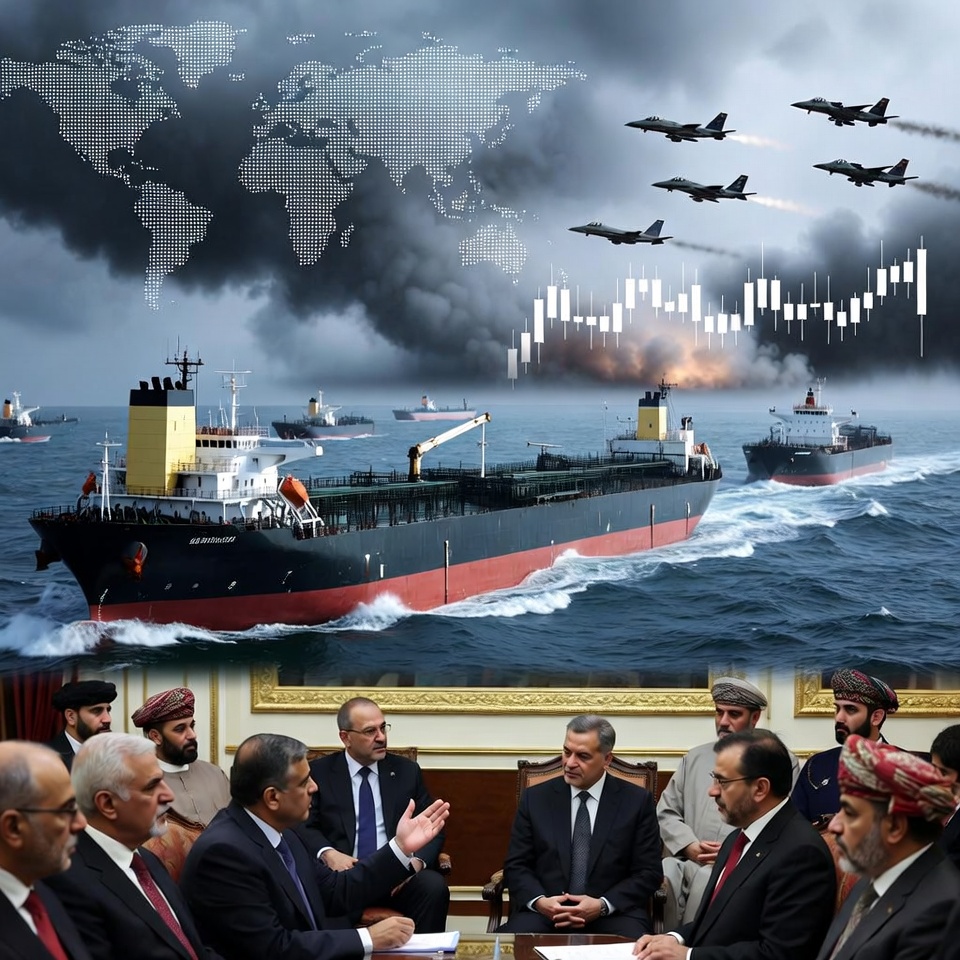
Oman has launched a new diplomatic effort to ease tensions surrounding the Strait of Hormuz by sending a high-level delegation to Tehran for talks with Iranian officials, as military exchanges between the United States and Iran continue to escalate. The discussions are focused on maintaining safe navigation through one of the world’s most strategically important maritime routes, where the ongoing conflict has disrupted global energy markets and heightened concerns over international trade.
According to Iran’s state-run IRNA news agency, the Omani delegation arrived in Tehran on Friday evening to explore practical mechanisms for managing shipping traffic through the Strait of Hormuz. The visit forms part of continuing consultations between the two neighboring countries, with both sides seeking ways to prevent further disruption in the critical waterway.
Iranian Foreign Minister Abbas Araghchi also held a telephone conversation with his Omani counterpart, Badr Albusaidi, to discuss the latest developments. While officials have not disclosed specific proposals under consideration, Tehran has consistently stated that it is willing to cooperate with Oman in overseeing navigation through the strait during the ongoing crisis.
The Strait of Hormuz has become the central flashpoint in the confrontation between Washington and Tehran. Before the conflict erupted, roughly one-fifth of the world’s oil and liquefied natural gas exports passed through the narrow passage. Its closure has sent global energy prices sharply higher, raising fears of prolonged economic disruption and supply shortages across international markets.
Although Iran has promoted joint management of the waterway with Oman, the proposal has not gained support from the United States or Gulf Arab states. Nevertheless, Oman remains a key regional mediator due to its strategic location at the entrance to the strait and its long-standing diplomatic relations with both Iran and its Gulf neighbors.
In a statement shared on social media, Omani Foreign Minister Badr Albusaidi emphasized that vital international waterways, including the Strait of Hormuz, must remain open to commercial shipping. He stressed that freedom of navigation and uninterrupted international trade are essential for regional and global stability.
Meanwhile, the military confrontation between the United States and Iran entered its fourteenth consecutive day, with both sides continuing to exchange air strikes despite renewed diplomatic efforts. Previous negotiations had temporarily reduced hostilities through a memorandum of understanding, but that agreement later collapsed amid disagreements over navigation rights in the Strait of Hormuz.
Regional tensions have further intensified following the Houthi movement’s declaration of a naval blockade against Saudi Arabia earlier this week, opening another front in the wider conflict.
Iranian military officials claimed responsibility for additional attacks targeting US military facilities across the Middle East on Friday. Reports indicated strikes or attempted attacks on bases located in Kuwait, Bahrain, and Jordan. Separately, a drone crash near Iraq’s Erbil International Airport temporarily disrupted flight operations.
Iran’s Islamic Revolutionary Guard Corps (IRGC) also claimed responsibility for targeting an Amazon data center in Bahrain, alleging that the facility was providing intelligence support to US military operations. The claim has not been independently verified.
At sea, reports suggested that Houthi forces continued targeting Saudi oil tankers operating in both the Strait of Hormuz and the Bab al-Mandeb Strait. However, Houthi representatives denied claims that they had completely blocked maritime traffic through either waterway.
The US Central Command announced that its latest round of air operations against Iran had concluded. Iranian media later reported explosions in several locations, including Khorramabad, Jask, Ahvaz, Bandar Abbas, and Qeshm Island, leaving at least four people injured.
According to Iran’s Health Ministry, the recent US strikes have resulted in at least 55 deaths and nearly 650 injuries, underscoring the growing humanitarian impact of the expanding conflict. As diplomatic initiatives continue alongside military operations, international concern remains focused on preventing further escalation and restoring stability to one of the world’s most critical energy corridors.
