

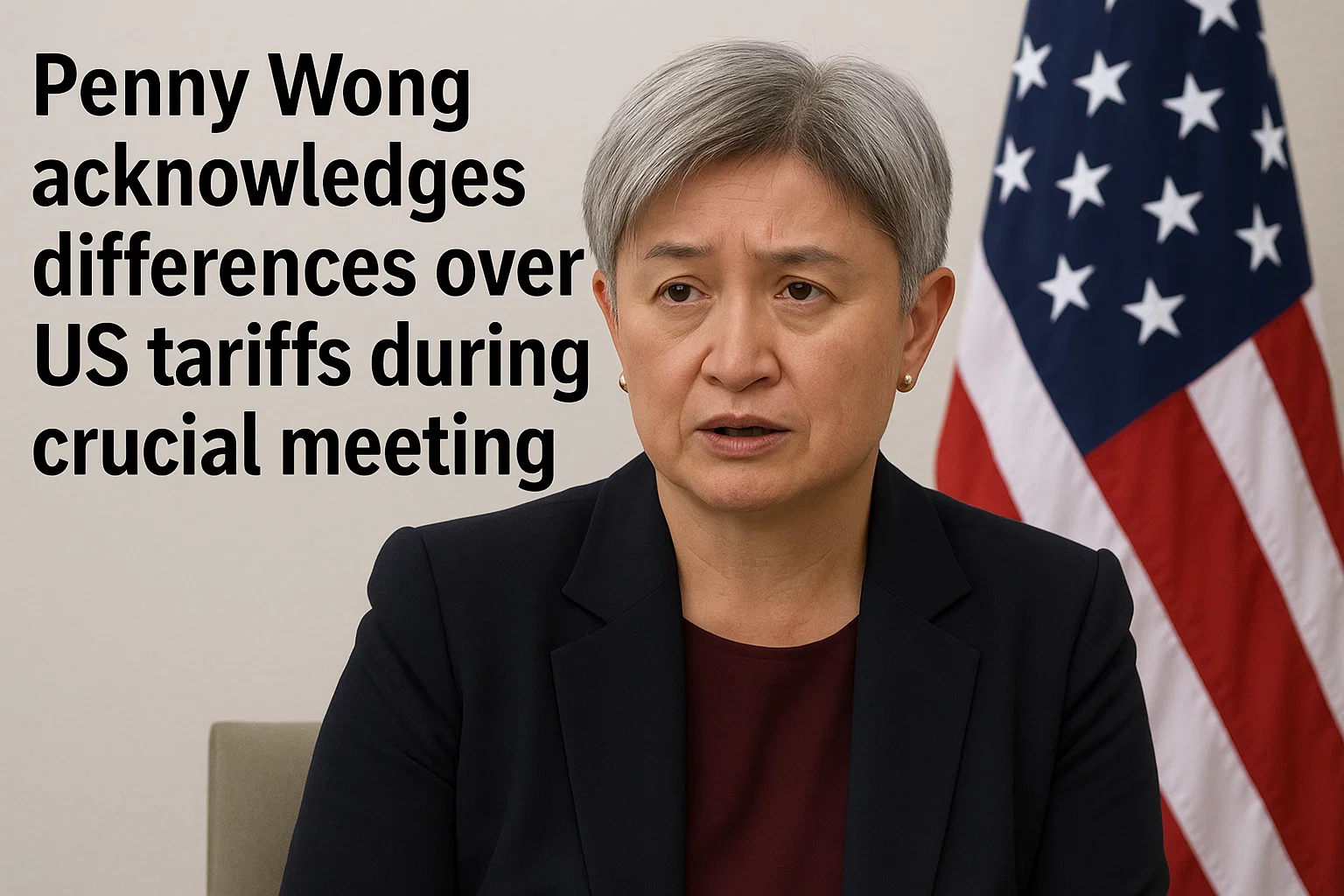
Foreign Minister Penny Wong has acknowledged differing views with her U.S. counterpart over Donald Trump’s tariff policies, while reaffirming Australia’s commitment to the bilateral free trade agreement with the United States.
Wong met with U.S. Secretary of State Marco Rubio on the sidelines of a Quad summit in Washington, where she also held separate discussions with the foreign ministers of India and Japan.
Following the meetings, Wong said that critical minerals—a focal point in Australia’s tariff exemption proposal—were part of the discussion with Rubio. However, when asked if there had been progress on Australia’s proposal, she avoided giving a direct answer.
“Our position on tariffs hasn’t changed,” Wong told reporters.
“We have a free trade agreement that supports free trade. We continue to honour it, and American goods still enter Australia tariff-free under that agreement. We want to see the agreement respected on both sides.”
Wong also sidestepped questions about Prime Minister Anthony Albanese’s inability to secure a meeting with the U.S. President.
Commenting on Trump’s broader foreign policy stance, Wong said:
“We recognise President Trump’s vision of a different role for the United States in the world. We respect that and continue to advocate for Australia’s interests.”
She emphasized the strength of the U.S.–Australia alliance, calling it a trusted and mutually beneficial partnership.
A statement from the U.S. State Department said Wong and Rubio met to strengthen U.S.–Australia cooperation, particularly in enhancing security in the Indo-Pacific and building secure critical mineral supply chains.
“As a committed Indo-Pacific nation, the U.S. will continue to deepen engagement with Quad partners to safeguard shared regional interests,” the statement read.
Concrete Commitments
The foreign ministers of the Quad—Australia, the U.S., India, and Japan—concluded their summit by reaffirming their commitment to promoting peace, stability, and prosperity in the Indo-Pacific, amid rising concerns over China’s military and economic ambitions.
The Quad is widely regarded as a strategic response to China’s growing influence. Trump has signalled that addressing China’s assertiveness will be a core focus of his potential second term.
In his opening remarks, Rubio described the Quad as “a great partnership,” but said it must evolve into a platform for tangible action.
“We have shared priorities, and there are challenges both globally and within our own countries that we can solve together,” Rubio said.
“The next step is transforming our discussions into real-world cooperation—taking concrete, coordinated actions that serve not only our nations but others around the world.”
Wong echoed Rubio’s sentiments, calling the Quad “an important partnership for our region and the world.”
She noted the increasing global instability and competition, highlighting the need for unified action.
“We face significant strategic challenges, and as we meet in a time of global conflict and rising competition, it’s more important than ever that we harness our collective strength to ensure peace, stability, and prosperity in the Indo-Pacific,” she said.
