


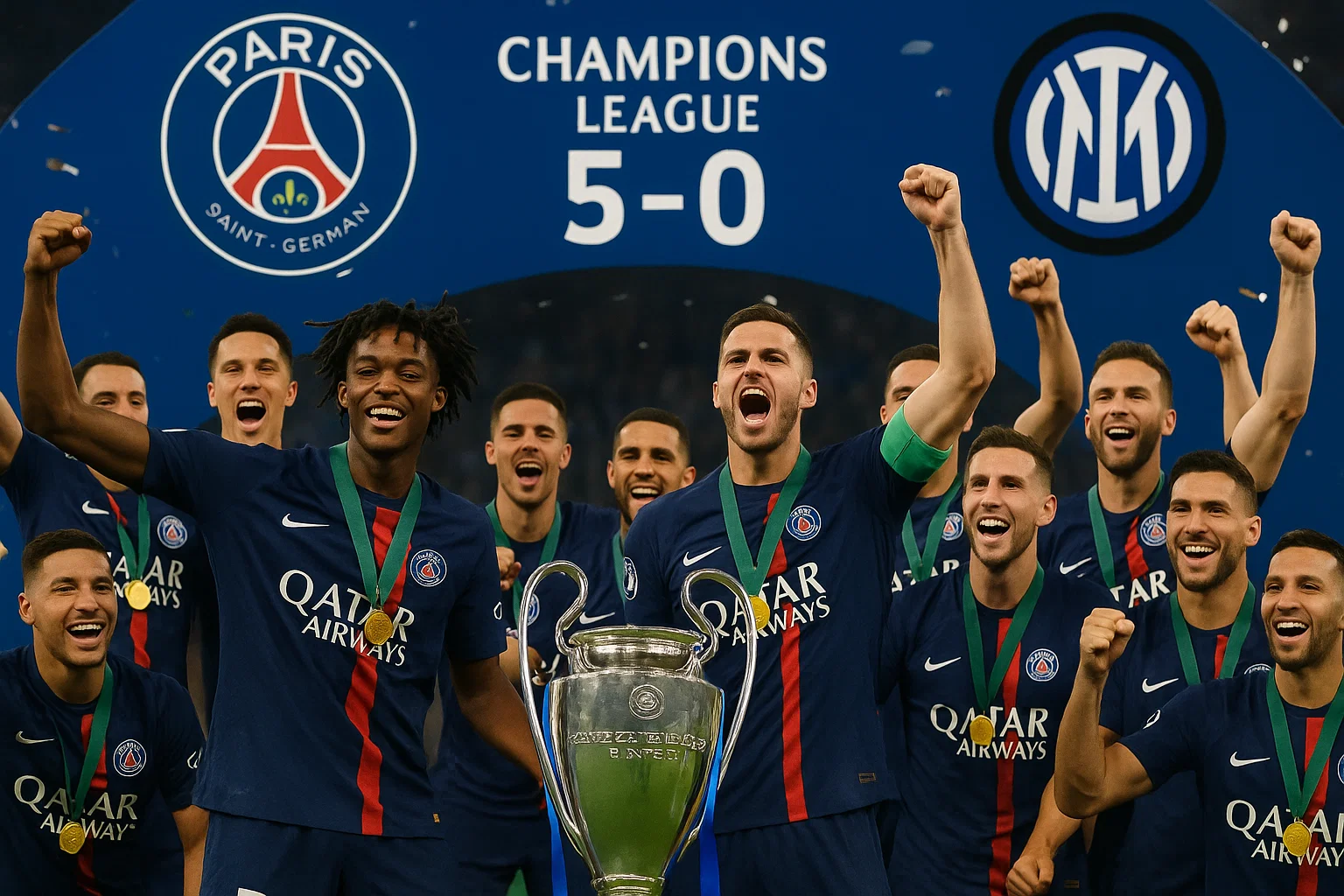
Paris Saint-Germain is finally a Champions League winner.
After years of heavy investment and high-profile signings under Qatari ownership, the French club has claimed European football’s most coveted prize with a commanding 5-0 victory over Inter Milan in Munich.
Despite the presence of global stars like Lionel Messi, Neymar, and Kylian Mbappé in recent years, none could deliver what head coach Luis Enrique achieved — transforming PSG into a unified force rather than a collection of individual talents.
Leading the charge was 19-year-old Désiré Doué, who played a starring role in the final, scoring twice and assisting another. His performance places him alongside greats like Patrick Kluivert and Carlos Alberto as one of the few teenagers to score in a Champions League final.
Doué’s dynamic display was just the beginning. Achraf Hakimi, Khvicha Kvaratskhelia, and teenage substitute Senny Mayulu — only the fourth teenager to score in a final — all found the net in a record-breaking rout. PSG’s 5-0 win now stands as the largest margin of victory in the competition’s 69-year history.
At last, PSG can be counted among the true giants of European football — not just for its financial power, but for what it has now accomplished on the field.
For years, PSG’s Champions League story was one of missed opportunities and heartbreak, including the 2020 final loss to Bayern Munich. But this time, inside Bayern’s Allianz Arena, the French side dominated from start to finish, watched by jubilant fans who had travelled to Munich and lit up the night with flares and celebrations.
As captain Marquinhos lifted the trophy amid golden confetti and fireworks, fans surged toward the pitch, prompting police to intervene and maintain order.
A Dominant Performance from Start to Finish
The tone was set early. Just 12 minutes in, Vitinha sliced through Inter’s defence to find Doué in the box, who unselfishly squared the ball for Hakimi to finish into an open goal — a goal the former Inter defender celebrated with restraint.
Soon after, PSG doubled their lead when Doué’s shot deflected off Federico Dimarco and beat Inter keeper Yann Sommer.
Doué bagged his second just after the hour mark, slotting home with precision, before Kvaratskhelia and Mayulu completed the rout.
For manager Luis Enrique, it was another milestone in a storied coaching career. He became just the seventh manager to win the Champions League with two different clubs, following legends like Pep Guardiola, Jose Mourinho, and Carlo Ancelotti. His treble-winning season with PSG — Ligue 1, French Cup, and now the Champions League — mirrors the feat he achieved with Barcelona a decade earlier.
A Long Road to Glory
This triumph marks the culmination of a 14-year journey that began when Qatar Sports Investments acquired PSG in 2011. That purchase ushered in a new era, with headline-making signings like Zlatan Ibrahimović, David Beckham, Edinson Cavani, Neymar (for a world-record $262 million), Mbappé, and Messi.
But despite this star power, the ultimate prize remained elusive — until now.
Ironically, it was the departure of that famed trio over the past two years that seemed to refocus PSG’s efforts on building a cohesive team rather than relying on individual brilliance.
Still, PSG’s transformation hasn’t come cheaply. While the club may no longer be defined by marquee megastars, it still fields one of the most expensive squads in the game.
A Broader Debate Around State-Backed Clubs
The victory also reignites conversations around state ownership and the role of “sportswashing” in modern football. Qatar’s financial backing was instrumental in PSG’s rise, mirroring Manchester City’s 2023 Champions League win under Abu Dhabi ownership — also against Inter.
With Saudi Arabia’s Public Investment Fund bankrolling Newcastle United, who are set to return to the Champions League next season, questions over the influence of nation-state-backed clubs on European football are likely to grow louder.
