


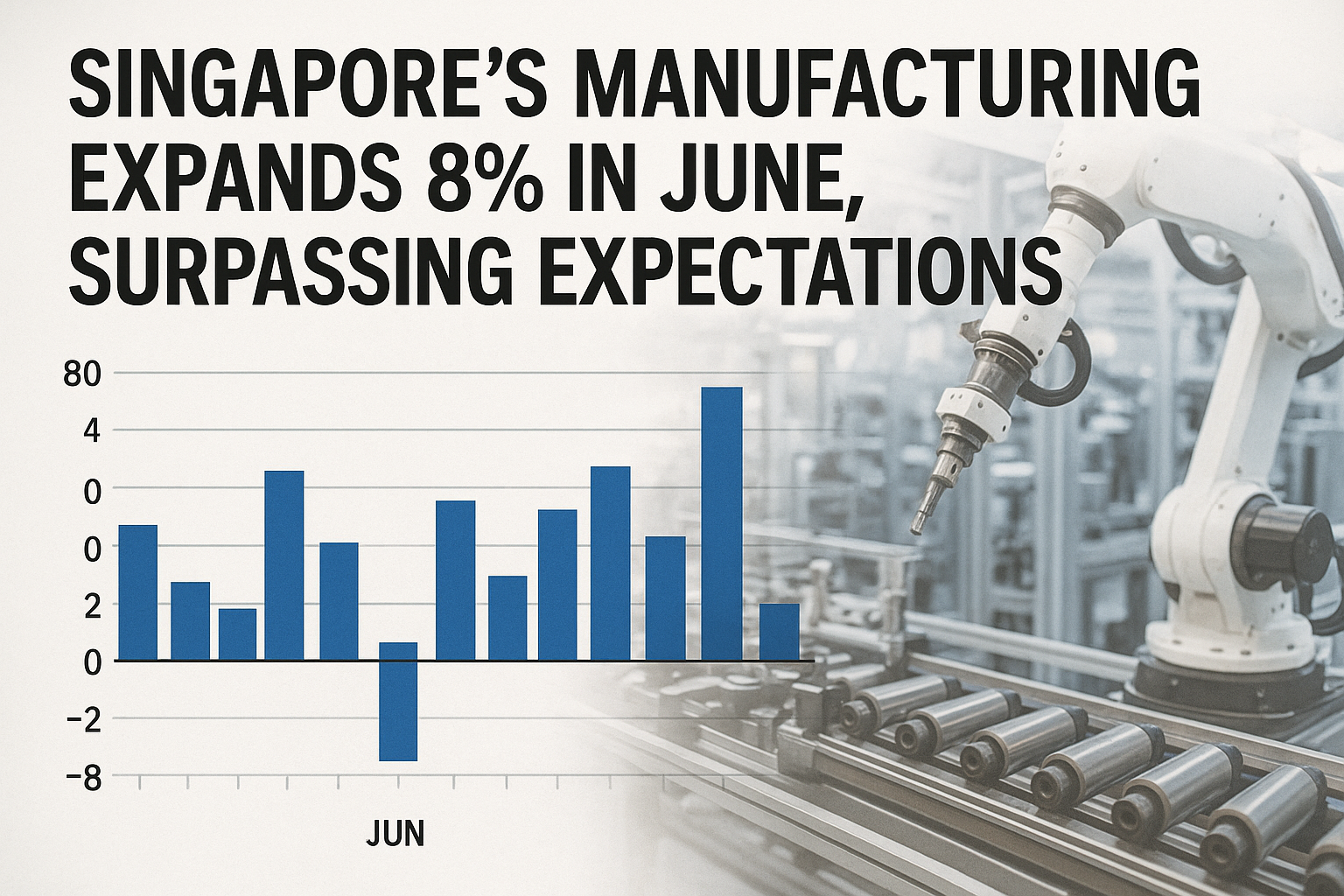
Singapore’s Manufacturing Output Surges 8% in June, Exceeding Expectations
Singapore’s factory output rose 8% year-on-year in June, outperforming forecasts and gaining momentum from May’s revised growth of 3.6%, according to data released by the Economic Development Board on Friday (Jul 25).
A Bloomberg survey of economists had anticipated a smaller 7.1% increase.
When excluding the typically volatile biomedical manufacturing sector, output climbed 8.2% year-on-year—up from May’s revised 4.8% increase.
However, on a seasonally adjusted month-on-month basis, output was largely flat compared to May. Stripping out biomedical manufacturing, factory output actually dipped 0.8%, reversing the previous month’s 2.4% growth.
Cluster Breakdown
Nearly all manufacturing clusters recorded year-on-year growth in June, with the exception of general manufacturing.
- Electronics, Singapore’s key manufacturing segment, saw output rise 6.6% in June, improving on May’s 3.4% growth. The strongest performance came from the infocomms and consumer electronics segment, which surged 22.4%, followed by semiconductors at 4.3%. These gains outweighed declines in computer peripherals and data storage (-14.6%) and other electronic components (-14.8%).
- Precision engineering posted the largest annual increase at 18.9%, driven by a 19.3% expansion in the machinery and systems sub-sector—boosted by stronger production of semiconductor and process control equipment.
- Biomedical manufacturing rose 11.3%, as a 38.8% surge in pharmaceuticals (from a low base last year) offset a 2.5% decline in medical technology output.
- Transport engineering output increased 9.2%, thanks to a 20.6% jump in the aerospace segment due to higher production of aircraft parts and increased maintenance activity from commercial airlines. This helped counter a 2.6% drop in marine and offshore engineering and an 11.7% dip in land transport manufacturing.
- Chemicals production grew 1.1%, led by a 6.9% rise in petrochemicals, supported by last year’s low base caused by plant maintenance. Gains were also recorded in other chemicals (5%) and petroleum products (1.8%). However, the specialties segment shrank 6.5% due to lower output in industrial gases, biofuels, and food additives.
- General manufacturing was the only cluster to contract, with output down 11.6%. All segments declined except for printing, which rose 2.5%. The food, beverages and tobacco segment dropped 12.7% amid weaker production of drinks and milk powder, while the miscellaneous industries segment fell 11.6% on lower output of structural metal parts and packaging materials.
