


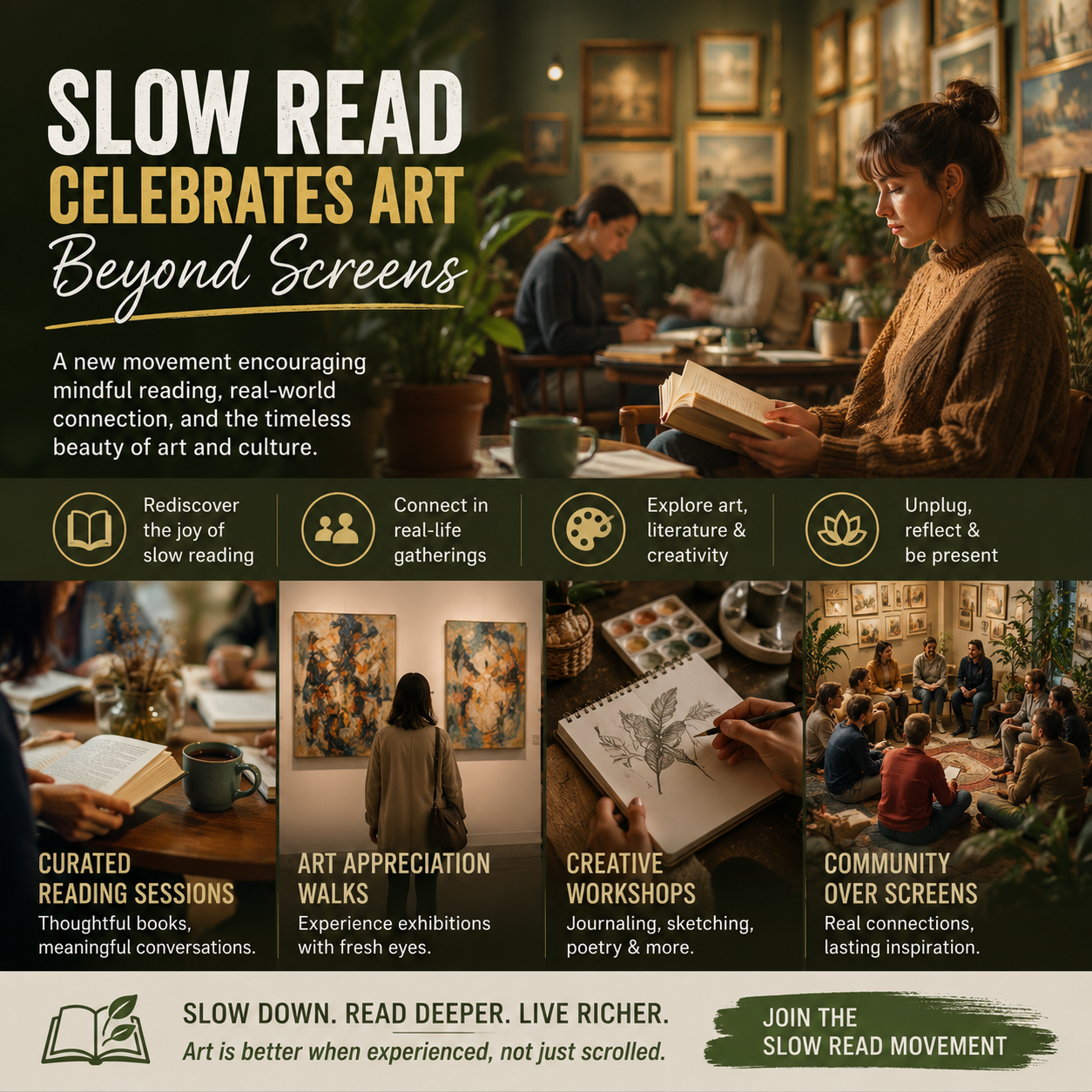
A new Melbourne exhibition is encouraging visitors to step away from endless digital scrolling and rediscover the concentration, patience and sensory pleasure involved in reading and viewing printed material.
Titled Slow Read, the exhibition at Town Hall Gallery in Hawthorn Arts Centre brings together works by nine Australian artists who transform books, paper, archives, poetry and printed images into layered, tactile artworks.
Curator Rachel Keir-Smith said the exhibition was designed as an alternative to the fast, fragmented experience of consuming information online. Rather than offering images that can be understood instantly, many of the works require visitors to pause, observe closely and allow their meanings to emerge over time.
The exhibition features multimedia and collage artists from across Australia, including Melbourne-based collaborative duo Gracia and Louise, who have worked together since 1999.
Their practice includes collages, prints, drawings and handmade publications, often drawing inspiration from animals, plants and the natural environment.
Venezuelan-born artist Nadia Hernández is also represented through Palomita/Soledad, a work whose title roughly translates as Little Dove/Solitude. The piece incorporates fragments from a poem written by Hernández’s grandfather, connecting personal memory, family history and language through visual art.
Together, the works explore how pages and printed materials can become more than containers for information. Books are cut, layered, woven, arranged and reconstructed into objects that viewers experience physically as well as intellectually.
Weaving memory and identity
One of the exhibition’s featured artists is Jacky Cheng, a Malaysian-born artist of Chinese heritage who lives and works on Yawuru Country in Broome, Western Australia.
Her artwork Thrums uses woven paper offcuts, old calendars, Tyvek and nylon thread to create a looping, wave-like form.
The title refers to two meanings of the word “thrum”. It can describe a continuous humming or vibrating sound, but it can also refer to leftover threads from a loom.
Cheng combined kozo paper with discarded Chinese calendars, including calendars that had belonged to her grandmother. She then stitched the individual fragments together by hand, a process that took almost a year to complete.
The calendars were once part of a daily ritual in which pages were torn away to mark the passage of time. Within Cheng’s artwork, those fragments carry traces of language, belief, family life and cultural rhythm.
She said weaving allows separate pieces, each containing its own story, to develop new relationships when they are brought together.
The process also reflects the way identities are formed—not through one simple narrative, but through overlapping memories, experiences and cultural influences.
Cheng described her creative practice as the opposite of doom-scrolling. Weaving is repetitive, deliberate and time-consuming, and its meaning cannot always be absorbed immediately.
She said viewers need to spend time with the work because its ideas gradually become clearer through sustained attention.
Like many people, Cheng acknowledged that she can lose time online. To protect her concentration, she answers emails in the morning and then spends several uninterrupted hours working in her studio.
She has even made a cardboard replica of a mobile phone, placing it nearby as a humorous reminder that no messages require her immediate attention.
Archives become living material
Emerging First Nations artist Jayda Wilson also uses printed documents to examine history, identity and language.
Wilson, who is of Gugada, Wirangu and Thai descent and lives in South Australia, contributed a work titled (un)silenced.
The installation uses archival documents, transparent paper and layered handwritten text to explore the effects of colonialism and the suppression of Indigenous languages.
At the centre of the work is a speech delivered by Wilson’s grandmother, Neva Gryzbowicz, to the Anthropological Society of South Australia.
In the speech, Gryzbowicz described growing up as a First Nations woman during the era of the White Australia Policy. She also discussed authorities preventing people from speaking Gugada and Wirangu wangga, languages connected to South Australia’s Far West Coast.
Wilson reproduced the complete speech and highlighted sections that carried particular personal or historical significance.
Beside the document, they placed transparent sheets containing hand-traced notes. The layers create the impression of a story being analysed, dismantled and assembled again from a contemporary perspective.
Wilson said the work brings their grandmother’s experiences into conversation with the present, demonstrating how historical policies continue to shape family identity and cultural memory.
The installation treats archives not as fixed records that simply belong to the past, but as living materials that can be reread, questioned and given new meaning.
Wilson said their work often involves slowing down and examining what exists between the lines. Because the text is layered, audiences need time to unpack the relationships between the different documents and ideas.
Books transformed into art
Keir-Smith developed her interest in artists’ books while exploring the State Library of Victoria’s Rare Book Collection.
An artist’s book may take the form of a conventional publication, but it can also be a sculpture, installation or experimental object built from the physical and conceptual elements of books.
Artists may use text, images, page numbers, layout, typography and binding to expand an existing publication or create a completely new work.
Keir-Smith said the artists in Slow Read use those familiar book elements in ways that reward patience and sustained observation.
The experience differs sharply from online media, where viewers are often presented with a rapid stream of unrelated images, messages, headlines and videos.
Digital platforms encourage immediate reactions and constant movement. The exhibition instead asks audiences to remain with a single object, notice details and form their own interpretations.
Keir-Smith said engaging with art does not require specialist knowledge. Viewers already possess the essential tools: the ability to look, notice, feel, question and make connections.
She hopes visitors leave the exhibition with a renewed understanding of what books, printed pages, photographs and archives can become when artists treat them as creative materials.
The show also reflects wider interest in the potential wellbeing benefits of spending time with art. Keir-Smith noted that research has associated artistic engagement with improvements in concentration and reductions in anxiety.
At a time when many people feel overwhelmed by notifications, social-media feeds and constant digital stimulation, Slow Read offers a quieter experience.
It presents reading and looking not as passive activities, but as deliberate encounters requiring curiosity, patience and attention.
Slow Read is showing at Town Hall Gallery in Hawthorn Arts Centre, Victoria, until July 25, 2026.
