


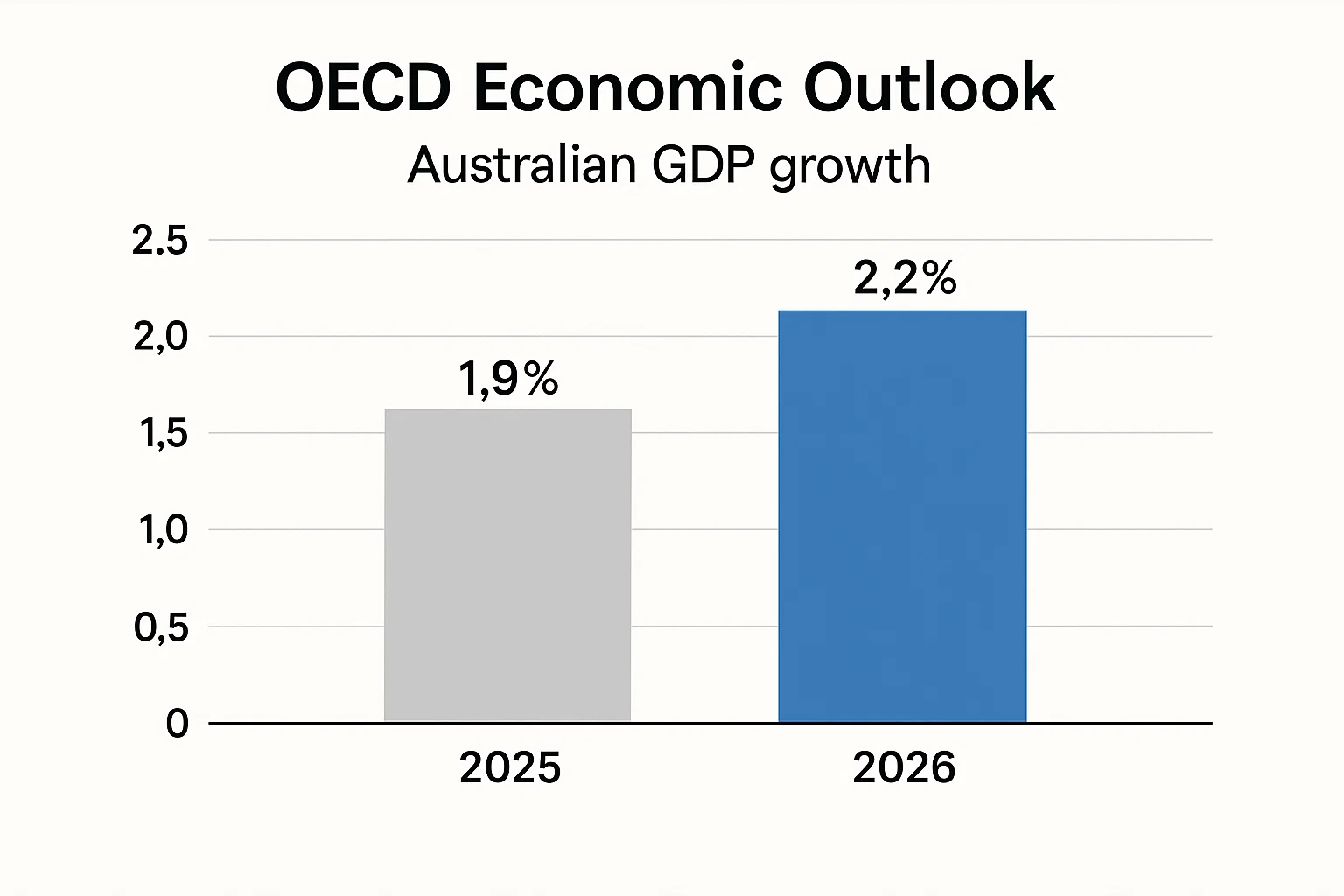
The OECD has lowered its growth forecast for Australia’s economy, urging the government to tackle the “housing affordability crisis” and speed up the transition to net zero emissions.
Australia’s GDP growth is now expected to be 1.8% in 2025, a slight downgrade from the 1.9% projected in March.
For 2026, the OECD predicts growth of 2.2%, better than the March interim forecast of 1.8%, but still below the 2.5% forecast made last December.
The international organization encouraged the Albanese government to address longer-term issues such as demographic changes, housing shortages, and climate change, along with reforms to improve tax system efficiency.
“To strengthen competition and productivity and reverse the ongoing decline in housing affordability, policy measures including easing zoning restrictions are necessary,” the report stated.
The OECD highlighted housing and reaching net zero carbon emissions as critical policy priorities.
“Boosting housing supply to ease affordability and accelerating progress towards net zero emissions—particularly in transport and industry—are essential,” the report said.
It also recommended stronger investment incentives, especially for social housing and public infrastructure to improve electricity grid connections.
Regarding tariffs, the OECD noted that global trade tensions have dampened business and consumer confidence. While Australia’s exposure to US tariff hikes is limited (with exports to the US accounting for about 5% of total exports), lower commodity prices could negatively affect the domestic economy.
The report pointed out risks from declining import demand in China, Australia’s largest export market.
“Global trade tensions impact Australia mainly through reduced investment worldwide, causing lower prices for iron ore, coal, and natural gas,” it stated.
Inflation is expected to stay near target levels, averaging 2.4% over the next two years.
Disposable incomes have recently started to recover after a slump, but they remain well below 2022 levels.
Treasurer Jim Chalmers said the downgraded growth outlook reflects the “uncertainty, unpredictability, and volatility” in the global economy.
“This highlights the risks from tariffs, trade tensions, conflicts, and fragmentation,” he said.
“While Australia isn’t immune to global challenges, we are well-positioned thanks to strong economic progress.”
With lower inflation, low unemployment, positive growth, and falling interest rates, Chalmers said the OECD indicates that Australia’s economy is improving even as global conditions worsen.
He also noted that upcoming economic data will reflect both global headwinds and the impact of recent natural disasters, which have cost the economy $2.2 billion.
The Australian Bureau of Statistics is expected to report a modest 0.4% GDP growth for the March quarter on Wednesday at 11:30 a.m.
