


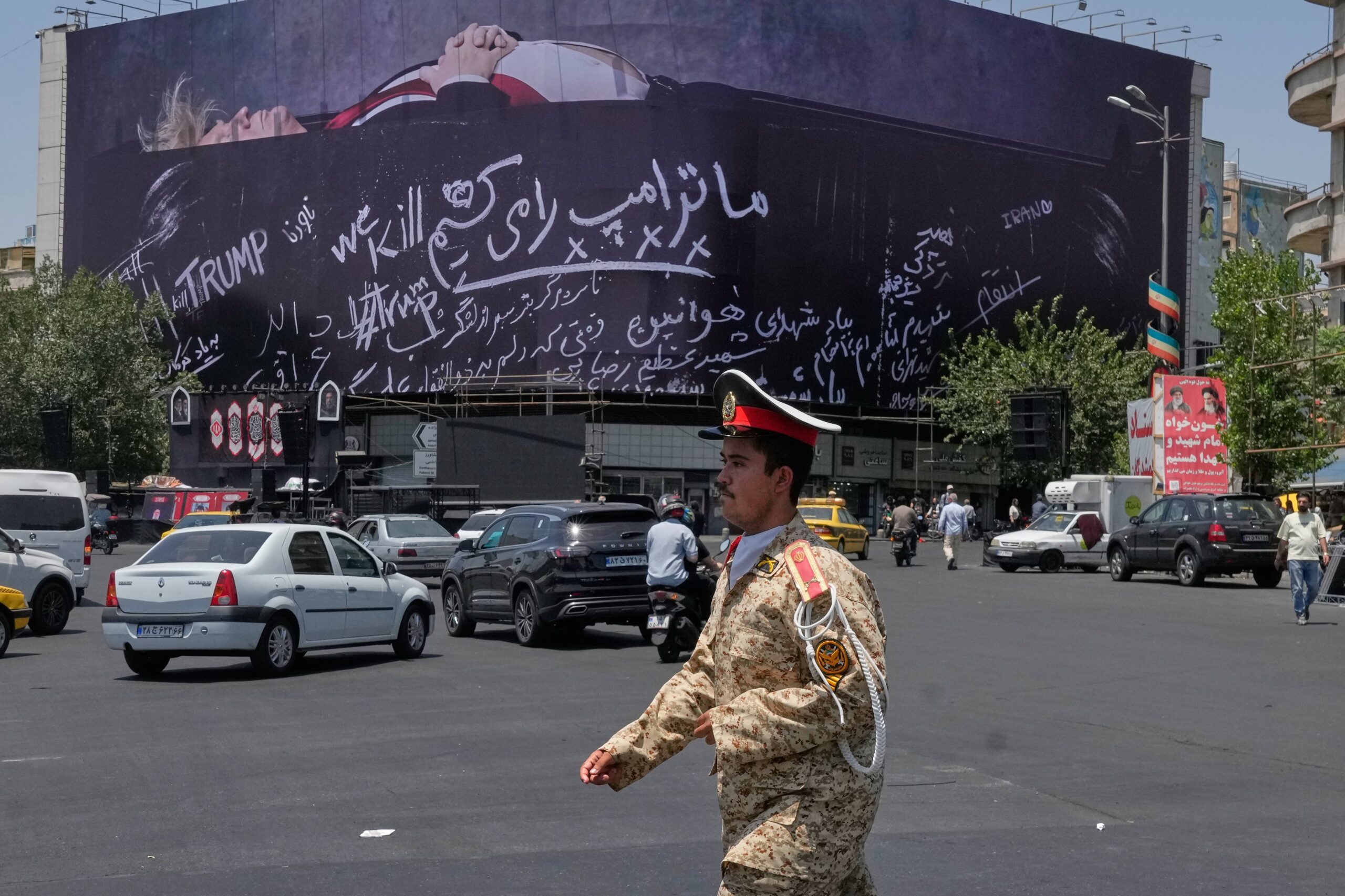
The United States has carried out a twelfth consecutive night of strikes against targets in Iran, while Tehran has warned that infrastructure across the Gulf could come under attack if Iranian security is not guaranteed.
US Central Command said the latest operation was intended to further reduce Iran’s ability to threaten commercial shipping and civilian vessels using regional waterways.
Iranian media reported attacks in several southern locations, including Bushehr, Ahvaz, Jask, Andimeshk and Sirik.
Officials in Khuzestan province said a missile strike hit the Shalamcheh border crossing between Iran and Iraq, killing two people and injuring 11 others.
Kuwait also reported that its air-defence systems had responded to an Iranian drone attack, adding to fears that the conflict is spreading across the wider Gulf region.
Iranian officials have repeatedly said attacks on neighbouring countries and regional infrastructure will continue as long as the United States keeps striking Iranian territory.
Mohammad Bagher Ghalibaf, described as Iran’s chief negotiator, issued one of Tehran’s strongest warnings yet after US President Donald Trump threatened further attacks on Iranian bridges and electricity facilities.
Ghalibaf warned that Iran would not allow other regional states to trade oil safely if Iranian exports were blocked.
He also said infrastructure elsewhere in the region could not be considered secure unless Iran’s own security was protected.
The warning came after US strikes reportedly damaged power facilities and roads inside Iran.
Both Washington and Tehran have increasingly targeted infrastructure during the latest escalation, raising concerns over civilian casualties and the legality of attacks on nonmilitary sites.
Under international humanitarian law, civilian infrastructure is generally protected unless it is being used for military purposes.
Iran’s Health Ministry said US attacks since late June had killed 53 people, including three children, and wounded approximately 590 others.
Iran has responded with repeated missile and drone attacks against locations in Bahrain, Kuwait and Jordan, all of which host or cooperate closely with US forces.
Some Iranian strikes have reportedly hit water and electricity facilities in Kuwait.
An Iranian attack on a military base in Jordan killed three US service members, while another American soldier died in Erbil, Iraq, during the controlled destruction of an armed drone.
According to the US military, the latest deaths brought the number of American personnel killed during the conflict to 18.
Iranian Foreign Minister Abbas Araghchi said Tehran would answer future attacks with equivalent retaliation.
He warned that any strike on Iranian territory or infrastructure would produce a forceful and decisive response.
Iran’s military issued a similar statement, saying continued threats from Washington would only widen the war rather than force Tehran to surrender.
The escalating rhetoric reflects the difficulty both governments face in stepping back from the conflict without appearing weak.
Mehran Kamrava, a professor of government at Georgetown University in Qatar, said neither side wanted to be seen as retreating under pressure.
However, he argued that Iran’s range of available regional targets was becoming more limited because further attacks could severely damage Tehran’s diplomatic standing among neighbouring countries.
The latest exchange has effectively pushed aside the interim peace arrangement reached between the United States and Iran last month.
Both sides now appear to consider the deal suspended, at least temporarily, after accusing each other of violating its terms.
One of the central disputes remains control and security in the Strait of Hormuz.
Iran has insisted that it retain influence over the strategic waterway, through which a significant share of the world’s oil and gas supplies normally passes.
US Central Command has said the strait remains open to shipping despite attacks and threats from Iran’s Islamic Revolutionary Guard Corps.
Washington has repeatedly stated that it will not allow Tehran to close or dominate the passage.
The conflict has also created new risks for another critical maritime route.
The Iran-aligned Houthi movement in Yemen has threatened shipping near the Bab al-Mandeb Strait by announcing a blockade of Saudi ports.
The threat reportedly caused several oil tankers to change direction in the Red Sea.
Any sustained disruption to the Strait of Hormuz or Bab al-Mandeb could have serious consequences for global energy prices, supply chains and maritime insurance costs.
Trump further escalated the confrontation by warning that the United States would strike an Iranian power plant or bridge whenever Iranian forces attacked a ship in the Strait of Hormuz.
The statement suggested Washington was adopting a direct retaliatory formula linking maritime attacks to strikes on Iranian infrastructure.
Muhanad Seloom, an assistant professor at the Doha Institute for Graduate Studies, said Trump appeared to have lost patience with diplomatic efforts.
He argued that no mediator currently seemed to possess enough credibility with both sides to bring them back to meaningful negotiations.
Regional and international officials are nevertheless continuing efforts to revive diplomacy.
US Secretary of State Marco Rubio said Washington remained open to negotiations but accused Tehran of failing to approach the process seriously.
Speaking during a meeting of Southeast Asian foreign ministers in Manila, Rubio said the United States was prepared to respond diplomatically if Iran demonstrated genuine intent.
He added that Washington would otherwise take whatever action it considered necessary to protect US interests and regional allies.
Iranian officials have reportedly maintained indirect contacts with Washington, but those exchanges have not prevented the military confrontation from intensifying.
The latest strikes indicate that both sides remain focused on imposing costs rather than reducing tensions.
The United States is attempting to weaken Iran’s military, missile, drone and maritime capabilities.
Iran, meanwhile, is using attacks on bases, infrastructure and shipping routes to demonstrate that it can still threaten American forces and regional partners.
The conflict is therefore increasingly becoming a contest over deterrence, regional access and economic pressure.
Washington wants to preserve freedom of navigation and protect allied governments, while Tehran is signalling that it can disrupt energy infrastructure and maritime trade if its own territory continues to be attacked.
The danger is that repeated retaliation could create a cycle in which each strike produces a larger response.
Attacks on power facilities, bridges, ports and oil routes could also draw additional countries into the conflict, even if they are not directly involved in the original dispute.
With diplomatic efforts stalled and both governments issuing increasingly severe threats, the risk of a broader regional war remains high.
The next phase will depend on whether mediators can restore talks before attacks on infrastructure and shipping trigger further military escalation across the Gulf.
