


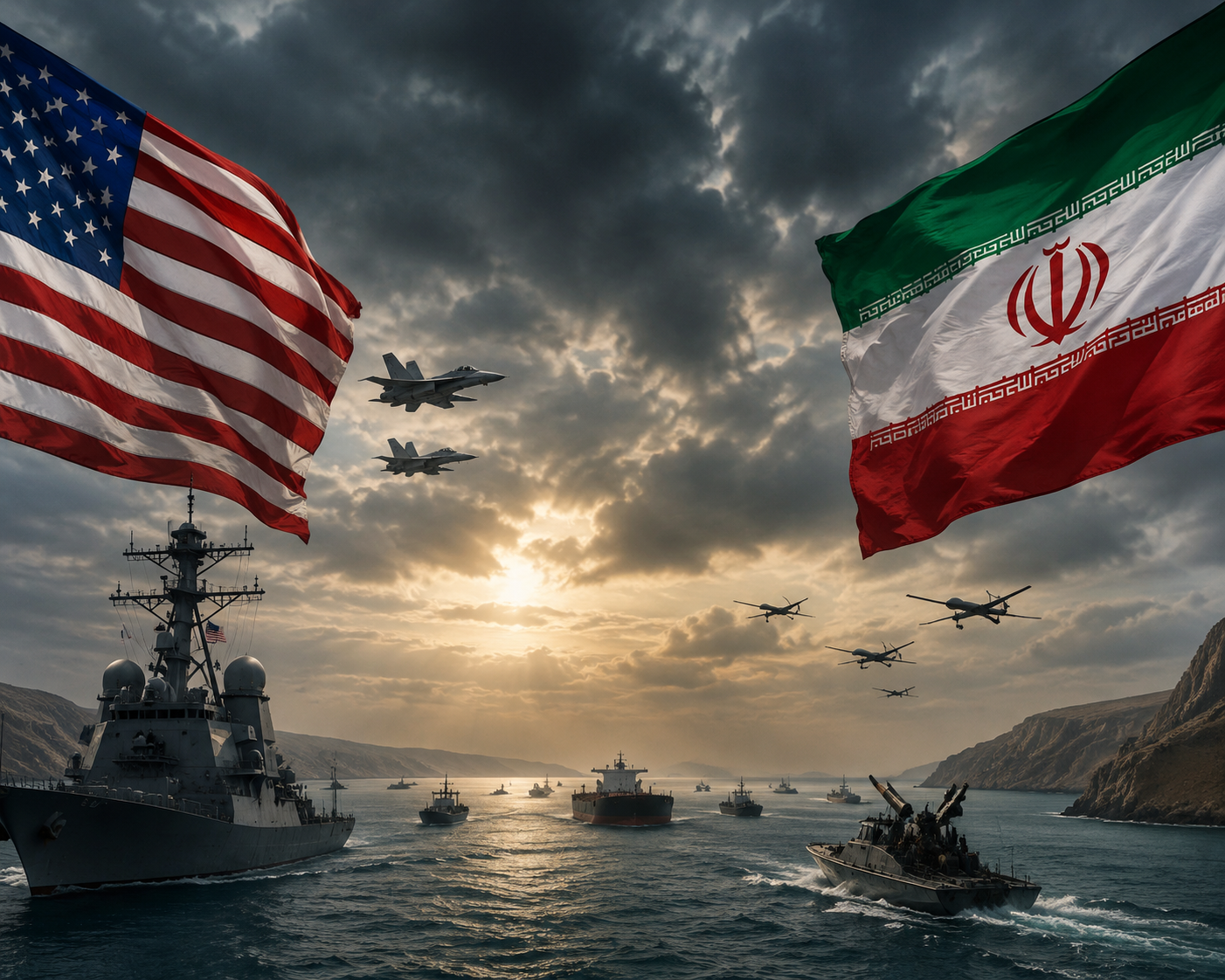
The United States has launched another wave of airstrikes against Iran as the two countries intensify their confrontation over control of the Strait of Hormuz, one of the world’s most important energy-shipping routes.
US President Donald Trump said the military campaign would escalate until Tehran stopped attacking vessels and agreed to restore safe passage through the waterway. During a 90-minute operation, American forces struck missile storage and launch facilities on Greater Tunb Island, located near the strait in the Persian Gulf.
US Central Command later announced additional strikes against Iranian air-defence systems, missile and drone facilities, and coastal-surveillance installations. The operation was intended to weaken Iran’s ability to threaten commercial shipping, according to the command.
Iranian state media reported that air-defence systems had been activated in parts of Tehran as the attacks continued. However, the latest US campaign has primarily targeted military infrastructure in southern Iran and remains less intensive than the widespread bombardment seen during March and early April.
The escalation has further undermined an interim peace agreement signed by Washington and Tehran in June. The deal has largely broken down as both sides accuse each other of violating its conditions, particularly its provisions concerning the reopening of the Strait of Hormuz.
The agreement did not clearly establish how quickly unrestricted shipping would resume, contributing to competing interpretations. Iran has insisted that it should retain significant authority over the waterway, while the United States has demanded safe and open passage for international vessels.
The strait is critical to the global energy market because Saudi Arabia, Qatar, the United Arab Emirates and other Gulf producers transport much of their oil and gas exports through it. Concerns about further disruption pushed Brent crude above US$85.25 per barrel, extending its gains for a fourth consecutive session.
The confrontation also expanded to commercial shipping. US Central Command said American forces fired missiles into the smokestack of an unloaded, Curaçao-flagged tanker travelling towards an Iranian port.
According to the US military, the vessel had ignored repeated warnings and attempted to breach the American blockade. The tanker was prevented from continuing to Iran, while two other ships had previously been turned back. American forces also reportedly helped more than 10 vessels navigate the area overnight.
The International Maritime Organization warned that conditions in the Strait of Hormuz remained too dangerous for normal commercial transit. The warning represented the United Nations agency’s strongest message to the shipping sector since the June agreement was reached.
US Vice-President JD Vance described Washington’s strategy as a combination of military pressure, economic measures and continued diplomatic engagement. The Trump administration maintains that negotiations remain possible despite the renewed fighting.
Trump said Iran had expressed interest in returning to talks, although Tehran had not publicly confirmed that claim. The US president also announced that Iran had released an American woman who had been detained since December 2024.
The woman was identified by her lawyer as Dena Karari, a dual American-Iranian citizen. Trump welcomed her release as a positive gesture and said she had safely left Iran.
Despite that development, Iran has shown no indication that it is prepared to surrender control of the strait. The Iranian military said the waterway would remain closed until Washington accepted a system of passage governed by Tehran.
Iran’s Islamic Revolutionary Guard Corps also warned that regional oil and gas exports must either remain available to every country or be denied to everyone. Parliament speaker and senior negotiator Mohammad Bagher Ghalibaf said Iran had little reason to continue honouring the interim agreement if it received no benefits from it, although he did not formally withdraw Tehran from the deal.
The conflict is also affecting aviation. The European Union Aviation Safety Agency raised its threat assessment for flights through the Middle East and advised airlines to avoid the airspace of Bahrain, Kuwait, Qatar, the United Arab Emirates and the Gulf of Oman.
Iranian authorities claimed that recent US strikes had killed more than 30 civilians. They said seven people were killed when a missile struck a barracks in Iranshahr on Wednesday. The claims were attributed to Iran and were not independently verified in the report.
Meanwhile, Republicans in the US Congress are seeking additional military funding despite concerns that the conflict is unpopular and contributing to higher consumer prices. The Trump administration is also considering an extension of shipping exemptions covering oil, fuel and fertiliser to reduce the impact of supply disruptions.
Washington has maintained the naval blockade that it first imposed in April and temporarily lifted following the June agreement. Continuing the blockade could further damage Iran’s economy while increasing the risk of a wider regional confrontation and prolonged disruption to global energy supplies.
