


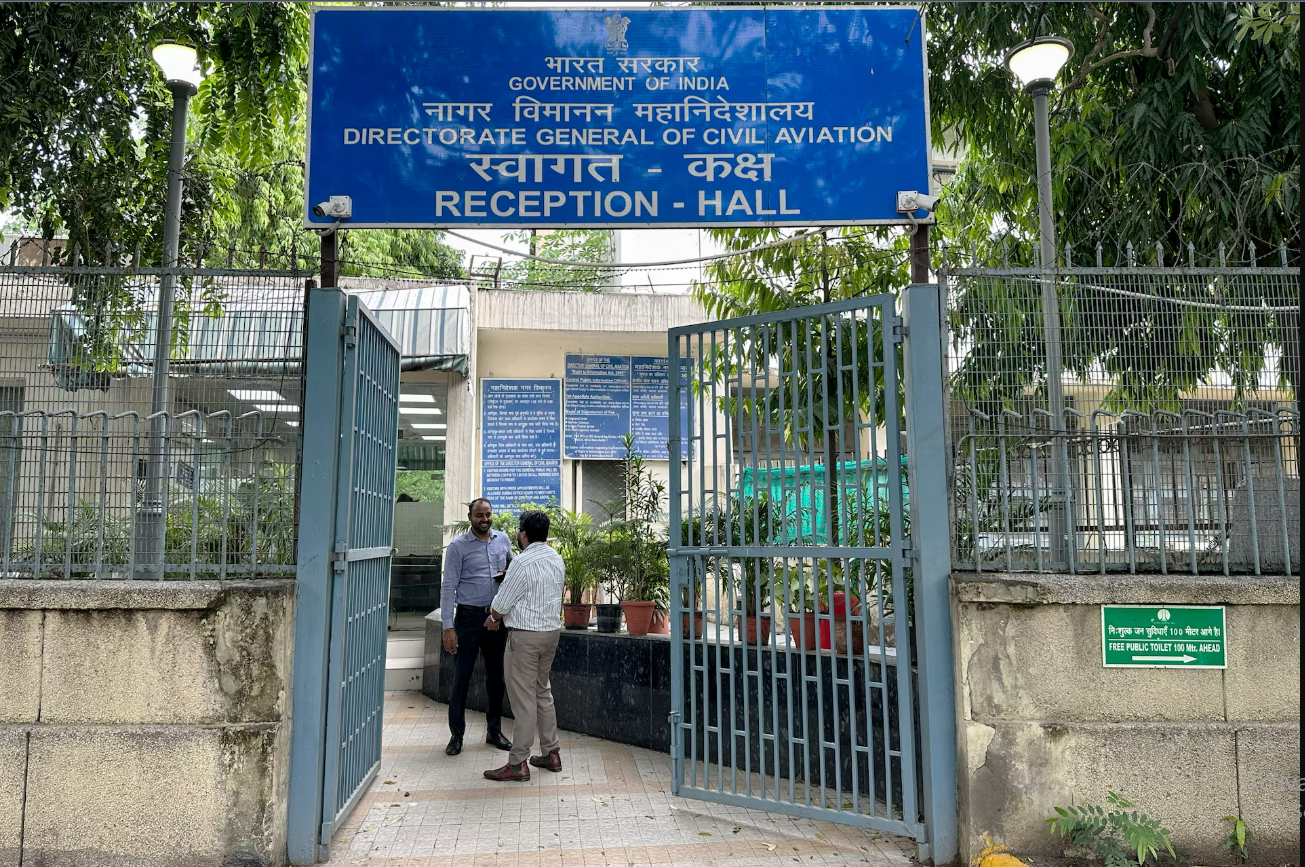
India’s Ministry of Civil Aviation has raised serious concerns about how the country’s aviation safety regulator handled possible conflicts of interest involving officials whose relatives obtained jobs with airlines and other companies operating in the aviation sector.
Government records indicate that the ministry repeatedly questioned the Directorate General of Civil Aviation, or DGCA, from the middle of 2025 over whether some officials may have used their regulatory positions to assist family members in securing employment with organisations under the agency’s supervision.
The ministry also criticised delays in declaring those relationships and failures to obtain required approvals within the proper timeframe.
The controversy comes at a sensitive moment for the DGCA, which oversees safety and regulatory compliance in one of the world’s fastest-growing aviation markets.
The regulator is already facing pressure over staff shortages, concerns about airline safety standards, an upcoming routine audit by the United States Federal Aviation Administration and a federal police investigation involving a DGCA officer accused of accepting a bribe.
A DGCA document prepared in January summarised the ministry’s criticism and acknowledged that the regulator had not effectively prevented or managed situations in which officials could potentially influence the hiring or placement of relatives, dependants or other family members.
The available records did not indicate whether disciplinary proceedings would be launched or whether additional penalties were being considered.
According to one document, 51 DGCA officials had declared that 59 of their relatives were employed in the aviation industry as of January 31, 2026.
A year earlier, only 33 officials had reported 41 relatives working in the sector.
Those family members were employed by a range of aviation-related organisations, including Air India, IndiGo, Akasa Air, Airbus India, airport operators and flying training institutions.
The aviation ministry, the DGCA and the companies named in the records did not publicly respond to requests for comment.
Indian government service rules prohibit federal employees from using their official authority or influence to obtain employment for relatives.
Officials are also required to disclose family members’ employment in relevant industries and seek approval when necessary.
Conflict-of-interest concerns are not new within India’s public sector.
At the DGCA, four officers were formally censured in 2013 over similar matters.
A senior official familiar with the latest dispute said the ministry was concerned that some DGCA employees could conceal the employment of relatives and later weaken inspections, approvals or enforcement actions involving the companies where those relatives worked.
The official said one retired DGCA employee was discovered to have approximately 12 relatives employed in the aviation industry.
However, the ministry reportedly became aware of those connections only after the officer had retired.
The official requested anonymity because of the sensitivity of the issue.
The records also reveal disagreement between the aviation ministry and the DGCA over who should manage such cases.
Former DGCA director-general Faiz Ahmed Kidwai sought broader administrative authority last year, including the power to address conflict-of-interest matters internally.
In a letter dated July 2025, Kidwai argued that the ministry’s approval process was slowing decisions and that greater authority should be delegated to the regulator.
The ministry rejected the request.
A January document stated that the ministry considered the DGCA’s repeated inability to identify responsibility for delays, missing approvals and incomplete disclosures to be deeply concerning.
Kidwai has since moved to India’s Department of Personnel and Training and did not publicly comment on the issue.
One of the most closely examined cases involved a DGCA assistant director of engineering whose sister was employed by Air India’s quality department.
At the time, the officer was reportedly involved in regulatory approvals connected to the airline, raising questions about whether the family relationship could compromise his independence.
The DGCA told the ministry that the officer’s sister was an independent widow and argued that the rule requiring prior approval primarily applied to dependants, such as children.
As a precaution, the regulator said the officer would no longer be assigned work involving Air India.
The ministry rejected that interpretation.
In an August 2025 communication, it said a sister should be regarded as a family member under the relevant rules.
The ministry also said the possibility that the officer had influenced or participated in the recruitment process could not be excluded.
It further questioned whether the appointment had been handled transparently and through a legitimate process.
The case has intensified wider debate about the independence of India’s aviation regulator.
Safety authorities are expected to supervise airlines, airports, aircraft manufacturers, training schools and other aviation organisations without favouritism or personal influence.
Undisclosed family connections can create doubts about whether inspections, certifications, approvals and enforcement decisions are being carried out fairly.
Even when no wrongdoing is proven, the appearance of a conflict can weaken public trust in regulatory decisions.
International regulators commonly rely on strict disclosure, recusal and reassignment procedures to manage these risks.
In the United States, ethics standards generally require public officials to withdraw from matters where close family relationships could reasonably cause doubts about their impartiality.
European aviation bodies also require employees to declare relevant interests and may restrict their responsibilities when a potential conflict exists.
Harsh Vardhan Pratap Singh, president of the Association of Flying Training Organisations, has called for greater openness from the DGCA.
He said the regulator should publicly disclose which officials have relatives working in the aviation industry.
According to Singh, transparent declarations are necessary to protect safety, preserve confidence in enforcement and prevent suspicion around regulatory decisions.
The ministry’s criticism adds to pressure on the DGCA to demonstrate that it can act independently and apply aviation rules consistently.
India’s aviation sector has expanded rapidly in recent years, with airlines adding aircraft, airports increasing capacity and passenger numbers continuing to grow.
That expansion makes effective oversight increasingly important.
Any perception that regulatory decisions could be influenced by family relationships risks damaging public confidence and could attract further attention from international aviation authorities.
The issue is therefore not limited to administrative procedure.
It raises fundamental questions about whether India’s aviation regulator has adequate safeguards to identify, disclose and manage conflicts of interest in an industry where safety decisions can have major consequences.
