


Concerns are growing across Asia about whether the United States would be willing and able to defend its regional allies in a major conflict as China increases military pressure and Washington remains heavily focused on its confrontation with Iran.
The debate has intensified following a serious clash between Chinese and Philippine forces at Second Thomas Shoal in the South China Sea, one of the region’s most contested maritime flashpoints.
The Philippines has maintained a presence at the reef for decades using the Sierra Madre, a World War II-era naval vessel deliberately grounded there and staffed by rotating Philippine troops.
An international tribunal ruling has supported Manila’s position, but China continues to claim the surrounding waters.
Last month, a Chinese Coast Guard vessel reportedly circled the Sierra Madre before smaller boats moved toward Philippine service members. Philippine and US officials said one Filipino serviceman suffered head injuries after being struck with a wooden baton during the confrontation.
China has rejected that account of responsibility and accused the Philippines of provoking the encounter.
South China Sea Clash Raises New Questions
The confrontation was described as one of the most serious incidents between China and the Philippines at the shoal in years.
Washington publicly expressed strong support for Manila, with the US ambassador condemning the incident and reaffirming America’s commitment to its long-standing treaty ally.
However, the clash has also exposed a deeper question facing countries across the Indo-Pacific: whether US security guarantees remain as credible as they once appeared.
China has shown no sign of scaling back its activities in disputed waters, while Washington is increasingly consumed by military demands elsewhere.
Iran War Drains US Military Resources
One of the biggest concerns for Asian governments is the cost of the US-Israeli conflict with Iran.
The war has reportedly placed heavy pressure on American military resources, including critical air-defence interceptors.
Iranian missile and drone attacks have also forced US troops to abandon some Middle Eastern bases and have damaged military facilities.
Those developments have raised uncomfortable questions in Asia about how the US military would cope with a conflict involving China, whose armed forces are significantly larger and more capable than Iran’s.
For governments such as the Philippines, Japan and others along the first island chain, the issue is not simply whether Washington is politically willing to respond, but whether it would have sufficient weapons and forces available to do so.
China Demonstrates Growing Military Capability
Beijing has meanwhile continued to demonstrate its military reach.
In early July, China carried out a rare test launch of a nuclear-capable intercontinental ballistic missile from a nuclear-powered submarine into the Pacific.
The test highlighted one of the most powerful elements of China’s strategic arsenal and reinforced concerns about its accelerating military modernisation.
At the same time, China continues to pressure neighbouring states through coast guard operations, maritime patrols and military exercises.
The combination has contributed to perceptions that Beijing is testing how far it can expand its influence without triggering a stronger response from Washington.
Trump Administration Rejects Claims of Retreat
Officials in the Trump administration insist the United States is not withdrawing from Asia.
During a recent speech in Manila, US defence policy official Elbridge Colby said Washington remained committed to maintaining a military posture capable of denying China the ability to seize strategically important territory along the first island chain.
That region includes Taiwan and islands belonging to the Philippines and Japan.
Colby also argued, however, that US allies need to increase their own defence spending and integrate their forces more closely with the American military.
The message reflects a broader theme of President Donald Trump’s foreign policy: Washington expects allies to contribute more heavily to their own defence.
Diplomatic Footprint Also Under Scrutiny
Despite those military assurances, other decisions have added to concerns over America’s regional commitment.
The State Department is reportedly preparing to close some US consulates in Japan and Indonesia.
Critics argue such moves could weaken Washington’s diplomatic presence at a time when China is expanding its influence.
Representative Gregory Meeks, the leading Democrat on the House Foreign Affairs Committee, has sharply criticised Trump’s Asia strategy, arguing it has undermined US credibility and created opportunities for Beijing.
Administration officials reject that assessment and say American military commitments remain intact.
Trade Policies Have Complicated US Relationships
Security is not the only source of unease.
Trump’s global tariff policies have also affected Southeast Asian countries, creating the perception among some governments that the United States can be both a security partner and an economic adversary.
Washington has struggled for years to present a broad economic strategy for the region.
Both Republican and Democratic leaders moved away from the large Pacific trade agreement originally promoted during the Obama administration, leaving China with a significant advantage in regional commerce.
Because China is the largest trading partner for many Asian countries, governments are reluctant to choose sides completely.
Asian Nations Want a Strong US Counterweight
Countries across Southeast Asia generally do not want to become trapped in a direct confrontation between Washington and Beijing.
However, many still see a strong US presence as necessary to balance China’s economic and military power.
Former US National Security Council official Mira Rapp-Hooper has argued that the perception of the United States drifting away from the region has left a significant impression on Asian partners.
The concern is particularly acute for countries such as the Philippines, which depends heavily on China economically but relies on the United States for security.
Trump’s Warmer Relationship With Xi Adds Uncertainty
Trump’s approach toward Chinese President Xi Jinping has further complicated the picture.
Although Trump has frequently described China as an economic competitor, his relationship with Beijing has become warmer following the tariff confrontation between the two countries.
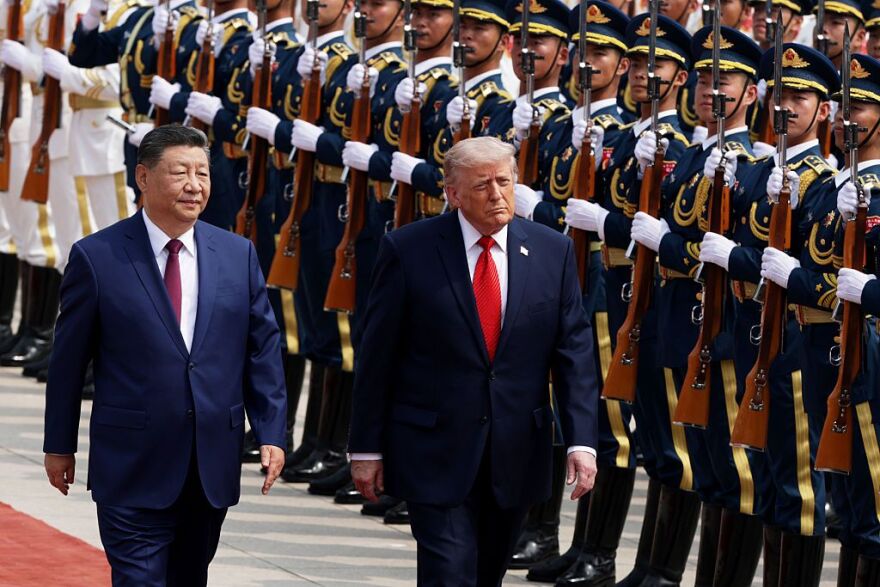
During a summit in Beijing in May, Trump publicly praised Xi, and the Chinese leader is expected to visit Washington for a state visit in late September.
Trump has also promoted the idea of a “G2” relationship between the two countries.
That approach has unsettled some Asian governments because it raises fears that Washington and Beijing could pursue major-power agreements without fully considering the interests of smaller regional states.
As US-China relations improve at the leadership level, some governments are becoming more cautious about antagonising Beijing.
Philippines Caught Between Security and Trade
The Philippines illustrates the dilemma particularly clearly.
Manila has a formal defence treaty with Washington and remains the only Southeast Asian country with such an alliance.
At the same time, China remains economically important to the Philippines.
Political analyst Richard Heydarian has described the situation as difficult because Manila wants strong relationships with both powers.
The Philippines needs US military backing to counter Chinese pressure, but many Filipinos feel Washington offers less outside defence and security.
US Seeks New Economic Initiatives
The United States has attempted to expand economic cooperation with the Philippines.
During the Biden administration, Washington supported development of the Luzon Economic Corridor, designed to improve infrastructure and integrate the Philippines more deeply into international supply chains.
The Trump administration is now seeking to involve the country in its Pax Silica initiative, focused on semiconductor production and artificial intelligence.
However, these projects remain relatively limited compared with the scale of military cooperation between the two countries.
US-Philippines Military Cooperation Continues
Despite concerns over American resources, military ties between Washington and Manila remain strong.
Secretary of State Marco Rubio recently reaffirmed that the United States would continue defending freedom of navigation and honour its treaty obligations.
The two countries have also continued joint military exercises.
In May, US and Philippine forces tested a Typhon missile launcher during an exercise, demonstrating a weapon that could potentially be used against Chinese forces in a future conflict.
The Philippines has also broadened its partnerships by bringing Japan into regional military exercises.
Japanese troops participated in exercises on Philippine territory in June, marking a significant development in defence cooperation between the two countries.
Manila Builds a Wider Security Network
The Philippines’ closer relationship with Japan reflects both continuity and caution.
Previous US administrations encouraged tighter cooperation between Manila and Tokyo as part of a wider regional security network.
The Philippines appears to be maintaining that approach while also ensuring it is not completely dependent on Washington.
Expanding partnerships with Japan and other countries gives Manila more options if US attention or resources become constrained.
China’s Rise Tests American Credibility
The broader challenge for the United States is maintaining credibility in Asia while simultaneously managing military commitments in the Middle East and elsewhere.
China continues to increase pressure in the South China Sea, expand its military capabilities and deepen its economic influence.
For US allies and partners, Washington’s promises remain important, but questions are growing over whether those commitments would translate into decisive action during a serious conflict.
The Philippines remains a crucial test case.
Its treaty with the United States is one of Washington’s strongest security commitments in Southeast Asia, yet repeated clashes with China continue to push the boundaries of that guarantee.
As Beijing expands its regional reach and Washington remains preoccupied with Iran, Asian governments are increasingly preparing for a future in which they may need to rely more heavily on themselves and on one another.
