


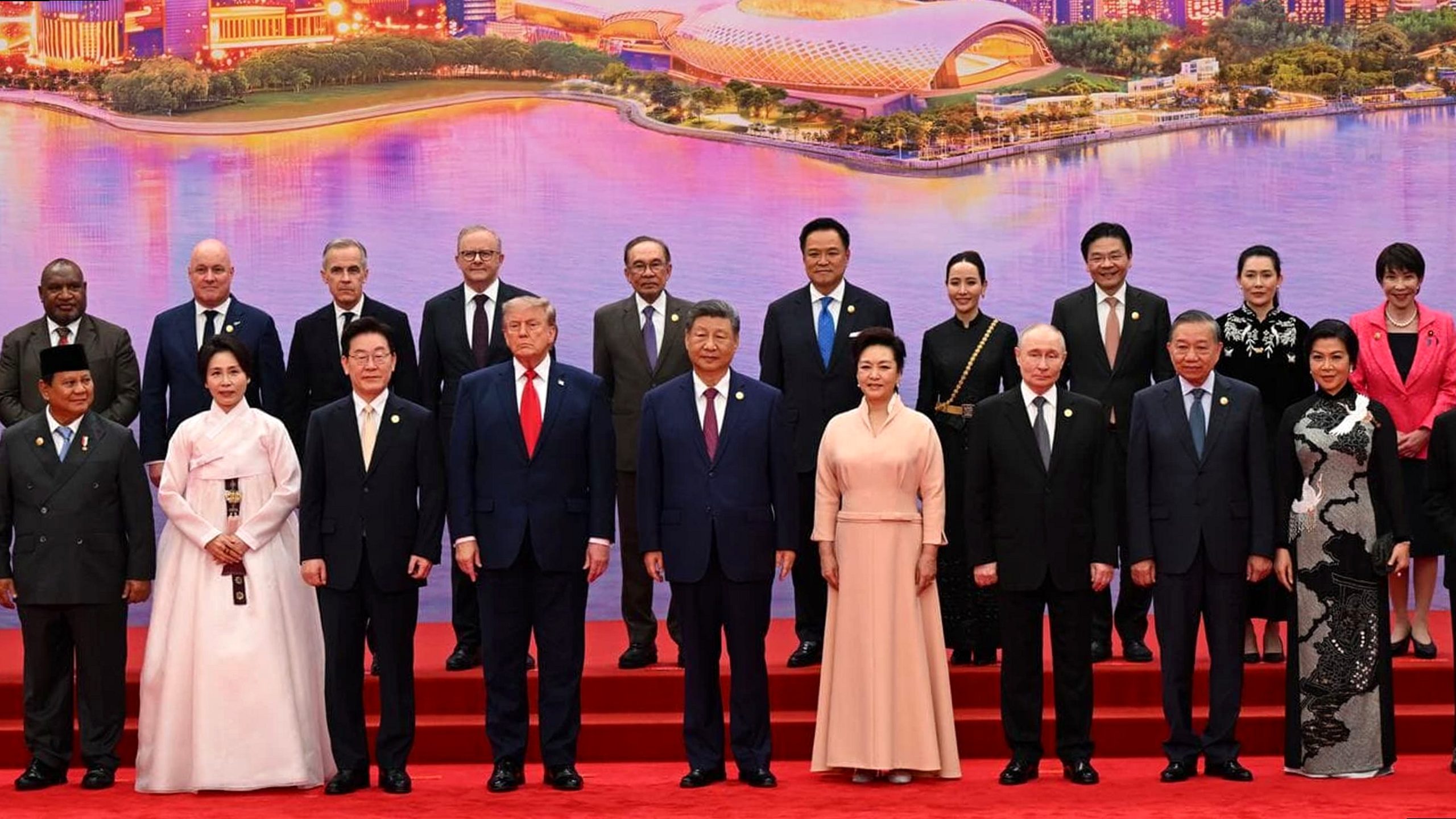
Prime Minister Anthony Albanese has appeared in a group photograph alongside Russian President Vladimir Putin, Chinese President Xi Jinping and United States President Donald Trump at the Asia-Pacific Economic Cooperation summit in Shenzhen, a moment that has drawn both criticism at home and a firm defence from his government.
Mr Albanese mingled with other world leaders at a banquet on Wednesday night, including New Zealand Prime Minister Chris Luxon and Canada’s Mark Carney, ahead of a much-anticipated meeting between Mr Putin, Mr Trump and Mr Xi at the summit.
The photograph was taken despite appeals from Ukrainian Australians, who had urged the prime minister not to normalise the Russian president’s involvement at a global summit. Both the Australian and Canadian prime ministers condemned Mr Putin’s invasion of Ukraine, but chose not to boycott the photo at the request of their Chinese hosts.
The decision has been derided by Australian Greens leader David Shoebridge.
“It’s about time that (Albanese) started expressing Australia’s values, which seem to be a very long way away from who he chooses to do his photo ops with,” Senator Shoebridge said on Thursday.
Acting Prime Minister Richard Marles defended the move as the right thing to do.
“You respect the host when you go to any country with a multilateral,” he told News24.
“And that’s what we’re doing in terms of participating in the family photo.
“That’s what other world leaders have done, who have exactly the same position as we do in relation to the Ukrainian conflict has done.”
The controversy echoes an earlier episode in October, when the Canadian and Australian foreign ministers refused to appear in a photo with Russian counterpart Sergei Lavrov.
The leaders’ photograph comes before Mr Putin, Mr Trump and Mr Xi hold an unprecedented meeting on Thursday, where nuclear proliferation is likely to be a key talking point.
Critics have said the unprecedented meeting could result in a re-run of the 1945 Yalta conference, in which the United States, Britain and the Soviet Union divided the ruins of Europe into competing spheres of influence.
Ukrainian President Volodymyr Zelenskiy has raised concerns about the major powers deciding the fate of Ukraine against the wishes of the former Soviet member state.
As he arrived in China on Wednesday, Mr Putin derided Western sanctions on Russia. He argued they had made Russia stronger, while Europe was stuck in a “humiliating decline”.
Mr Carney hit back at Mr Putin, claiming the former KGB agent was lying about the financial situation on the ground in Russia.
Mr Albanese said there was still a role for middle powers, like Canada and Australia, to use their influence on the global stage. He reiterated Australia’s support for Ukraine, and condemned Russia for its “illegal and immoral” invasion.
As well as Mr Carney, Mr Albanese will meet with the leaders of Mexico, South Korea and New Zealand on Thursday.
He will likely continue to promote the benefits of Australia’s plan for artificial intelligence safety standards, after Mr Carney called for global governance on AI.
AI could bring new prosperity to the Asia-Pacific region as long as safety, security and social licence were assured, Mr Albanese said in a speech to the APEC CEO summit.
Mr Albanese was welcomed to the APEC summit by Chinese President Xi Jinping.
