


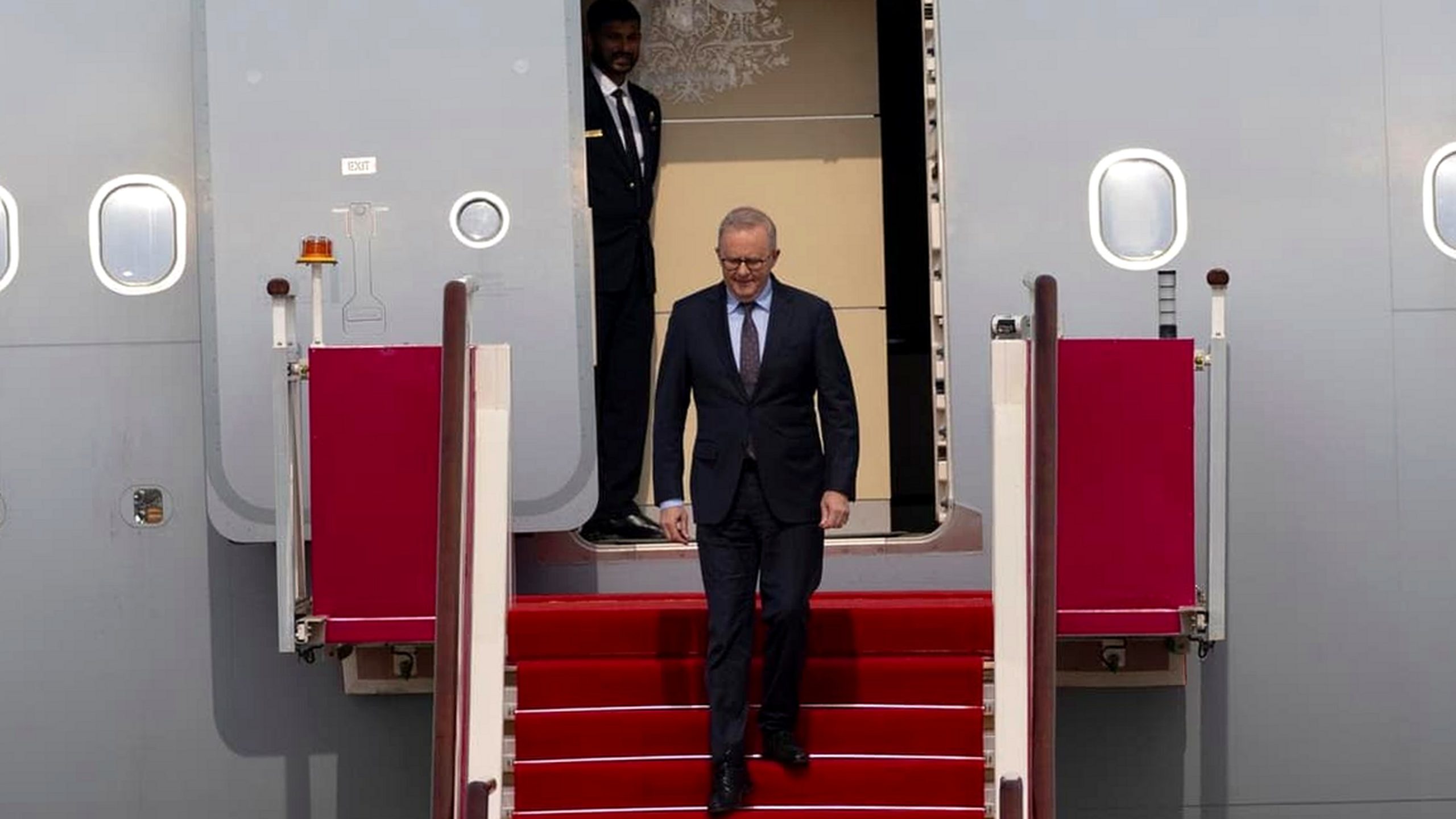
Prime Minister Anthony Albanese has landed in China for the annual APEC summit and a much-anticipated one-on-one meeting with Chinese President Xi Jinping, determined that a gathering of the world’s three most powerful men will not steal the show from Australia’s middle-power diplomacy.
Mr Albanese touched down in the southern Chinese city of Shenzhen on Wednesday, just days after agreeing to deepen co-operation with United States President Donald Trump and other Quad leaders in Manila.
His meeting with Mr Xi is likely to be overshadowed by a highly anticipated three-way conference between the Chinese president, Mr Trump and Russian leader Vladimir Putin on Thursday.
Ukrainian President Volodymyr Zelenskiy had previously compared the trilateral to the moment the great powers met to carve up Europe at the end of World War II.
Beijing has provided economic lifelines to Russia throughout its war with Ukraine, but Mr Albanese was determined that middle-power diplomacy could shine through the titanic talks as he also gears up for meetings with Asia-Pacific leaders.
“There is a role for middle power diplomacy, and we’ll see that at APEC,” he told reporters in Shenzhen, forecasting engagements with Canada, Mexico, Korea, Japan and Chile.
“It is important that the world engages – has a big interest in doing so.”
He stressed Canberra could not shy away from dialogue with its largest trading partner, but re-underlined Australia’s opposition to Moscow’s actions in Ukraine.
“This is a big power intervening in an illegal way to try to assert its will and underestimating the will and courage and conviction of the Ukrainian people,” he said.
“At the time when there are more conflicts today than at any time since the Second World War, we want to see more dialogue, less military conflict.”
Mr Albanese received a lavish ceremonial welcome on arrival in Shenzhen, complete with perfectly synchronised rows of dancers bearing pom-poms, and was greeted on the tarmac by a smattering of dignitaries.
But his first stop after touching down was a supermarket, where he was delighted by the sight of Australian apples, rock lobsters and beef on the shelves.
He inspected shelves of Aussie favourites like Weet-Bix, known in China as Nutri-Brex, and exchanged pleasantries on both countries’ peak cherry-eating season with the store’s manager Ivan Wu.
The prime minister also offered a piece of beef to his stony-faced Chinese minder, who politely declined.
China imposed beef import quotas at the beginning of the year, and before then subjected billions of dollars worth of Australian goods to trade bans following the COVID pandemic, but those have since eased.
“It’s good that Australian beef is back on the shelves, and the fact that they have hit that quota,” the prime minister said.
“Of course, we’d rather not have any quotas on Australian goods anywhere in the world, but the fact they’ve hit it is a signal that Chinese consumers want to buy Australian beef.”
The full range of issues surrounding increasing Australian trade would be raised in the coming days, Mr Albanese said, eyeing the teeming 18 million-strong city of Shenzhen and its booming consumer market.
“This relatively small area that you’d fit – almost inside the ACT – but certainly inside an Australian state, 80 million people. This is a very big market for Australia,” he said.
The Chinese metropolis is a global financial and tech hub which has sprung from the rice paddies over the past three decades.
The prime minister reminisced about his first visit to Shenzhen in 1998, saying it looked nothing like it did now.
His talks with the Chinese leader may also cover Labor’s efforts to terminate Chinese company Landbridge’s lease of the Port of Darwin, which Mr Albanese said were ongoing.
“It should never have been sold … we are continuing to pursue, we’ve made our position very clear that we want to buy the asset,” he told reporters.
“There are discussions taking place, but Landbridge is not ruling out taking action in terms of international tribunals as well.”
Mr Albanese will also sit down with China’s Premier Li Qiang for their annual leaders’ meeting during the visit.
