


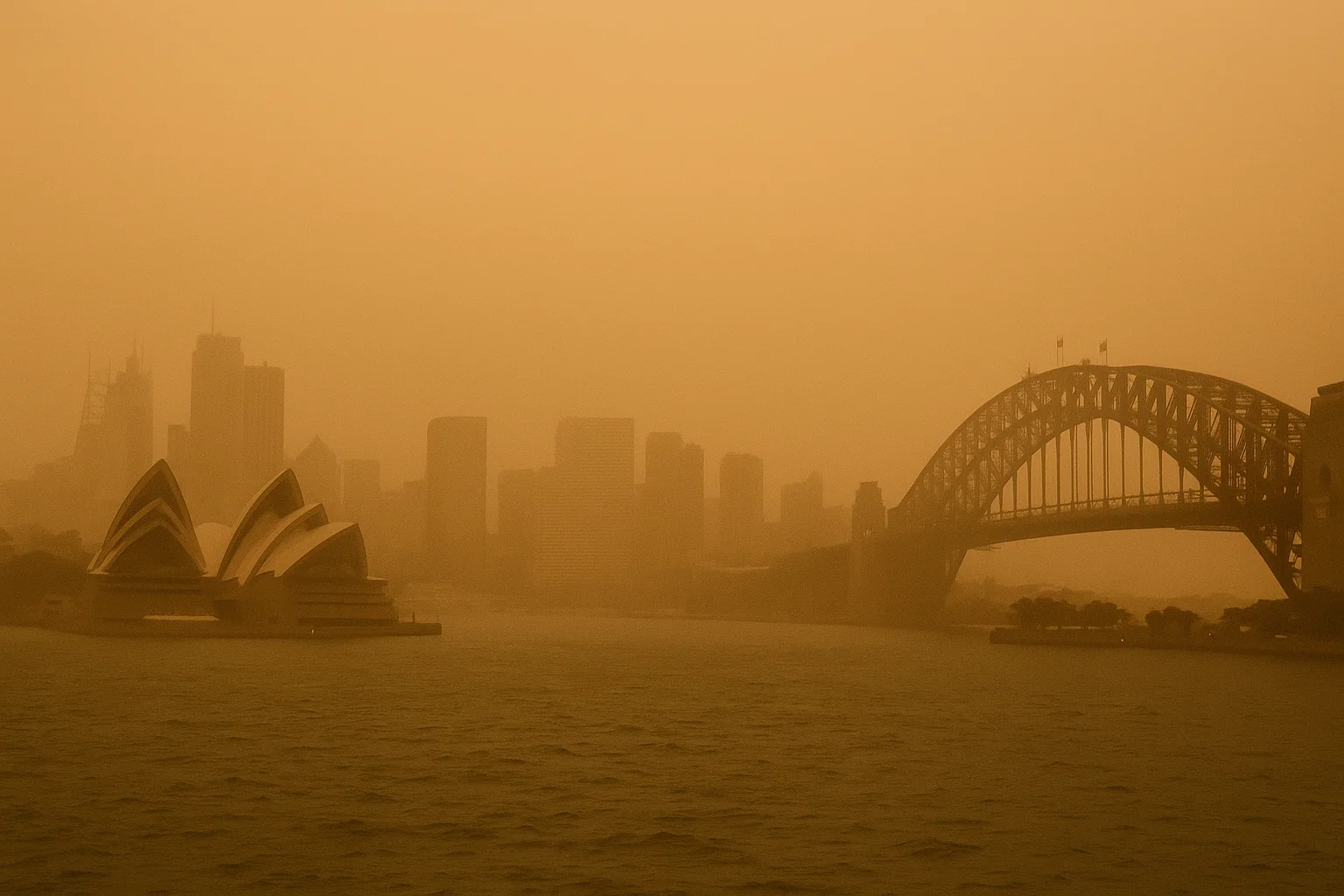
In areas such as Camden, visibility dropped below 300 metres, and the air quality deteriorated to hazardous levels, posing health risks after just a few hours of exposure.
The widespread dust storm originated in South Australia and swept across Victoria before impacting southeastern and central NSW. Sydney’s harbour area was heavily affected, with the iconic view significantly obscured.
Cause of the Dust Haze
Jiwon Park from the Bureau of Meteorology explained that the haze was caused by “extended dry weather combined with strong, gusty winds ahead of a powerful cold front.”
He noted that “dust haze often has a substantial impact on both the public and transportation systems.”
Western Sydney suburbs were also enveloped in the thick haze.
By midday Tuesday, visibility had improved, but air quality remained poor.
At 10am, Wollongong recorded an air quality index (AQI) of 926, classified as “hazardous”—the highest rating on the scale. By midday, it improved slightly to the “unhealthy” category.
Early Tuesday, air quality was better in Sydney’s eastern and inner-west suburbs. However, by 11am, Randwick recorded a “hazardous” AQI of 354.
In Western Sydney, Parramatta had an AQI of 109, classified as “unhealthy for sensitive groups.” Penrith, Prospect, and Rouse Hill saw “hazardous” levels ranging from 397 to 472 in the morning, although conditions gradually improved. Macquarie Park remained at “hazardous” levels by the afternoon.
According to NSW Health, elevated levels of PM10—particles smaller than 10 micrometres—can irritate the eyes, nose, and throat after short-term exposure. These tiny particles are capable of reaching deep into the lungs.
Short-term exposure to dust may worsen existing health issues, especially for individuals with asthma, lung conditions, or heart disease.
When Will the Dust Clear?
Mr Park added that dust particles can interfere with aviation by being ingested into jet engines, potentially causing mechanical issues. This could lead to delayed or canceled flights, although Sydney Airport reported that operations were continuing normally.
He said stronger westerly winds expected throughout Tuesday should help clear the dust from the air.
“We’re hopeful conditions will improve soon,” he said.
