


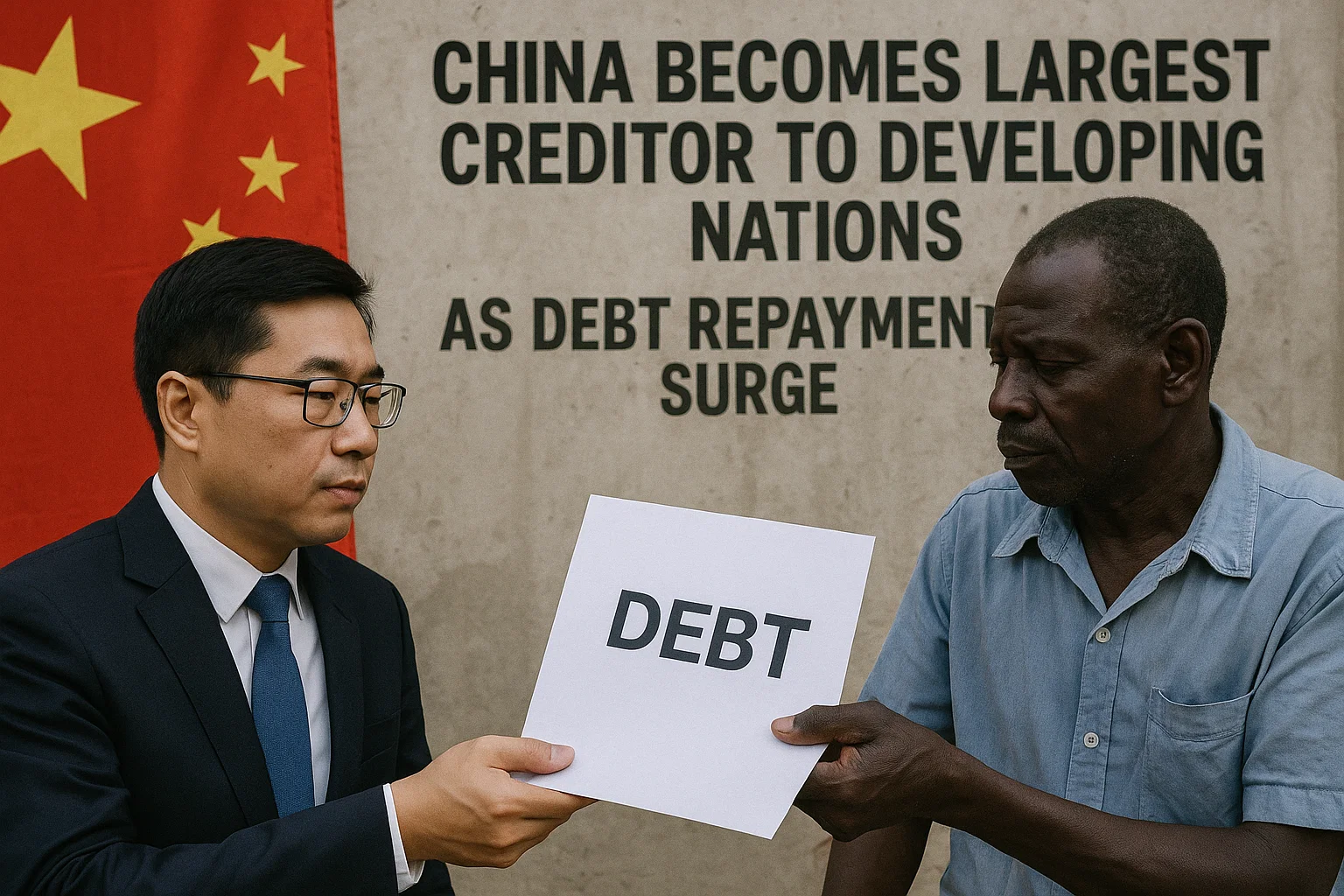
New research reveals that China has become the largest creditor to developing countries, which are expected to repay over $54 billion to Beijing this year.
According to a new analysis from Australian foreign policy think tank the Lowy Institute — based on World Bank data — some of the world’s poorest nations are now facing unprecedented debt repayment pressures.
Over the past decade, China significantly ramped up investments in infrastructure across the developing world through its Belt and Road Initiative (BRI), financing railways, ports, and roads throughout Latin America, Africa, Central Asia, and Southeast Asia. While many of these projects were initially welcomed, they’ve now left governments burdened by mounting debt.
Although China has scaled back its lending in recent years, Riley Duke of the Lowy Institute says repayment obligations from the lending boom are now coming due.
“China’s earlier lending boom, combined with the structure of its loans, made a surge in debt servicing costs inevitable,” Mr Duke explained.
He noted that as the BRI lending peak occurred in the mid-2010s, grace periods on loans began expiring in the early 2020s, triggering a wave of repayments.
“This period was always going to be a crunch time for repayments to China,” he added.
COVID Deferrals Amplify Current Strain
China’s decision to defer loan repayments during the COVID-19 pandemic was described as helpful in the short term, but it has added to the current spike in repayment pressure.
While China does not routinely disclose details of its lending, making the full picture unclear, Mr Duke said it’s evident that many developing countries — particularly in the Pacific — are now under significant strain.
“From now through the rest of the decade, China will play more the role of debt collector than lender to the developing world,” he said.
The burden of debt, he added, could hinder poverty reduction, stall development progress, and increase economic and political instability.
Pacific Island Nations Under Pressure
Countries such as Tonga, Samoa, and Vanuatu are among those heavily indebted to China, and have sought loan extensions.
Tonga, for example, took out substantial loans from China following the 2006 riots in Nukuʻalofa. The country has since begun repaying approximately $190 million — a figure equal to about a quarter of its GDP. But these repayments, alongside the costs of natural disasters, have strained Tonga’s finances and sparked political tension.
Australia has stepped in to assist, including providing an $85 million budget support package to help Tonga stay afloat.
Diplomatic Dilemma for China
The report suggests that while China has sometimes agreed to defer payments, it rarely forgives debts. This creates a diplomatic tightrope: pressuring countries too hard could damage China’s foreign relations, yet Chinese lenders — especially quasi-commercial ones — are under pressure to recover funds.
“Beijing faces a dilemma: pushing too hard for repayment could harm its diplomatic relationships, but not recovering debts strains its financial institutions,” Mr Duke said.
The report concludes that China’s current approach increasingly resembles the “extend and pretend” tactics of Western lenders during the 1980s, which led to a prolonged debt crisis in the developing world — one that only eased after widespread loan restructurings and write-offs in the 1990s.
