


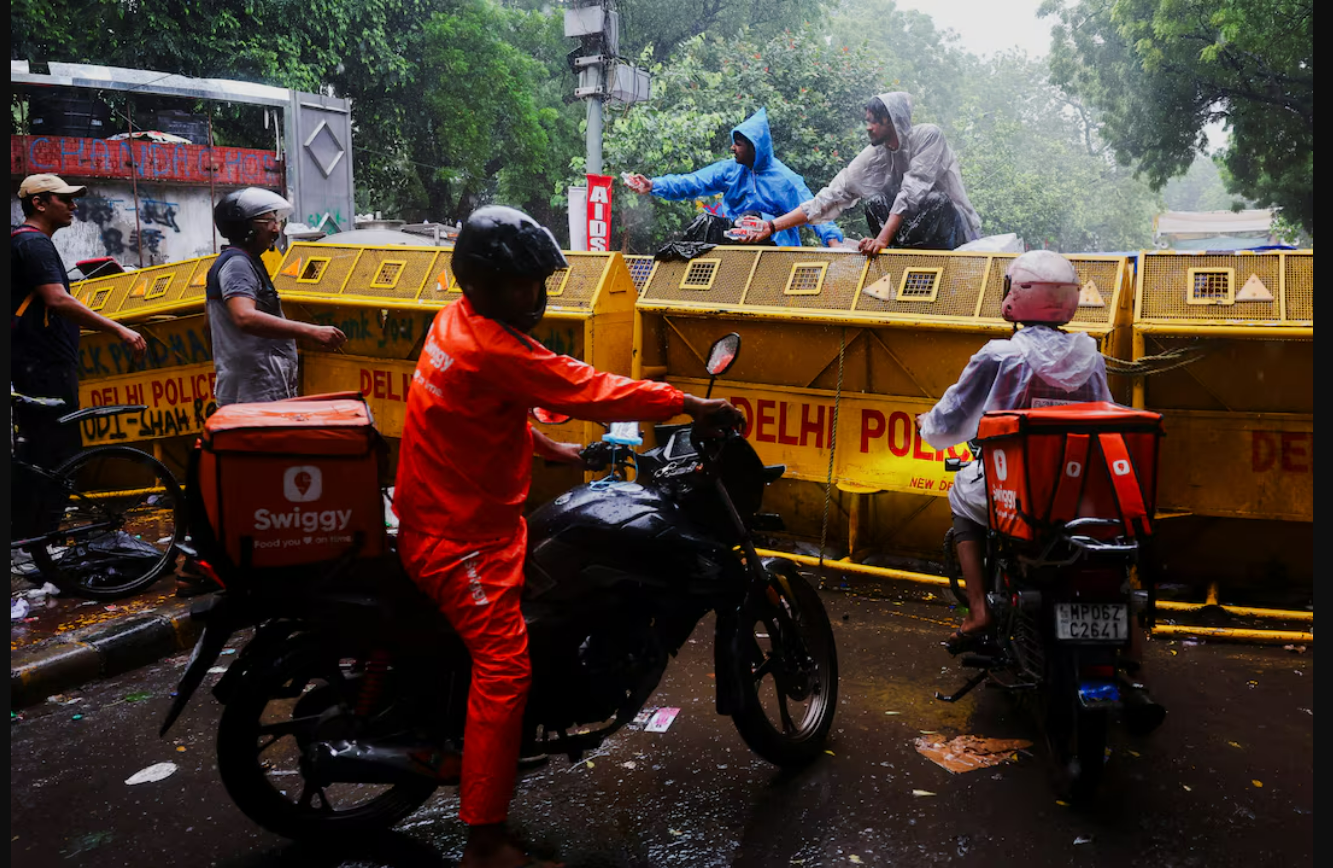
A continuous flow of donated meals, bottled water, medical assistance and volunteer support is helping keep India’s youth-led protest movement active in central New Delhi, despite police action, monsoon rain and growing pressure from authorities.
Food delivery riders have become a familiar presence near the protest site at Jantar Mantar, arriving throughout the day with packets of meals, fruit, biscuits, snacks and drinking water ordered by supporters who cannot attend in person.
The supplies are being sent from across India and from overseas, reflecting the widening reach of the movement and the growing public response to allegations of examination paper leaks and police violence against student demonstrators.
Delivery riders stop near security barricades surrounding the protest area, where volunteers collect the packages and pass them through the crowd to distribution points closer to the main stage.
One rider said food orders had been arriving from locations ranging from the southern Indian state of Kerala to the United States.
The protest is being organised by the Cockroach Janta Party, or CJP, a youth movement that began as online satire in May before expanding into a broader campaign over repeated failures in India’s competitive examination system.
The group is demanding the resignation of Education Minister Dharmendra Pradhan, accusing the government of failing to prevent examination paper leaks and protect the futures of millions of students.
Although CJP supporters have maintained a presence at Jantar Mantar since last month, the movement gained significant momentum after a well-known activist began an indefinite hunger strike in support of the demonstrators.
Attendance increased further following a major confrontation on Monday, when tens of thousands of mainly young protesters attempted to march towards Parliament.
Police blocked the procession and used batons and tear gas after parts of the crowd tried to move through security barricades.
The crackdown left protesters and police officers injured and triggered widespread anger, particularly among students who accused the authorities of responding to legitimate demands with excessive force.
Volunteers at the protest site said many supporters were unable to travel to Delhi but wanted to contribute by purchasing food, water and other essential supplies for those remaining at the demonstration.
Raj Rathore, a 25-year-old volunteer, said public anger intensified after images of police striking students circulated widely.
He said people who could not physically join the protest were supporting it by sending fruit, biscuits, meals and water.
These contributions have helped maintain the protest throughout the day and night.
Students have created an organised volunteer network to manage food distribution, crowd movement, waste collection, first aid and other practical needs.
Delhi University student Rina Rawat said the demonstration was surviving because of public generosity and unity among the participants.
The 20-year-old volunteer said she had been struck on the leg by a police baton during Monday’s confrontation but returned the following day because she felt responsible for supporting the movement.
By Wednesday afternoon, the number of protesters at Jantar Mantar had reportedly grown to around 5,000 despite intermittent monsoon showers.
Many of those present were Generation Z students carrying placards, waving flags, playing patriotic Bollywood music and chanting slogans against the government.
Some protesters openly criticised Prime Minister Narendra Modi, an unusual display of public opposition to a leader who has dominated Indian national politics since 2014.
One participant said he had supported Modi until recently but changed his view after witnessing the police response to the student march.
The demonstrations have become one of the most visible expressions of youth dissatisfaction faced by the Modi government.
India’s population is heavily concentrated among younger age groups, with people under 30 estimated to make up more than half of the country’s roughly 1.42 billion residents.
Many young Indians argue that years of strong economic expansion have failed to create enough stable employment opportunities.
The examination controversy has therefore become connected to wider concerns about unemployment, education costs, recruitment delays and limited career prospects.
Prime Minister Modi has not directly addressed the protest movement in detail.
However, a government minister said Modi had assured members of the ruling coalition that strong measures were being taken to protect students’ interests.
Education Minister Pradhan has promised reforms, accountability and answers regarding the examination system.
Protesters say those commitments remain insufficient and insist that political responsibility must accompany administrative reform.
Alongside food distribution, volunteers have developed a range of services to sustain the encampment.
Some participants clear rainwater and puddles after monsoon showers, while others collect rubbish, organise queues and use handheld fans to help people cope with the heat and humidity.
A medical station staffed by volunteer doctors and medical students has been operating at the protest site for approximately a month.
Volunteers said demand for treatment increased sharply following the police confrontation.
The medical team has been providing first aid, basic medicines and assistance to people suffering from dizziness, nausea, fatigue and minor injuries.
A 23-year-old medical volunteer said many doctors and students supporting the protest had personally experienced the emotional pressure caused by examination leaks.
She said uncertainty surrounding compromised tests can create severe anxiety for candidates who have spent years preparing for highly competitive careers.
The protest site has also developed a strong symbolic and cultural identity.
Some demonstrators carry images of Indian revolutionary Bhagat Singh, while others hold copies of the Constitution or distribute roses as symbols of peaceful resistance.
Several participants have adopted humorous imagery linked to the movement’s satirical origins.
Some have worn Spider-Man masks, while others have used playful language to describe themselves as rebellious youth challenging an unfair system.
Despite the mixture of humour, music and popular culture, protesters say their central demands are serious.
They want a transparent investigation into examination leaks, stronger protections for candidates, accountability for administrative failures and an end to what they describe as the politicisation of education.
The demonstration has also brought together young people from different religious, regional and social backgrounds.
One 19-year-old protester said the movement had no place for Hindu-Muslim division and that participants were united by a shared demand for fairness.
She said students were no longer willing to remain silent or be intimidated by police action.
The combination of public donations, volunteer medical services and growing participation has allowed the movement to continue despite attempts to restrict it.
The protest has become more than a gathering at Jantar Mantar.
It now represents a wider network of supporters contributing remotely, whether through food orders, financial assistance, medical work or online mobilisation.
As the demonstrations continue, the government faces increasing pressure to address not only the examination controversy but also broader anger among young Indians over employment, opportunity and political accountability.
