


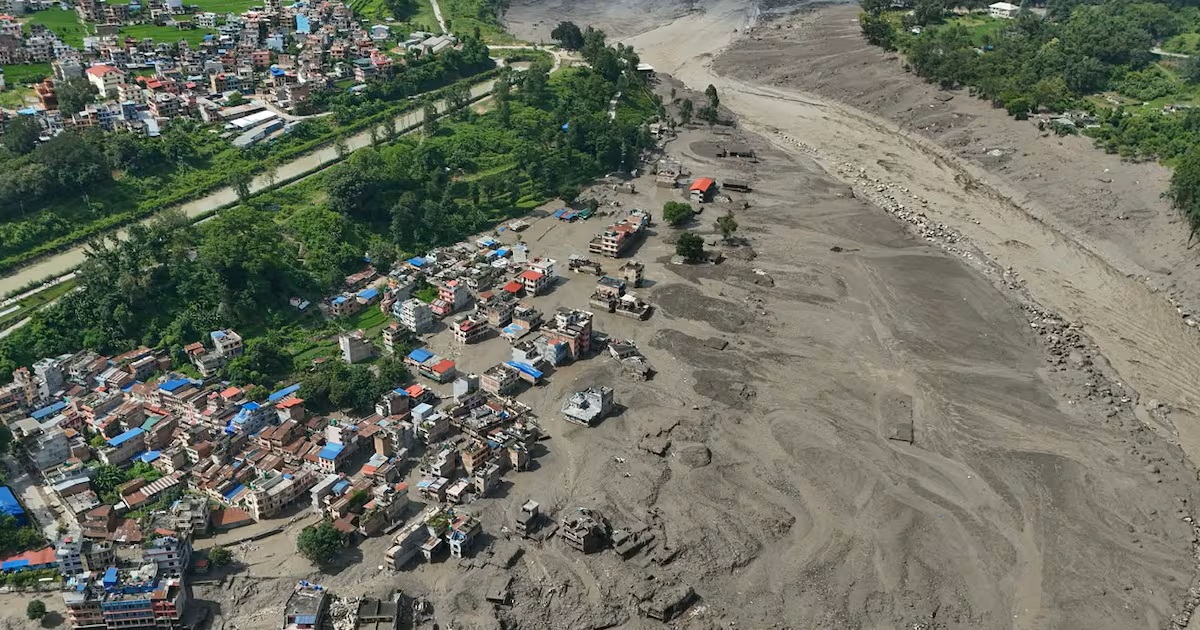
An ice avalanche followed by the formation and sudden collapse of a debris-filled lake may have triggered the devastating flash flood that struck Nepal’s Bhotekoshi River in Rasuwa district, according to preliminary assessments by disaster authorities.
Officials from Nepal’s Department of Hydrology and Meteorology said satellite images received from Chinese authorities indicate that a massive blockage occurred around 20 kilometres upstream from the Miteri Bridge near the Nepal-China border.
The blockage reportedly formed after an ice avalanche and landslide created a temporary debris lake. When the natural barrier collapsed, a huge volume of water mixed with rocks, soil and other debris rushed downstream, creating a powerful flood wave that destroyed communities and infrastructure along the river.
Binod Parajuli, chief of Nepal’s Flood Forecasting Division, said satellite images before and after the disaster showed signs of an icefall, landslide and temporary river blockage.
“An ice and debris lake formed and then burst, creating a natural dam before releasing the water downstream,” Parajuli said.
He explained that the large amount of debris carried by the flood significantly increased its destructive power.
“If it had been only water, the damage would not have been this severe. The mixture of water and debris increased the force and depth of the flood,” he said.
Possible glacier-related disaster
Experts believe the flood may have been linked to a glacier-related event, although investigations are still underway to confirm whether a glacial lake outburst also occurred.
Climate researcher and Kathmandu University professor Rijan Bhakta Kayastha said available evidence suggests an ice avalanche may have fallen into the Lhende River, blocking its flow and allowing water to accumulate before being released suddenly.
“There is information that an ice avalanche from the Nepal side blocked the Lhende River,” Kayastha said.
He also noted that an earthquake occurred in the Tibetan region around the same time, raising questions about whether seismic activity may have contributed to the event.
According to the United States Geological Survey, a magnitude 4.4 earthquake struck Tibetan territory at around 8:37am, approximately 47 kilometres north of Gosainkunda.
However, experts said more analysis is required to determine whether the earthquake played any role in triggering the avalanche or whether a glacial lake collapse occurred.
Previous flood linked to glacier lake collapse
The region has experienced similar disasters in the past.
A sudden flood hit the same Bhotekoshi River system on July 8, 2025, when Nepal’s Department of Hydrology and Meteorology concluded that a glacial lake outburst had triggered flooding in the Lhende River near the Nepal-China border.
Satellite analysis at the time indicated that a glacial lake had burst, sending a powerful surge of water downstream.
The latest disaster has renewed concerns about the increasing risks faced by Himalayan communities due to unstable glaciers, melting ice and extreme weather events.
Investigation continues as rescue operations remain priority
The National Disaster Risk Reduction and Management Authority (NDRRMA) said it had also received early information suggesting that an ice avalanche blocked the river.
The information was shared through the International Centre for Integrated Mountain Development (ICIMOD), which obtained details from sources in China.
Shanti Mahat, spokesperson for NDRRMA, said the information remains a preliminary assessment and that authorities are currently prioritising rescue and relief operations.
“The exact cause will become clearer after further investigation,” Mahat said.
Officials confirmed that there was no significant rainfall in the Rasuwa area before the disaster, strengthening the possibility that the flood was caused by a sudden geological event rather than normal monsoon rainfall.
The disaster has highlighted the vulnerability of Himalayan regions to sudden glacier-related hazards and the urgent need for stronger monitoring systems, satellite-based warning mechanisms and cross-border cooperation between Nepal and China.
