


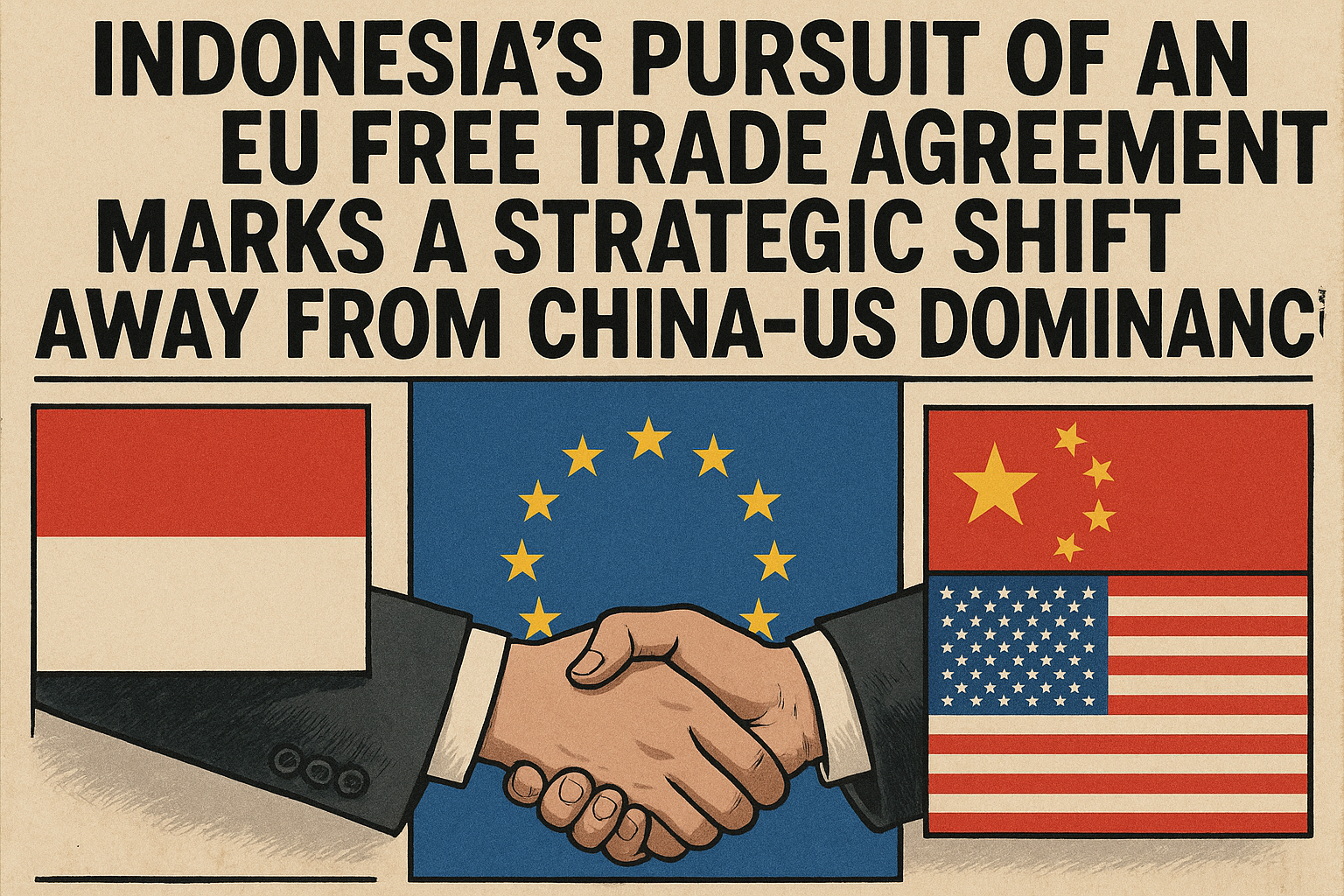
Indonesia’s EU Trade Deal Signals Strategic Shift from China and US Dependency
Indonesia’s renewed efforts to finalize its long-delayed free trade agreement with the European Union—formally known as the Indonesia-EU Comprehensive Economic Partnership Agreement (CEPA)—reflect a notable pivot in its trade strategy. As Southeast Asia’s largest economy, Indonesia is working to reduce its heavy reliance on traditional trade giants China and the United States.
Negotiations for CEPA have stretched over a decade, but momentum has picked up recently, especially following President Prabowo Subianto’s visit to Brussels on July 13. Officials now suggest the agreement could be concluded by September.
Facing a 19 percent US import tariff and declining commodity exports due to China’s economic slowdown, Indonesia sees CEPA as a vital economic opportunity. “This deal could be a lifeline for domestic industries,” noted Andry Satrio Nugroho, head of Indef’s Center of Industry, Trade and Investment.
Broadening Trade Horizons
With global trade dynamics shifting due to escalating geopolitical tensions and tariffs, many nations are rethinking their international partnerships. Rory O’Donnell of Penta Group highlighted the growing trend among ASEAN countries to diversify trade, especially since the US reinstated sweeping tariffs.
O’Donnell added that tariff threats have prompted countries to restructure supply chains as a safeguard. CEPA is expected to significantly boost trade: the EU estimates an €8 billion increase in bilateral trade, while Jakarta predicts a 50% jump in exports to Europe.
Indonesia’s Coordinating Minister for Economic Affairs, Airlangga Hartarto, emphasized that the agreement would eliminate tariffs on nearly 80% of Indonesian exports to the EU and remove many non-tariff barriers. Over time, CEPA could unlock up to US$60 billion in economic value and connect businesses across a combined population of 700 million.
For Indonesia, the agreement holds deeper significance beyond trade figures. It offers hope for labor-heavy sectors like footwear manufacturing, currently threatened by layoffs and US tariffs. Yoseph Billie Dosiwoda of the Indonesian Footwear Association believes the deal could generate millions of new jobs. The EU is already a key market, importing US$1.7 million in Indonesian footwear last year.
Moving Beyond Traditional Partners
Analysts interpret the agreement as a strategic effort to reduce economic dependence on China and the US. O’Donnell remarked that Indonesia is seeking more resilient trade relationships amid growing uncertainty with Washington. Similarly, China’s economic stagnation has exposed the risks of overconcentration in a single market.
Diversification has become urgent for Indonesia’s downstream commodities, such as ferro-nickel, which now need alternative buyers beyond China. Some European nations—including Italy, Belgium, and the Netherlands—have begun importing these products.
Securing CEPA is also a matter of regional competitiveness. With Singapore and Vietnam already enjoying EU trade agreements, Indonesia risks falling behind. “It’s essential for Indonesia to finalize its own deal to stay competitive,” said Nugroho.
A Welcome Prospect for Europe
European business leaders are optimistic. Chris Humphrey of the EU-ASEAN Business Council said EU companies have long viewed Indonesia as a key strategic market. He noted, “There’s growing optimism, although the final details are still awaited.”
CEPA is expected to benefit sectors like palm oil, coffee, cocoa, footwear, and textiles—industries where Indonesia is strong but faces EU trade barriers. It could also open doors for automotive, green technology, and critical raw materials.
The Indonesian government hopes the agreement will promote value-added exports, especially in sectors like nickel, copper, and palm oil, which are still largely exported in raw form. In turn, EU exporters would gain better access to Indonesia’s growing market for dairy, meat, and processed foods.
In 2023, total trade between the EU and Indonesia reached US$30.1 billion, with the EU exporting €9.7 billion to Indonesia and importing €17.5 billion.
Humphrey added that if Indonesia addresses concerns like local content rules and non-automatic import licenses, CEPA could attract more European investment and enhance Indonesia’s role in global supply chains, particularly those focused on sustainability.
Challenges Ahead
Despite the optimism, experts caution that full implementation may take time. Even after signing, the agreement must be ratified by both EU and Indonesian legislative bodies, a process that could extend to 2027.
Non-tariff barriers, especially EU sustainability standards, pose another challenge. Indonesia has faced EU resistance over deforestation-linked products, such as palm oil. The new EU Deforestation Regulation—requiring proof of sustainable sourcing—was delayed amid European parliamentary debate.
“Many Indonesian exports still don’t meet EU certification standards,” Nugroho said, stressing the need for government support to help SMEs and producers meet these requirements.
