


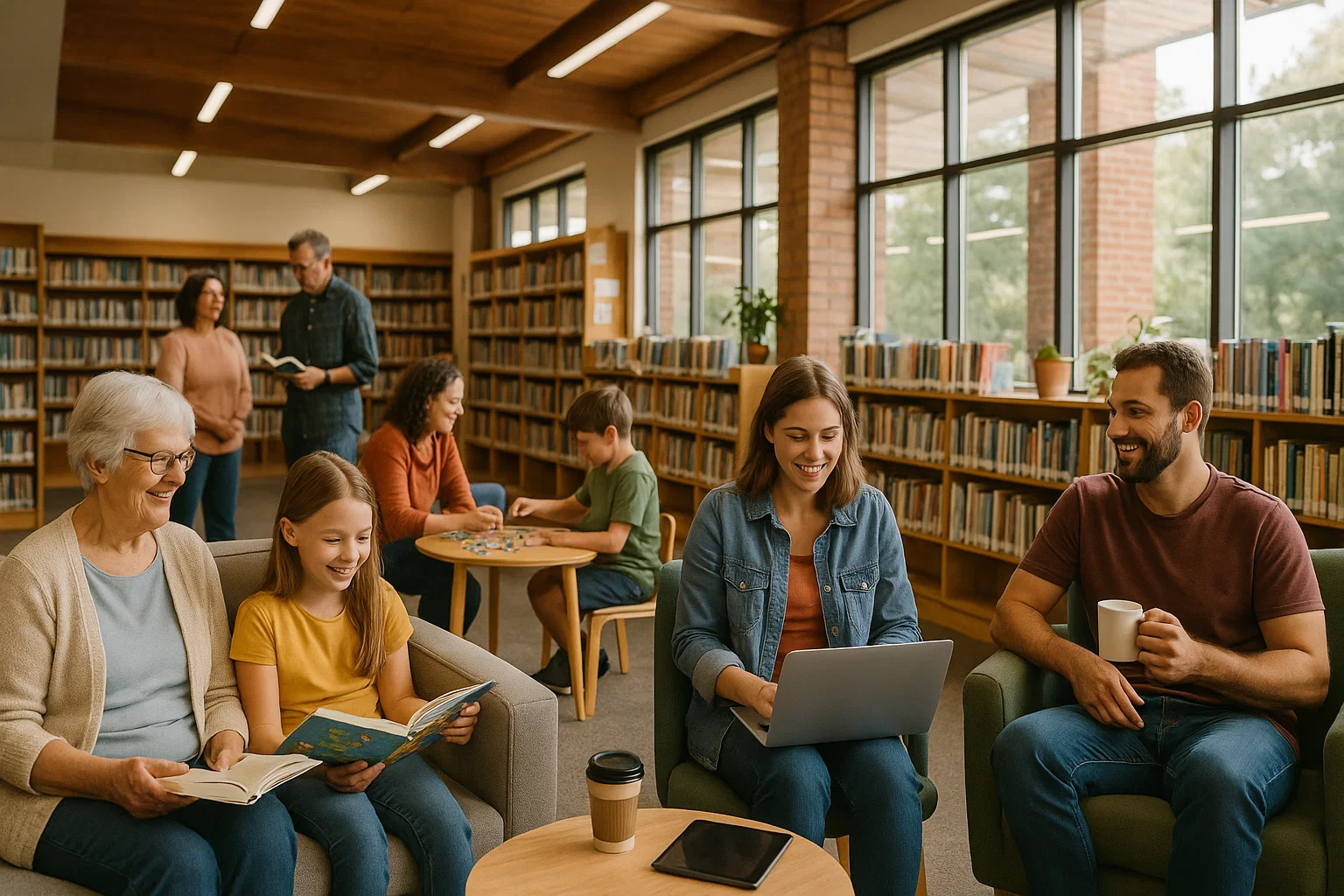
Rural Libraries Evolve as Vital Community Hubs and ‘Living Rooms’
From modest sheds in remote towns to high-tech facilities in growing suburbs, public libraries across Australia are transforming into vital “third spaces” — places that act as community living rooms for those who need them most.
Australia is home to over 1,400 public library branches, in addition to mobile libraries, school libraries, and street libraries. These spaces offer far more than books — they provide free access to internet, run craft groups, host citizen science projects, and even offer therapy dog visits and seed-sharing programs. Especially in regional and remote communities, libraries have become indispensable.
Julatten’s One-Room Library Keeps the Community Together
In the rural town of Julatten in Far North Queensland, a single-room community-run library has been a cornerstone since 1952, when locals Edna and Bill Head rallied support to build it. Packed with books, games, and local history, the library still stands as a symbol of community resilience and connection.
“Julatten is quite spread out — most properties sit on five-acre blocks,” says Lindsay Fisher, the library’s vice-president. “Back in the 1950s, the town was isolated, and books were a lifeline, especially for women.”
Today, Julatten’s library remains accessible 24/7 via a keypad entry for members. For just $7 a year, members gain access, while the local council provides an annual $1,500 grant to help replenish the collection.
But as committee president Bianca Velder explains, the library’s value goes beyond books. “It’s the glue — or glitter — of the community. Books start conversations, build connections, and offer a sense of belonging.”
Libraries as Inclusive, Safe, and Social Spaces
Griffith University researcher Dr Amber Marshall describes libraries in rural towns as essential hubs for social inclusion. In towns with little more than a pub or a post office, the library often stands as the only neutral, inclusive space.
“The library is for everyone — no matter your background, interests, or age,” Dr Marshall says.
She and colleagues from Charles Sturt University are preparing for a long-term study on rural libraries and their social impact.
In Shellharbour, NSW, children’s librarian Kellie John says the demand for free, family-friendly services has surged due to rising living costs. Toddler story time sessions are booked out, and intergenerational programs like Be Connected pair elderly visitors with young children to combat loneliness and build social bonds.
“With my background in social work, I know the importance of connection,” John says. “Sometimes, we’re the only human interaction someone has in a day.”
Shellharbour libraries also run life-skills sessions for foster children and at-risk youth, and proudly feature a beloved therapy dog, Ollie, who attends events and story time sessions.
Upskilling, Digital Inclusion, and Local History
As public needs evolve, so do librarians’ roles. In remote regions, libraries are increasingly taking on the responsibility of digital upskilling.
Jacinta Ward, who manages nine library branches across Queensland’s Western Downs — an area roughly the size of Switzerland — emphasizes how vital libraries are for digital access. “In some places, the library is the only source of internet,” she says.
Libraries also help preserve local history through projects like the Picture Western Downs archive, which invites community members to identify people and places in old photographs.
Ward’s team also runs the Words Out West festival, bringing authors and readers together for a week of workshops, panels, and school visits. In 2024, the festival drew over 2,500 students — some from schools with just a few students.
“We get buses from tiny schools that might only have five kids,” Ward says. “Those kids wouldn’t otherwise get access to something like this.”
Funding Challenges in a Growing Sector
Despite increased usage post-COVID, funding for public libraries hasn’t kept pace. Adjusted for inflation, per-capita funding has declined, according to the Australian Library and Information Association (ALIA).
Dr Marshall points out that measuring a library’s value by foot traffic alone misses the broader social impact, especially in smaller communities.
“Even if a librarian travels hundreds of kilometres to reach five people — for those five, it can be life-changing,” she says.
Funding models based on population size often disadvantage rural libraries, making it more difficult to justify travel costs and attract presenters for workshops or festivals.
But passion and resourcefulness keep these programs alive. “We just make it work,” Ward says.
The Future of Libraries: More Than Just Books
Back in Julatten, Velder dreams of turning the small library into a modern learning and co-working hub. But for now, she’s focused on expanding membership and continuing to serve as a safe, welcoming community space.
“Libraries aren’t relics — they’re evolving,” she says. “There’s still nothing like holding a book with a cup of tea. But they’re also so much more than that — they’re at the heart of our communities.”
