


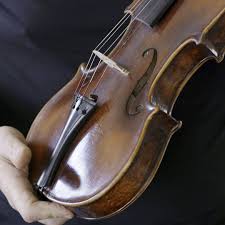
Hidden Note in Violin Reveals Holocaust Survivor’s Message from Dachau
During World War II, inside the confines of the Dachau concentration camp, a Jewish prisoner secretly crafted a violin and tucked a handwritten note inside—a silent message to the future that would remain hidden for more than 80 years.
The faded note read:
“Trial instrument, made under difficult conditions with no tools and materials. Dachau. Anno 1941, Franciszek Kempa.”
The violin, created in 1941 by Franciszek “Franz” Kempa while imprisoned at the Nazi camp in southern Germany, remained unidentified for decades. Its origins only emerged when art dealers in Hungary, who had acquired it as part of a furniture purchase, sent the violin for restoration.
The restorer, while recognizing the refined craftsmanship, was puzzled by the inferior materials and crude tools used. These inconsistencies hinted at a story beyond what met the eye.
“You could see from its structure that the maker was a skilled luthier,” said Szandra Katona, one of the Hungarian art dealers. “But the wood was unlike anything a professional would choose.”
Driven by curiosity, the restorer took the instrument apart—revealing Kempa’s hidden note. It offered insight into the conditions under which the violin was made: a master artisan doing his best amid extreme hardship.
Dachau, established in March 1933 near Munich, was the first Nazi concentration camp. Initially used for political prisoners, it later imprisoned Jews, Roma, clergy, LGBTQ individuals, and others persecuted by the regime. It became infamous for forced labor, inhumane treatment, and mass deaths. The camp was liberated by American forces on April 29, 1945, with at least 40,000 lives lost there.
Although music existed in many Nazi camps—often encouraged by authorities for propaganda—surviving instruments from Dachau were thought to have been brought in by inmates. Kempa’s violin is the only known instrument built within the camp itself.
How the violin traveled from Dachau to Hungary remains a mystery. However, documentation from the Dachau memorial museum confirms that Kempa survived the Holocaust, returned to Poland, and resumed instrument making until his death in 1953. The records also indicate the Nazis were aware of his skills, which may have contributed to his survival.
Tamás Tálosi, one of the Hungarian dealers, explained why the instrument is now called the “violin of hope.”
“We chose that name because when someone faces immense hardship, having a purpose or challenge can carry them through,” he said. “Focusing on the task rather than the suffering may have helped this man survive.”
