


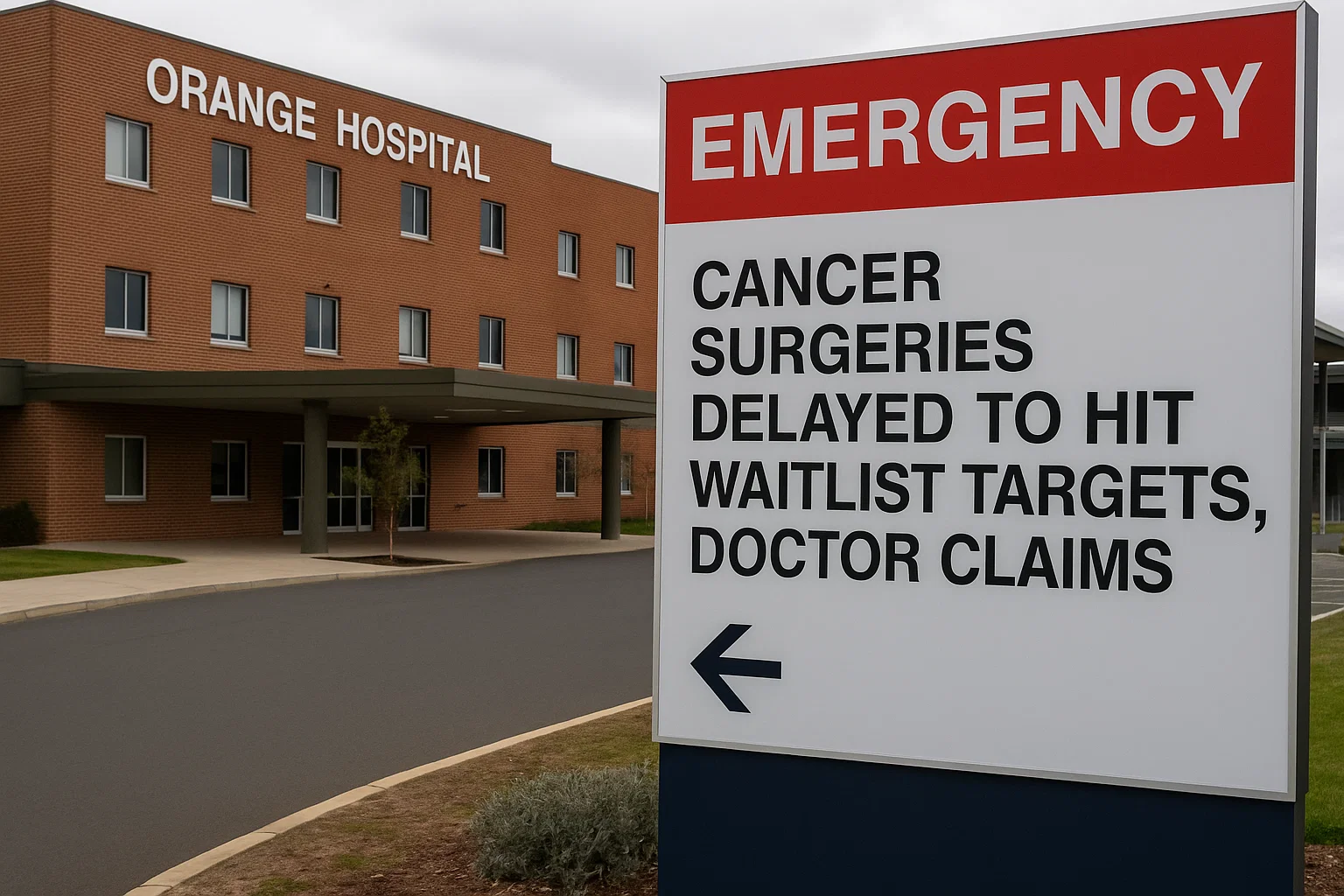
NSW Health has announced a formal review of surgical re-categorisation practices at Orange Hospital, following explosive claims from senior surgeons that cancer patients’ procedures were downgraded without clinical justification.
Health Minister Ryan Park said he had been reassured that the hospital was following proper guidelines but added he would not hesitate to investigate if evidence suggested otherwise.
“If there are issues where that has not been the case, then I’d want them investigated,” Mr Park told 7.30.
The move comes after 7.30 aired allegations from Dr Rob Knox, Director of Surgery at Orange Hospital, and his predecessor, Dr Clair Whelan. They claim that surgeries — including those for cancer patients — were routinely reclassified to lower urgency categories to avoid exceeding official wait time targets.
Surgeries Downgraded Without Doctors’ Consent
Dr Knox said he first became concerned in early 2024 when he discovered that several of his patients, originally marked as Category One — requiring surgery within 30 days — had been reclassified as Category Four, indicating they were “not ready for care.”
“I questioned management and was told, ‘We’re allowed to do this,’” he said.
Dr Knox and other surgeons began documenting the discrepancies and say they’ve since received numerous requests from management to downgrade surgery urgency — sometimes without their approval.
Emails obtained by 7.30 show hospital administrators requesting delays or suspensions of surgeries and asking surgeons to extend clinical wait times, even for cancer patients. In one instance, a request was made to change a patient’s timeline from 30 to 90 days due to limited theatre availability.
“The policy is very clear — urgency classifications should only change if the patient’s medical condition changes, not because of resource constraints,” Dr Knox said.
NSW Health’s policy outlines five strategies to help hospitals avoid surgery delays, including expanding theatre time or referring patients elsewhere. It also states that surgery postponements should occur only after all alternatives have been exhausted.
Patients Left in Limbo
Katrina Reiss, a former Orange Hospital employee and breast cancer patient, described her own anxiety after experiencing delays. Diagnosed in June 2024, she was due for surgery in December but feared she wouldn’t make the 30-day window due to the holiday period.
“I knew the system well and realised something wasn’t right,” she said. “I was lucky — I could advocate for myself. But what about patients who can’t?”
Reiss ultimately received surgery within the recommended timeframe and is now cancer-free. But doctors say the lead-up to Christmas is when the system is most strained, as many people delay medical attention until the end of the year.
Surgeons Under Pressure
Dr Clair Whelan, who served as director of surgery before Dr Knox, said while none of her patients were re-categorised without her approval, she had received requests to do so — particularly for cancer cases — which placed her in an impossible position.
“Sometimes we don’t know which cancer is more urgent until after surgery,” she explained.
Some patients, frustrated with delays, have opted to remove themselves from the public system and seek private care. Dr Whelan noted that hospital administrators may see this as a way to reduce waiting lists — without addressing the underlying issue.
‘Hidden Waitlist’ and Data Discrepancies
Despite official data showing only 37 patients had waited beyond recommended timeframes for surgery at Orange Hospital, Dr Knox said internal records painted a different picture.
“Published waitlist figures suggested there were no overdue patients — but that’s not what we were seeing,” he said.
Dr Knox said access to specialist surgeons is a major bottleneck, with over 70% of patients at Orange Hospital waiting more than a month for an initial consultation — far above the national average of 35–39%.
In addition, many patients are missing out on timely diagnostic procedures, such as colonoscopies, due to backlogs. Surgeons refer to these delays as the “hidden waitlist,” since these patients aren’t officially counted until they’re booked for surgery.
Staffing Shortages and Missed Opportunities
Orange Hospital recently lost its only vascular surgeon, and one of Dr Whelan’s urological colleagues relocated, leaving the region underserved. When Dr Knox requested an additional breast cancer surgeon in August 2024, he was told it would “generate too much demand.”
“We’re not creating cancer — we’re just identifying it,” Dr Knox said. “The real concern is that acknowledging the full extent of need would force the hospital to act — and that’s seen as a liability.”
Health District Responds
The Western NSW Local Health District has denied the claims.
“We reject that surgeons have been asked to reclassify procedures to prioritise targets over patient care,” a spokesperson said.
They acknowledged challenges such as staff shortages and limited theatre space but said these factors did not amount to a “wait time blowout.” They also noted that a business case is underway to assess vascular surgery needs in the region.
