


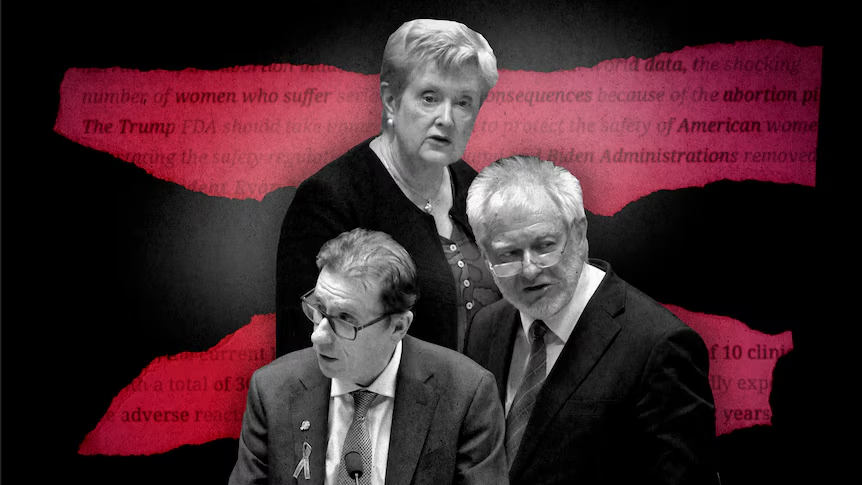
During a recent parliamentary debate on expanding access to abortion in New South Wales, several MPs referenced a controversial US report that critics say misrepresents the risks of medical abortion.
The legislation, which passed both houses, allows nurse practitioners and endorsed midwives to prescribe abortion medication in early-stage pregnancies. During the debate, members from across the political spectrum — including the Liberal, Labor, and independent benches — cited a US paper claiming the abortion pill mifepristone causes more harm than previously believed.
However, Australian experts strongly rejected the paper, labelling it “unscientific,” “misleading,” and “propaganda.”
Report’s Origins and Lack of Scientific Rigor
The document was released by the Ethics and Public Policy Center (EPPC), a conservative US think tank known for opposing progressive agendas. The authors, Jamie Bryan Hall and Ryan T. Anderson, are affiliated with the Heritage Foundation, which backs initiatives like Project 2025 — widely seen as a policy roadmap for Donald Trump’s potential second term.
The report alleges that 10% of people who use mifepristone suffer serious adverse outcomes, far exceeding the <0.5% figure cited in clinical trials. But experts like University of Sydney gynaecologist Professor Kirsten Black criticised the study’s lack of transparency and peer review, calling it “propaganda” and “misinformation.”
Data Issues and Methodological Flaws
The EPPC insists the data is replicable, but has refused to reveal its source. The authors claim their dataset comprises nearly all US insurance claims from 2017 to early 2024, but haven’t provided the information necessary for others to verify the findings.
Despite these red flags, at least 11 NSW MPs referenced the paper in parliament — including independent MP Dr Joe McGirr and Labor MP Greg Donnelly.
Dr McGirr acknowledged citing the report in the context of discussing various estimates of complication rates. However, he did not confirm whether he examined its methodology. Donnelly and other MPs did not clarify why they chose to highlight the report, despite more robust and peer-reviewed research being available.
Medical Community Pushes Back
Health experts were swift to dispute the paper’s credibility. Professor Danielle Mazza of Monash University dismissed the EPPC report as “scaremongering by anti-abortionists,” and emphasised that serious adverse events from mifepristone in Australia are rare.
Epidemiologist Gideon Meyerowitz-Katz called the report “very inadequate,” noting that its definition of “serious adverse events” included issues like follow-up surgical procedures and ectopic pregnancies — which are not caused by the drug. He argued the report made assumptions of causality without scientific basis.
He also highlighted contradictions between the report and its FAQ page, including confusion over whether miscarriage-related procedures were included, and a lack of clarity around the inclusion of mental health conditions.
“The authors assumed all complications post-abortion were caused by the medication,” Dr Meyerowitz-Katz said. “They don’t provide enough detail to assess their claims. This is not credible science — it’s political messaging dressed up as research.”
A Political Tool in the US — and Possibly in Australia
The timing of the report’s release — just before US Republicans pushed for new restrictions on mifepristone — suggests political motivations. On April 28, the day the report was published, Republican Senator Josh Hawley cited it in a letter urging a renewed FDA review of the drug.
Two weeks later, Health and Human Services Secretary Robert F. Kennedy Jr. confirmed that a review was underway.
While it’s unclear how NSW MPs obtained the report, an adviser to Dr McGirr said it had been shared by a parliamentary colleague.
Dr Meyerowitz-Katz concluded that the document is best described as a white paper from an ideologically driven group, not a legitimate scientific study.
“This isn’t objective evidence. It’s a political strategy by an anti-abortion organisation masquerading as science.”
