
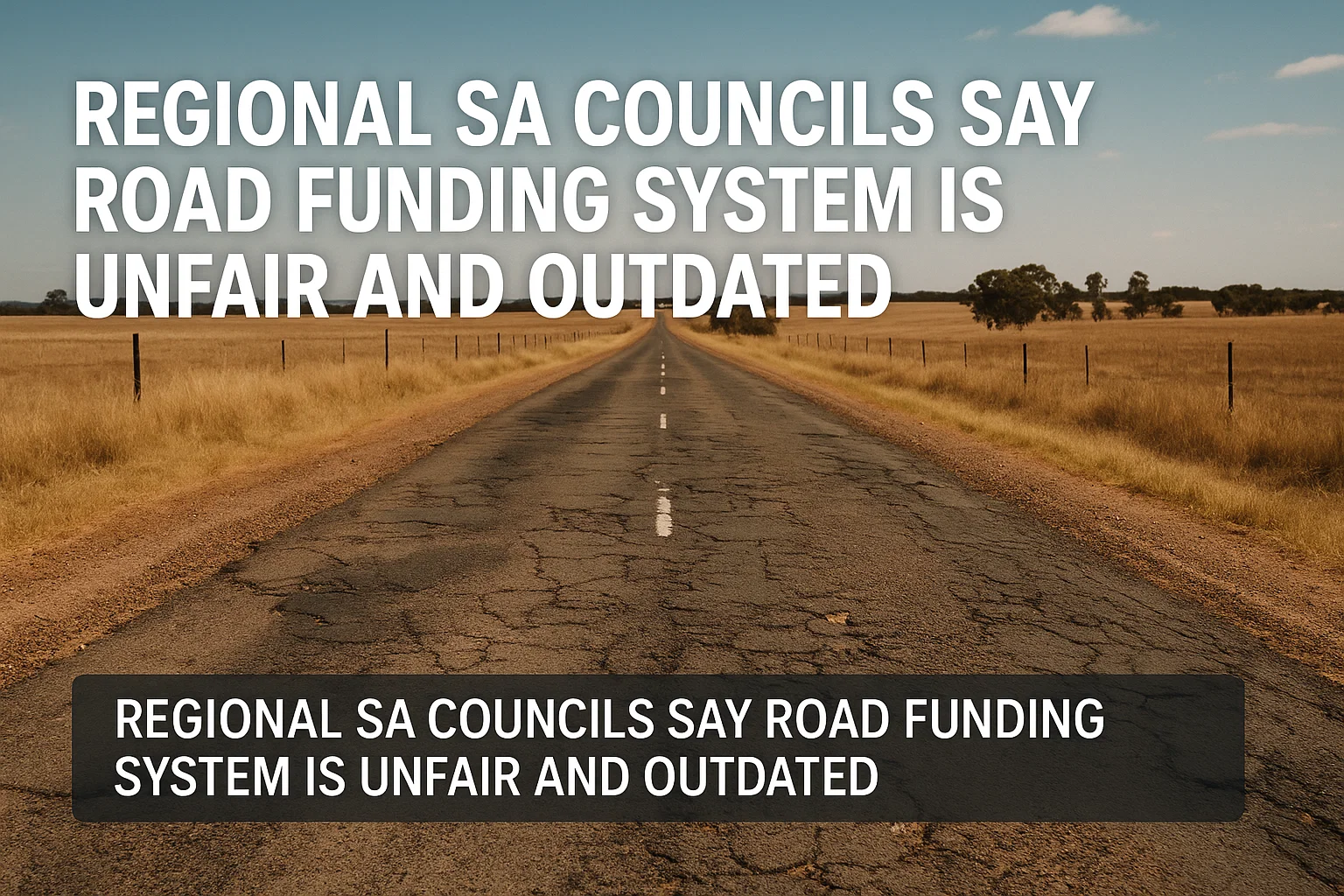
South Australian regional councils are calling for a more equitable system for funding road maintenance and upgrades, arguing the current model disproportionately favours metro areas and leaves smaller councils struggling to cope.
Wakefield Regional Council is responsible for 2,687 kilometres of roads — longer than the distance from Adelaide to Perth — but serves a population of just 6,780, meaning it has limited revenue to meet infrastructure needs.
“We discovered a $16 million backlog in road upgrades a few years ago,” said Mayor Rodney Reid. “We’ve developed a 10-year plan to address it, but even then, we won’t get to zero — that’s the scale of the challenge.”
As a result, other community projects like sports facilities have been delayed indefinitely, unless specific funding becomes available.
Funding Model Under Review
South Australian councils receive funding from the South Australian Grants Commission, which is financed by the state and federal governments. Mayor Reid has appealed to the commission for a fairer distribution model for regional areas.
In response, the commission confirmed it is reviewing its funding methodology, including the proposal submitted by Wakefield Council, to ensure fairness in how grants for local roads are allocated.
A spokesperson for the state government emphasized that the commission is independent and must follow federal legislation when making funding recommendations.
Currently, South Australia receives 5.5% of the national pool of local roads funding, despite accounting for 7% of the country’s population and maintaining 11.7% of its local roads.
‘Three Ratepayers per Kilometre’
Mid Murray Council CEO Simone Bailey, whose council oversees the second-largest road network in SA (3,386km), said regional councils don’t receive their fair share from the federal government.
“Much of the funding ends up with metro councils that don’t need it,” she said. “We’re in a position where only three ratepayers are essentially paying for every kilometre of road.”
An ongoing parliamentary inquiry into local government sustainability has already highlighted the need for more financial support across Australia’s 537 councils.
Between 2019 and 2024, Wakefield Council received $4.7 million in federal Roads to Recovery funding, while Mid Murray got $5.8 million. In contrast, the City of Onkaparinga in metropolitan Adelaide, with a smaller 1,530km road network, received $20.9 million.
Bailey said the funding gap forced the council to make tough decisions — like closing the Mannum Pool during a scorching summer.
“It cost $35,000 to run — which isn’t much to some councils, but for us, it’s significant,” she said. “We’re not like city councils with income from parking or other revenue streams.”
Competitive Grants Favour Larger Councils
Southern Mallee Council Mayor Ron Valentine argued that grant-based funding tends to benefit larger councils, which have more resources and staff to prepare competitive tenders.
“Small councils like ours can’t compete with bigger ones that have teams of grant writers and support staff,” he said. “Even if we try, there’s no guarantee we’ll win the funding.”
Southern Mallee Council is responsible for 1,332km of roads and struggles to access sufficient funding to maintain them. Valentine has voiced his concerns directly to federal officials.
“They know which councils are struggling — the issue is that not enough money is coming through,” he said.
Federal Government Responds
Federal Regional Development Minister Kristy McBain acknowledged the challenges and pointed to the government’s ongoing parliamentary inquiry — the first of its kind in 20 years.
“We’re awaiting the final report from the inquiry and look forward to its recommendations,” she said.
The 2025/26 federal budget allocated $3.45 billion — just 0.51% of total tax revenue — to local governments, with a portion set aside for competitive grants.
