


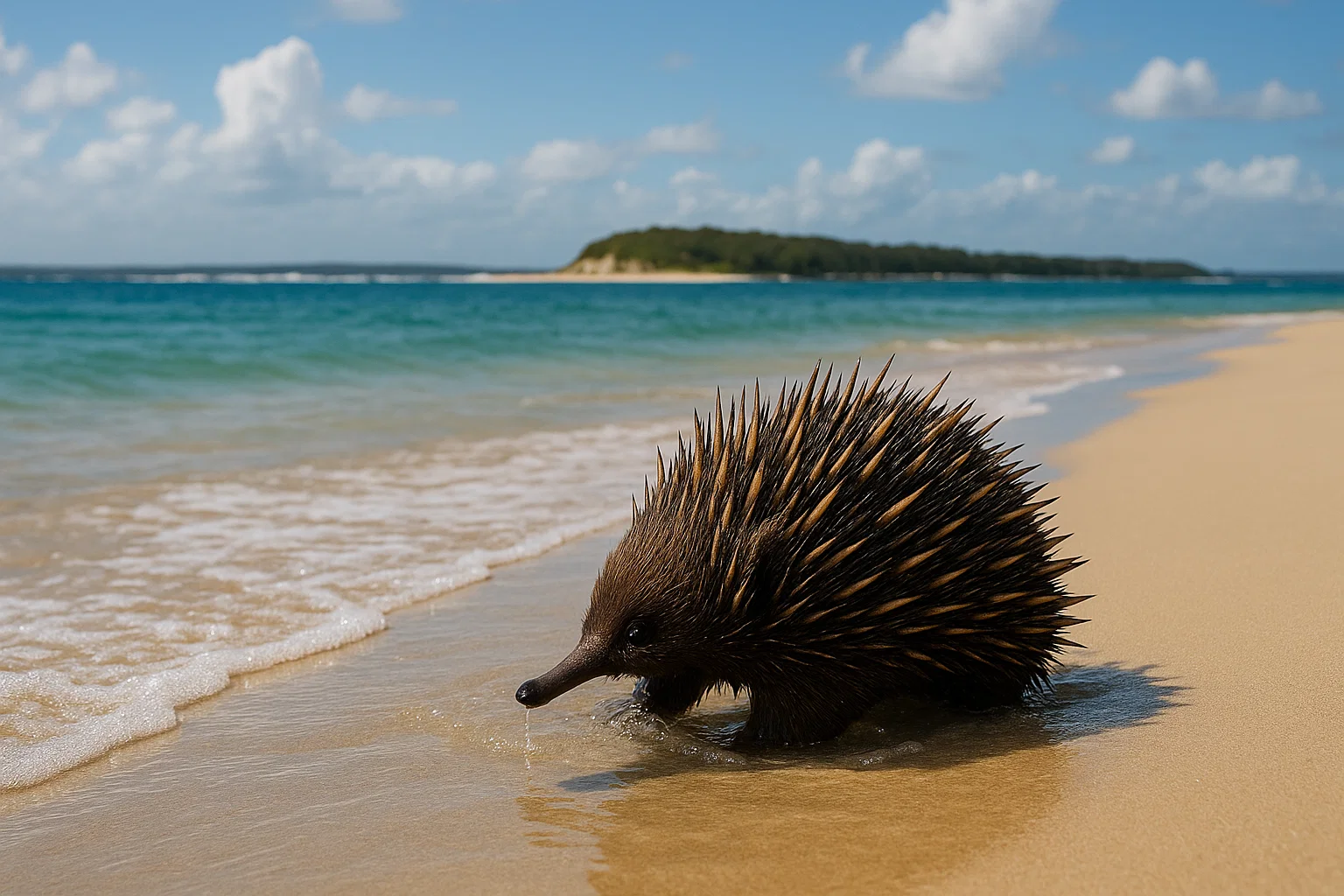
An echidna discovered washed ashore on Caloundra’s coastline may have swum over a kilometre from the remote northern end of Bribie Island.
Locals and wildlife carers suspect the animal, believed to be “Eddie”—a solitary echidna previously seen on the rapidly eroding land—was swept away during a high tide overnight.
Dave Cairns, a Sunshine Coast local, found the echidna near a rock wall at Golden Beach. Though it was alive, the animal appeared exhausted.
“It looked like it floated across overnight,” he said.
“It was about a kilometre from where wildlife has been trapped on the spit.
“With the tide and swell, it could have easily been carried off.”
Cairns, who has lived by the passage for decades, said he had never before seen an echidna in that part of Golden Beach.
“Not once in 30 years,” he said.
“That’s why I believe it came from the northern tip of Bribie.”
The echidna is currently receiving treatment at the Australia Zoo Wildlife Hospital for saltwater exposure.
Licensed wildlife carer Sybelle Foxcroft, who is caring for the echidna, said it was in a humidicrib and receiving oxygen.
“There was a crackling in his chest, possibly from inhaling water. He was extremely dehydrated and had salt irritation in his eyes,” she said.
Foxcroft had previously helped search the northern tip of the island for isolated wildlife and believes this may be the same echidna they had been monitoring.
“From the footage and his condition, he looks like the same one we’ve been tracking. His size and appearance fit with an animal that’s lacked proper nutrition for a while,” she said.
The area where the echidna was found is heavily developed, with limited suitable habitat for digging or sheltering.
Dr Kate Dutton-Regester, a wildlife conservationist from the University of Queensland, confirmed echidnas are capable swimmers, though sightings in water are rare.
“They have powerful forelimbs and can float with their beak functioning like a snorkel,” she explained.
While echidnas typically stay near freshwater, Dr Dutton-Regester said it is plausible for them to traverse saltwater distances, especially with assistance from currents.
The symptoms described by carers align with saltwater exposure. Though she couldn’t confirm if the echidna originated from Bribie Island’s tip, she noted that males often wander widely during breeding season in search of mates.
Coastal erosion expert Dr Javier Leon from the University of the Sunshine Coast said recent ocean swells may have displaced wildlife.
“A strong easterly swell over the past two days likely worsened erosion and possibly washed wildlife from the area,” he noted.
The region had already suffered significant erosion after ex-Tropical Cyclone Alfred in February, making it increasingly unsuitable for wildlife.
Jen Kettleton-Butler from the Pumicestone Passage Catchment Management Body recently visited the island’s tip with a wildlife carer to search for Eddie at sunset, but they couldn’t locate him.
Other animals—including snakes, goannas, lizards, and small marsupials—have also been seen on the now-isolated land.
Kettleton-Butler said the land spit, separated by two tidal breaks, is currently around 30–40 metres wide and 300–400 metres long, shrinking further with each high tide.
The Department of Environment initially stated there was no current evidence of escalating wildlife impacts that would necessitate intervention. It said the animals are adapted to rapidly changing coastal conditions.
The department has been asked for additional comment following the echidna’s discovery at Golden Beach.
Deputy Premier Jarrod Bleijie previously announced plans to seek urgent assessments from coastal engineering experts to examine erosion and the associated threats to wildlife.
