


Pentagon Reviewing AUKUS to Align with Trump’s ‘America First’ Strategy
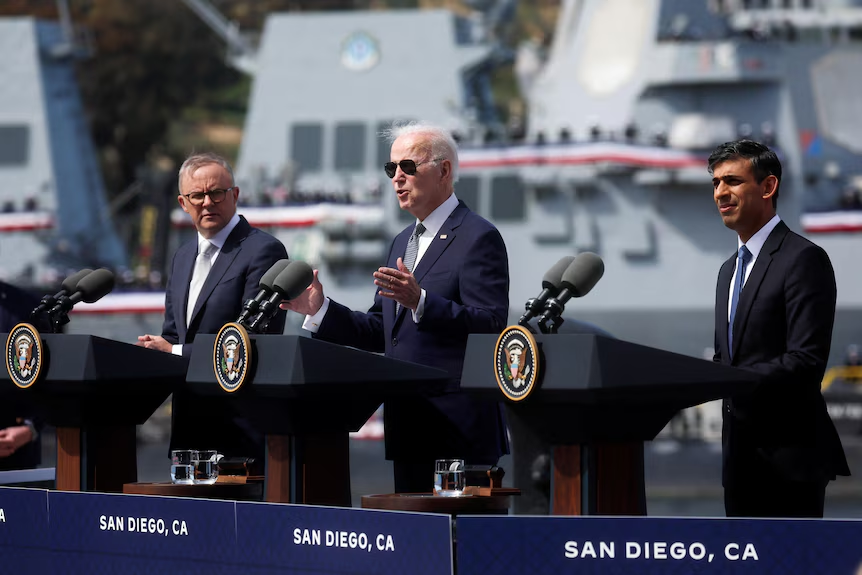
The Pentagon is reassessing the AUKUS security pact between Australia, the US, and the UK to ensure it aligns with President Donald Trump’s “America First” doctrine, a US defense official has confirmed to the ABC.
Despite the review, Australia’s Defence Minister Richard Marles remains optimistic that the trilateral agreement will endure. He described the review as a routine action expected under any new administration.
This development comes on the heels of a renewed US call for Australia to increase its defense spending, with Defense Secretary Pete Hegseth urging the Albanese government to boost investment “as soon as possible.”
“Allies must fully contribute to collective defense,” a US official said, echoing Hegseth’s position.
Nuclear Submarine Pact Under Review
Under AUKUS, Australia is set to receive a fleet of nuclear-powered submarines in a deal valued at over $350 billion. The Pentagon review is reportedly being led by Elbridge Colby, Under Secretary of Defense for Policy, who has previously voiced skepticism about the pact.
While Colby once described AUKUS as a “great idea in principle,” he noted concerns about its execution. However, he has recently expressed a more positive outlook based on new information.
Marles, speaking on ABC Radio Melbourne, reaffirmed his commitment to the agreement and dismissed suggestions Australia should develop a contingency plan.
“We have a plan. We’re sticking to it,” he said. “Constantly changing course guarantees failure.”
Trump Administration Reviews Foreign Deals
According to a White House official, the Trump administration is conducting regular evaluations of international agreements, particularly those initiated under President Biden, to ensure they meet “America First” criteria.
Australia recently paid the US nearly $800 million to help expand its submarine manufacturing capacity, part of the AUKUS implementation process.
Although Trump has expressed limited knowledge of AUKUS publicly—once responding to a question with, “What does that mean?”—key figures in his administration, including Hegseth and Secretary of State Marco Rubio, have previously backed the deal.
Still, concerns persist in Canberra and London due to Trump’s past criticism of longstanding alliances.
Albanese-Trump Meeting Uncertain
Prime Minister Anthony Albanese was expected to meet with President Trump during next week’s G7 summit in Canada. However, that meeting is now uncertain following US criticism of Australia’s sanctions on two far-right Israeli ministers—an action that may have angered Trump’s administration.
Former Australian ambassador to the US, Joe Hockey, said it was vital for Albanese to personally reinforce the strategic value of AUKUS in talks with Trump.
“If we don’t get the Virginia-class submarines by 2032, we’re left with nothing,” Hockey warned.
“Australia needs to maintain credible deterrence capabilities.”
Deal Faces Criticism and Strategic Stakes
While AUKUS enjoys bipartisan support across all three partner nations, critics including former Australian Prime Ministers Malcolm Turnbull and Paul Keating have labelled the deal as dangerous and unbalanced.
The Greens have proposed an alternative defence policy that would lead to the eventual cancellation of AUKUS altogether.
There are also concerns about the US Navy’s own challenges in meeting submarine production targets. Nevertheless, US Congressman Joe Courtney warned that abandoning the deal would undermine trust with allies and be welcomed by China.
“Scrapping AUKUS would damage US standing and bring celebration in Beijing,” Courtney said.
A spokesperson for the UK government said it was not unusual for a new administration to reassess major partnerships, as the UK itself did last year.
In a previous election debate, Albanese rejected the idea of needing a Plan B, asserting that AUKUS served the shared interests of all three nations.
The Australian Embassy in Washington declined to comment. The ABC has reached out to Mr Colby for a statement.
