


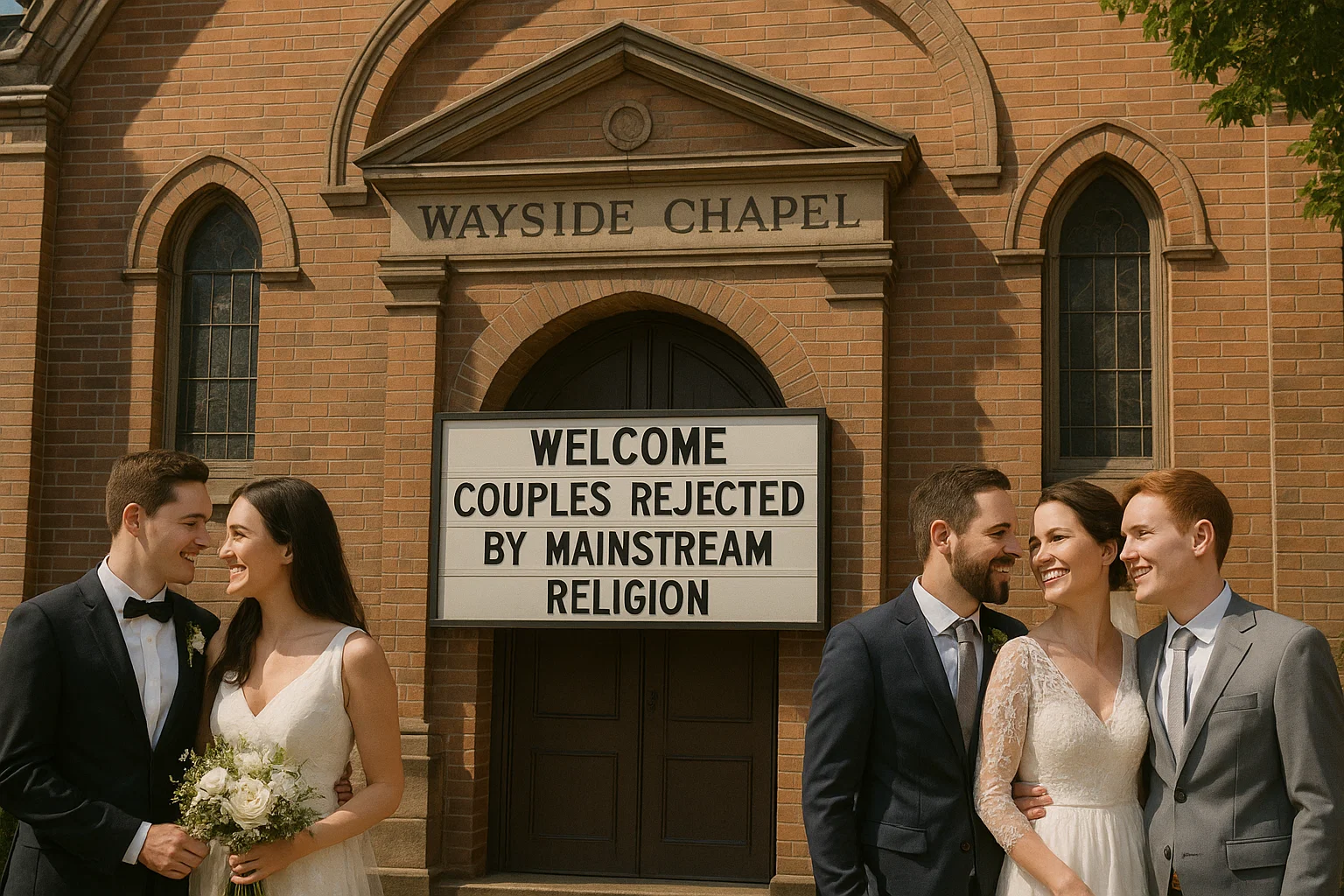
For decades, Sydney’s Wayside Chapel in Kings Cross has served as a refuge for individuals turned away by conventional religious circles.
Its founder, Reverend Ted Noffs, not only offered support to marginalized communities but also officiated weddings for divorcees and interfaith couples. Long before same-sex marriage was legalized, he even offered blessings to same-sex unions.
Playwright and writer Alana Valentine has been deeply intrigued by the stories of couples who found acceptance through marriage at Wayside. Her personal connection runs deep — her mother, Janice, was once a “Wayside bride.”
“My mum got married at 18,” she told ABC TV’s Compass. “She was pregnant with me, then had my brother. By the time I was five, she was divorced.”
At a time when most churches would have excluded Janice — a divorced mother of two — Wayside offered her a chance at new love.
A cherished black-and-white photograph captures Janice’s wedding day at the chapel, where Alana, still a child, witnessed the ceremony. It wasn’t until adulthood that Alana fully appreciated the defiance and courage her mother embodied.
“I used to judge my mum for not being the kind of mother other kids had,” Alana recalled. “She’d show up to school events late, dressed in high-fashion clothes, not conservative at all. When I came home from school, there wasn’t a meal waiting for me.
“Now, looking back, I realize just how incredible she was.”
Alana spent years gathering stories of couples who married at Wayside, transforming them into a stage production for Belvoir St Theatre. For her, Wayside’s legacy goes far beyond weddings — it represents a movement for justice and progress.
“People often reduce it to quirky weddings in Kings Cross led by a minister in eccentric outfits,” she said of Reverend Noffs’ distinctive style. “But these were people making bold, sometimes dangerous choices — that’s brave and inspiring.”
Rebelling for Love
The chapel also holds deep meaning for Kumar Ponnusamy. His Indian Hindu father and white Christian mother were wed at Wayside, in a joyful celebration that included a pink-dyed poodle.
“Wayside was ahead of its time. It was the only place willing to marry them,” Kumar said.
Despite the progressive venue, neither side of the family supported the marriage — both sets of grandparents chose not to attend.
“Each family expected them to marry someone within their culture,” Kumar explained. “But it was the 60s — they were rebellious and wanted to follow their hearts.”
Challenging Religious Norms
The message of inclusion that drew so many to Reverend Noffs’ chapel also captivated Alana Valentine.
She was especially inspired by Noffs’ role in broader social justice efforts, such as his support for the 1965 Freedom Rides alongside Aboriginal leader Charlie Perkins, and his advocacy for LGBTQ+ rights during a time when homosexuality was still criminalized.
When heroin swept through Kings Cross in the 1970s, Noffs pushed for harm reduction and rehabilitation rather than punishment — a position that clashed with many in the church.
“He believed in helping people physically as well as spiritually,” Alana said. “Others thought saving souls was the priority, but Ted saw it as hypocritical to ignore their suffering.”
For Reverend Noffs, rejecting people based on strict social or religious categories was unacceptable.
“I can’t categorize people into boxes and decide who’s in or out. That’s not just un-Australian — it’s unchristian,” he once said.
Beyond traditional services, the chapel hosted plays, music, and open discussions — making it a community hub for those often dismissed as societal “outsiders.”
Personal Journeys and Legacy
Ursula Zuffo, another Wayside bride, remembered Reverend Noffs’ compassion. Divorced and remarried at the chapel, she recalled how her Catholic husband Sergio’s family disapproved.
“They refused to attend and called the chapel a dreadful place,” she said. “But we ignored them and had a beautiful wedding.”
By the 1980s, Reverend Noffs had conducted thousands of weddings. After a major stroke later that decade, his wife Margaret continued the work.
“We’re doing this not just because we believe in the mission, but also for Ted,” she said at the time.
Reverend Noffs passed away in 1995, but his legacy lives on through the Ted Noffs Foundation, now run by his descendants. Jon Owen currently leads the chapel, and Alana notes that its founding principle — marrying anyone for love — remains central.
“I’m proud to have a personal connection to this part of Australia’s social history,” she said.
As a queer member of the Uniting Church, Alana sees the chapel’s ongoing work as a symbol of progress.
“Today’s acceptance and freedoms weren’t handed to us — they were fought for.”
