


The 2026 FIFA World Cup has delivered memorable football, dramatic eliminations and an elite group of semi-finalists, but it has also been surrounded by disputes over refereeing, disciplinary decisions, political influence and the way the competition has been organised.
Complaints following major defeats are hardly unusual at international tournaments. Players, coaches and supporters frequently blame officials when decisions go against them, particularly during emotionally charged knockout matches.
However, the intensity of the criticism at this World Cup has been unusually high. Some accusations have been based largely on frustration and unsupported conspiracy theories, while others have raised legitimate questions about consistency, transparency and the processes used by FIFA.
The governing body’s reluctance to provide detailed explanations for certain decisions has contributed to the atmosphere of suspicion. Even when there is no evidence of deliberate manipulation, a lack of clarity can make controversial outcomes appear less trustworthy.
Among the most heavily debated issues have been Cristiano Ronaldo’s suspended ban, the creation of a FIFA peace award presented to US President Donald Trump, a new seeded knockout structure, mandatory hydration breaks and several high-profile video-review decisions.
Ronaldo allowed to play despite three-match punishment
One of the first major controversies occurred before the tournament began.
Cristiano Ronaldo was sent off during Portugal’s penultimate World Cup qualifier against the Republic of Ireland after elbowing defender Dara O’Shea.
FIFA’s disciplinary committee initially extended the automatic one-game suspension to three matches, reflecting rules that generally require a minimum three-match punishment for violent conduct such as elbowing, punching or kicking an opponent.
Under a normal application of that sanction, Ronaldo would have missed Portugal’s final qualifier and its opening two World Cup fixtures.
However, FIFA suspended two matches of the punishment under a one-year probation period. That allowed Ronaldo to play at the tournament, provided he did not commit a similar offence during the specified period.
The governing body relied on a disciplinary provision that gives it discretion to suspend punishments in certain circumstances.
FIFA also considered Ronaldo’s previous disciplinary record, noting that he had not been sent off during his lengthy international career before the incident.
Critics argued that this reasoning was unusual because previous behaviour does not normally erase the minimum punishment associated with serious violent conduct.
The decision also attracted attention because Ronaldo had recently attended a formal dinner at the White House alongside Trump, Saudi Crown Prince Mohammed bin Salman and FIFA president Gianni Infantino.
There is no demonstrated evidence that the gathering influenced the disciplinary outcome. Nevertheless, the timing contributed to concerns about the appearance of preferential treatment.
Ronaldo’s commercial value to the tournament was also clear. Tickets for Portugal matches were among the most expensive on resale platforms, with only a small number of teams generating greater demand.
The controversy therefore centred not only on whether the rules permitted the suspension, but whether FIFA would have exercised the same discretion for a less commercially important player.
Controversy assessment: 8/10
FIFA peace award presented to Trump
Another major governance dispute emerged when FIFA announced the creation of an annual award titled the FIFA Peace Prize — Football Unites the World.
Infantino said the honour would recognise people who had made significant efforts to end conflict, unite communities and create hope for future generations.
The first award was scheduled to be presented during the World Cup draw in Washington, DC.
However, reports indicated that many members of FIFA’s governing council were not consulted about the creation of the award, its selection criteria or the choice of its first recipient.
Some senior officials reportedly discovered that the prize existed only after FIFA issued a public announcement.
The award was eventually presented to Trump during the World Cup draw at the Kennedy Center.
The ceremony concluded with the Village People performing “Y.M.C.A.,” a song closely associated with Trump’s political rallies.
The timing and presentation led critics to question whether FIFA had created a supposedly global humanitarian honour for political reasons rather than through an independent and transparent selection process.
The controversy was heightened by the close public relationship between Infantino and Trump throughout preparations for the World Cup in the United States, Canada and Mexico.
FIFA did not provide detailed information about a judging panel, nominations, evaluation standards or how other potential recipients had been considered.
The absence of a visible process made the prize appear closely tied to one political figure rather than an independently administered international award.
Controversy assessment: 9/10
Seeded knockout system protects leading teams
FIFA also introduced a new tournament structure designed to keep the highest-ranked teams apart until the later rounds.
The system resembled the seeding formats used in tennis, where leading competitors are placed in different sections of the draw to reduce the possibility of them meeting early.
Under the World Cup arrangement, the top-ranked teams were assigned pathways that would keep them separated if they won their groups.
Spain and Argentina were placed on opposite sides of the bracket, while France and England were also kept apart.
FIFA said the change was intended to preserve competitive balance.
Supporters of the format argue that keeping the strongest teams apart produces higher-quality semi-finals and finals. It can also increase global interest, ticket demand and television audiences during the tournament’s final stages.
The system produced exactly the kind of outcome FIFA may have wanted: France, Spain, Argentina and England—the tournament’s four highest-ranked teams—reached the semi-finals.
It was the first time since FIFA introduced its world rankings that the top four teams had all reached the last four of the same World Cup.
Critics said this was not a coincidence but a predictable result of a system designed to make that outcome more likely.
The structure gave the highest-ranked teams clearer routes while potentially forcing ambitious lower-ranked nations into more difficult sequences of matches.
Norway, for example, faced France and Senegal during the group stage before meeting Brazil and England in the knockout rounds.
Argentina, by comparison, reached the semi-finals without facing a team ranked inside the world’s top 18. England also avoided a top-10 opponent before the last four.
France faced Morocco, while Spain encountered Portugal and Belgium during what was arguably the most difficult knockout route among the leading teams.
There is nothing inherently improper about seeding. Most major sporting competitions use rankings to reward stronger participants.
The debate concerns how far organisers should go in shaping the bracket to maximise the chances of commercially attractive teams reaching the final rounds.
Controversy assessment: 7/10
Mandatory hydration breaks alter match structure
For the first time at a World Cup, FIFA introduced compulsory three-minute hydration breaks during both halves of every match.
The policy effectively divided games into four sections rather than the traditional two uninterrupted halves.
The breaks were introduced partly because several matches were played in extremely hot conditions at open-air stadiums.
Player safety is a legitimate concern, and scheduled opportunities to drink, cool down and receive medical attention can reduce the risks associated with heat and humidity.
However, the breaks were used universally, including at temperature-controlled indoor venues where extreme heat was not a factor.
That decision led to claims that commercial considerations may have influenced the policy.
Broadcasters could use the interruptions to show additional advertising during each half, creating valuable commercial inventory.
Infantino insisted that the measure was based entirely on sporting considerations and said FIFA did not directly profit from the additional intervals.
Even if the governing body received no immediate payment, the breaks increased the potential value of broadcast packages and offered additional exposure to tournament sponsors.
Coaches and players also argued that the interruptions changed the nature of matches.
A scheduled break allows managers to provide instructions, reorganise tactics and interrupt an opponent’s momentum in a way that was previously unavailable during normal play.
Uruguay coach Marcelo Bielsa criticised the transformation of football into a game of quarters, while England coach Thomas Tuchel said the extra interruptions affected the identity of matches.
Netherlands defender Virgil van Dijk supported hydration breaks in genuinely hot conditions but questioned why they should be automatic for every fixture.
The policy may now become difficult to reverse. Future World Cups in Brazil, Spain, Portugal and Morocco are also expected to involve hot-weather matches.
Once broadcasters, coaches and organisers become accustomed to the intervals, mandatory breaks could become a permanent feature of international football.
Controversy assessment: 7/10
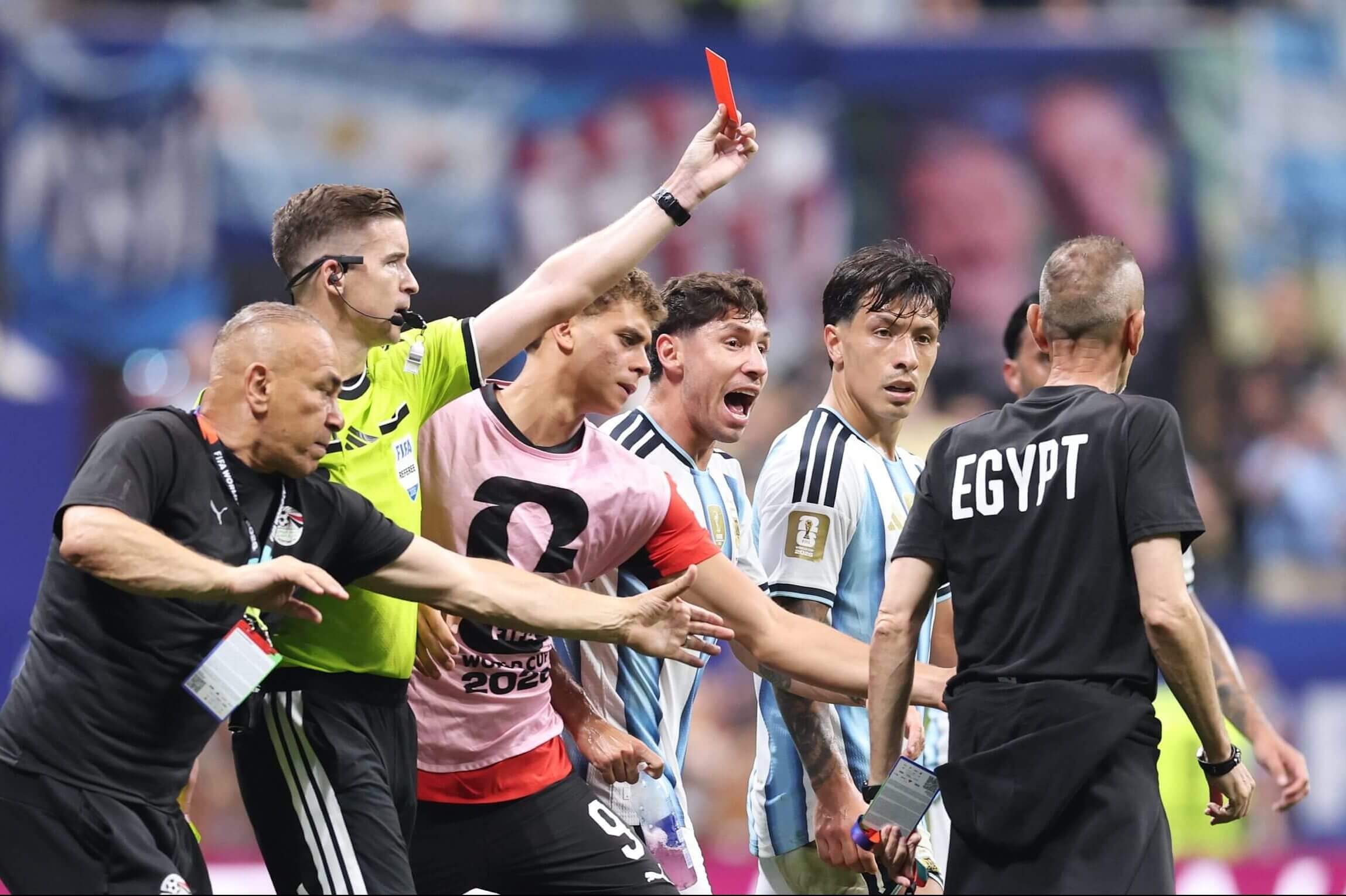
Egypt furious after disputed Argentina decisions
Some of the tournament’s most intense allegations followed Argentina’s dramatic knockout victory over Egypt.
Online users promoted the term “VARgentina,” suggesting that FIFA and its officials were helping Lionel Messi and the defending champions remain in the competition.
There is no credible evidence that FIFA rigged matches for Argentina. However, several disputed decisions provided fuel for the conspiracy theories.
Concerns had already emerged during Argentina’s group-stage victory over Algeria.
The Algerian federation submitted a complaint after Messi avoided punishment for a studs-up challenge that caught captain Aissa Mandi around the calf and Achilles area.
Messi remained on the field and later scored three goals in Argentina’s victory.
The controversy escalated during the round-of-16 match against Egypt.
Egypt led 2-0 before Argentina produced a late comeback and won 3-2. Egyptian players and staff blamed French referee François Letexier and the video-assistant system for the defeat.
Their strongest complaint involved a goal disallowed after a VAR review identified a foul by Marwan Attia on Lisandro Martínez much earlier in the attacking move.
Former Premier League referee Graham Scott later concluded that the goal should have been allowed.
He argued that the contact was ordinary football interaction rather than a clear foul and noted that it occurred almost the full length of the pitch away from where the goal was eventually scored.
Argentina had ample opportunity to reorganise defensively after the incident, making the decision to cancel the goal particularly difficult for Egypt to accept.
Egypt also believed it should have received a penalty before Enzo Fernández scored Argentina’s winning goal.
Coach Hossam Hassan suggested that officials may have been influenced by pressure to keep Messi and the defending champions in the competition.
Forward Mostafa Ziko went further, alleging that the tournament was being directed toward Argentina.
Those claims were not supported by evidence, but they reflected the anger of a team that felt a significant refereeing error had transformed the match.
FIFA refereeing chief Pierluigi Collina defended the integrity of the tournament’s officials.
He said constructive criticism of decisions was legitimate but warned that unsupported allegations could expose referees and their families to threats.
The case demonstrated how an apparently incorrect video-review decision can develop into a much wider crisis when the governing body is already facing mistrust.
Egypt had valid reasons to challenge the disallowed goal, but that did not establish the existence of a coordinated plan to help Argentina.
Controversy assessment: 9/10
Switzerland reduced to 10 through unusual VAR protocol
Argentina’s quarter-final victory over Switzerland produced another major video-review debate.
The teams were level when Swiss forward Breel Embolo received a second yellow card for simulation, reducing Switzerland to 10 players before Argentina eventually won 3-1 after extra time.
Initially, referee João Pinheiro believed Leandro Paredes had fouled Embolo and showed the Argentina midfielder a yellow card.
The video-assistant team reviewed the incident under the mistaken-identity protocol.
Replays indicated that Embolo had initiated the contact rather than being fouled.
Pinheiro cancelled Paredes’ booking and instead cautioned Embolo for diving. Because the Swiss player had already received a yellow card, he was then sent off.
The decision appeared to follow the regulations introduced for the tournament.
However, the unusual mechanism created a sense of disproportion.
Had the referee not originally booked Paredes, the video assistant would not normally have been able to intervene merely to punish Embolo’s simulation, particularly because the incident took place far from the penalty area.
The original yellow card created the mistaken-identity route that allowed the officials to review and reverse the decision.
Swiss players accepted that Embolo had exaggerated the contact but argued that similar incidents frequently pass without cautions.
Captain Granit Xhaka said the officials had followed the rules but believed the intervention destroyed the contest.
Midfielder Remo Freuler described the decision as disastrous and questioned why video review was used for that particular offence when numerous other possible yellow-card incidents went unexamined.
Coach Murat Yakin said his team had been severely punished by a refereeing decision.
Unlike the Egypt case, the main issue was not whether the officials had applied the rule correctly. It was whether the rule created an excessive consequence for a relatively minor incident.
The controversy highlighted the difference between an accurate technical decision and an outcome that still feels inconsistent with the way football is usually officiated.
Controversy assessment: 2/10
Political questions after Balogun suspension overturned
Perhaps the most politically sensitive controversy involved United States striker Folarin Balogun.
Balogun received a red card during the round-of-32 victory over Bosnia and Herzegovina and was initially expected to miss the next match against Belgium.
However, FIFA later ruled that he was eligible to play after a process involving US Soccer, lawyers, government officials and direct interest from Trump.
The decision was announced shortly before the Belgium match and triggered accusations that political pressure had influenced a sporting disciplinary process.
FIFA said an independent disciplinary committee had suspended the punishment.
However, it did not clearly explain why the sanction was lifted or confirm that the referee had made a mistake in issuing the red card.
Belgium formally objected to Balogun’s eligibility.
FIFA’s appeal committee rejected the challenge on procedural grounds, ruling that the Belgian federation had not been a party to the original disciplinary case and therefore did not have the legal standing to appeal.
Belgium still indicated that it might pursue further action, despite later defeating the United States 4-1.
The controversy became more serious when Trump publicly thanked FIFA for correcting what he called a major injustice.
He later confirmed that he had contacted Infantino and asked for the decision to be reviewed.
Trump said he did not instruct FIFA to reach a particular outcome and believed a committee made the final ruling.
Even without an explicit order, a request from a sitting US president inevitably carries significant institutional weight.
The episode therefore created concerns about whether FIFA’s decision-making system could remain genuinely independent when a powerful political leader intervened on behalf of the host nation’s team.
The result on the field ultimately made no difference to Belgium’s progress, but the governance questions remained unresolved.
A transparent publication of the committee’s reasoning could have reduced suspicion. FIFA’s failure to provide a detailed explanation allowed political-overreach allegations to continue.
Transparency remains central problem
Not every controversial decision at the World Cup proves misconduct or deliberate favouritism.
Some were legal applications of rules that supporters considered unfair. Others involved debatable refereeing judgments, while several accusations were driven by emotion rather than evidence.
The recurring concern has been FIFA’s limited transparency.
When disciplinary punishments are suspended, political awards are created without visible consultation or video-review protocols produce game-changing outcomes, the governing body must clearly explain how and why decisions were reached.
Without that openness, legitimate criticism becomes mixed with unsupported conspiracy theories.
The Egypt controversy showed how a significant officiating error could damage confidence in the competition.
The Switzerland case demonstrated how technically correct rule enforcement could still produce an outcome viewed as excessive.
The Ronaldo and Balogun episodes raised questions about whether commercially or politically important individuals receive access to forms of discretion unavailable to others.
The seeding and hydration-break debates illustrated FIFA’s growing willingness to alter football’s traditional structures in ways that may benefit television audiences, sponsors and the tournament’s biggest teams.
The 2026 World Cup has produced an elite final four and several unforgettable matches. Yet the competition’s reputation will also be shaped by how FIFA responds to growing demands for consistency, independence and greater public accountability.
Controversy will always accompany the World Cup. Suspicion becomes harder to control, however, when the organisation responsible for the tournament does not fully explain its most consequential decisions.
