


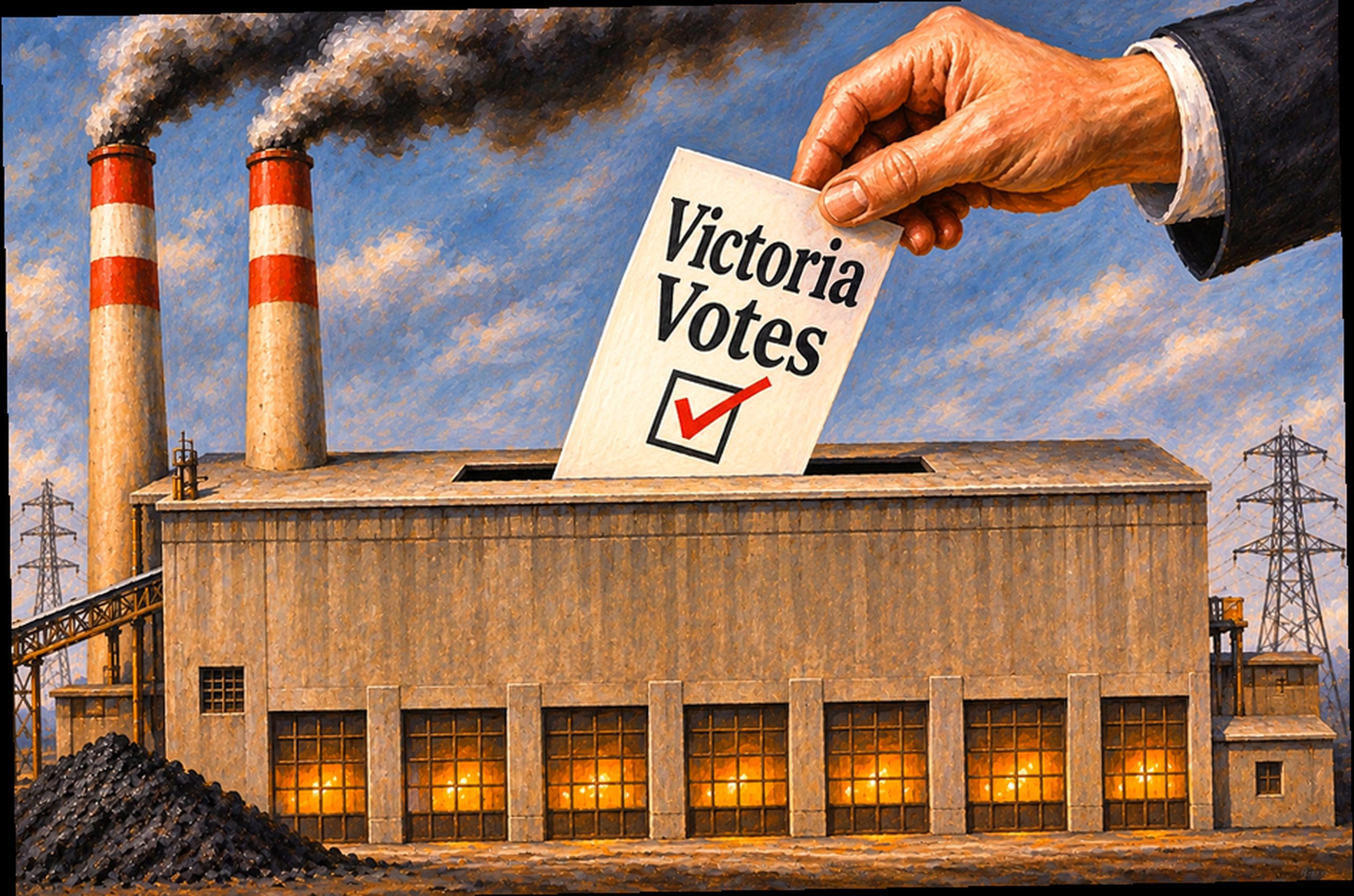
The dust has barely settled on the COP31 climate summit in Antalya, Türkiye, and in the view of Quadrant columnist Alan Moran, the gathering already looks like a turning point — not for the climate, but for the politics of energy. Writing in the days before Victorians go to the polls on 28 November, Moran argues that the summit’s faltering outcome, and the confusion it has exposed in every Australian party’s energy platform, have put power prices and power supply at the centre of the state election.
The author’s starting point is the summit itself. Australia, he notes, sent 193 taxpayer-funded delegates to COP31. Yet for all that expense — underwritten, in his words, by subsidies from consumers and taxpayers — the conference’s main resolution was, he argues, a limp wish: to lift the share of electricity in energy use from 20% to 35%. Tellingly, the author stresses, that goal came with no requirement to increase renewables while avoiding oil, gas and coal as fuel sources. For Moran, the contrast between the scale of the delegation and the modesty of the outcome captures the exhaustion of the enterprise.
The disappointment was not confined to critics of climate action, the author observes. Andreas Sieber, chief political strategist of the campaign group 350.org, lamented that the world stood “on the brink of an outrageous and utterly embarrassing lack of leadership by the COP31 presidencies.” Moran reads the summit as the death knell of what Donald Trump calls the “Green New Scam” — a doctrine, in the author’s account, that the US president first undermined a decade ago when he pulled the United States out of the Paris Agreement. The bomb Trump placed under the net-zero doctrine, Moran writes, did not detonate with a bang, but with “the whimper of unworldly green partisans confronted by reality.” Only Australia’s Energy Minister, Chris Bowen, who served as a co-chair of the gathering, appears to the author to have missed that the climate agenda is running out of steam.
Moran finds corroboration, as he sees it, in an unlikely quarter: the Paris-based International Energy Agency. For the first time in a dozen years, he notes, the press release accompanying the IEA’s latest World Energy Outlook fails to mention climate change at all. Instead, this year’s focus is on the agency’s founding principles — energy security and restoring oil and gas supplies from a politically turbulent Middle East. The author points out that the shift has not come without pressure: US Energy Secretary Chris Wright has heavily criticised the IEA and threatened to leave unless it dropped its climate focus, while America’s 14% funding commitment to the agency is currently two years in arrears. “Money talks,” Moran writes, “and a crimp in the funding pipeline speaks loudest of all.”
But the heart of the piece is what COP31’s failure means for Australian domestic politics — and here, the author argues, every party is engaged in obfuscation. The Greens, he notes, are surging in some Victorian polls a week before the state election, and continue to oppose nuclear power and to promise to move quickly to close down coal and gas. There is, he adds, also their stated intent to slug energy firms and banks so that they “pay their fair share” — discriminatory company taxes which, even if practicable under the Constitution, would in his view do nothing but accelerate the downward spiral of the state’s economy. Yet, he concedes, slick ads and populist slogans can work wonders in a democracy.
Labor, federally and in both Victoria and New South Wales, recognises in Moran’s account that the intermittency of wind and solar means net zero simply cannot work on the basis of those resources alone, prompting its policy of “firming up” renewable sources with batteries and newly tapped gas. The rub, the author argues, is cost: these solutions would see an estimated sevenfold hike in the cost of a fossil fuel-based system using batteries, or a threefold increase using gas, to augment peak demand. Gas-firming, he adds, would also require policy changes to facilitate the discovery and delivery of new gas finds.
The Coalition’s record, in Moran’s telling, is no more consistent. While Nationals leader Matt Canavan has been consistent in stating that coal and gas — and possibly nuclear — are essential to low-cost and reliable energy supply, Angus Taylor, as shadow energy minister back in 2021, endorsed Labor’s goal of retiring coal-fired generators ahead of time. That has clearly changed, the author writes: federally, the Coalition now opposes subsidies for large-scale wind and solar as well as for batteries. Moran asks whether Taylor has grown wiser, or was hiding his previous views to placate what he perceived to be a green-leaning electorate. The Coalition, he notes, has strongly supported subsidies for rooftop solar — which the author describes as actually the most expensive source of electricity — and has not indicated any change of mind.
In Victoria, the author reserves his sharpest criticism for the state Coalition’s own contortions. Deputy Liberal leader and former energy spokesperson David Southwick, he writes, has been “the very model of a political yo-yo” over the past 15 years. Originally, Southwick correctly described subsidies under the Victorian Renewable Energy Target as a market distortion that risked higher power bills, arguing that if solar and wind were truly the cheapest, projects should be able to proceed without subsidies. Four years ago, however, the author notes, Southwick chastised the Labor government for being inadequately enthusiastic in bringing in renewables.
The Victorian Coalition’s current energy policy, as Moran sets it out, is to slow down what leader Jess Wilson regards as an inevitable “transition” from coal, while overturning the state’s ban on new gas connections. The policy also opposes the deeply unpopular transmission-line build across rural Australia. But Wilson, the author argues, surely aware that renewables cannot be commercialised without subsidies, nevertheless calls for more wind and solar in addition to gas. Indeed, her policy calling for “urban solar parks” implies, in Moran’s reading, an intensification of subsidies to this high-cost form of generation. Moreover, in inviting new applications for gas exploration within her first 60 days in office, she rejects the use of fracking — the modern technology which, the author notes, has transformed the United States into the world leader in oil and gas production.
One Nation’s platform fares little better under the author’s scrutiny. The party’s energy policy seeks to eliminate subsidies to renewable energy; however, Moran points out, its own policy document, “Lowering Costs to Businesses and Households”, takes a contrary view, calling for “continuing, in principle, the subsidising of the small-scale renewable energy scheme to help more Australian households and small businesses to install solar panels and reduce their electricity costs.” Like the Coalition, One Nation would place impediments on transmission lines, seek protections for landowners from industrial usage — including AI “factories” — and remove the ban on new gas connections. The party in general does not oppose fracking technology for gas and, like the Coalition, is open to nuclear power.
For Moran, the muddle is the product of a much longer failure. “We are now reaping the bitter harvest of a decade or more of poor government,” he writes, “not least regulatory measures that shifted Australian energy supply away from low-cost coal and gas (and the nuclear ban).” Declining real incomes and de-industrialisation, he argues, have been the inevitable outcomes. Restoration of a deregulated energy policy would, in his view, be a major antidote. But although Jess Wilson dares to speak the name of Jeff Kennett, the author contends, she is far removed from the root-and-branch reform of the state’s energy supply that Kennett and his treasurer, Alan Stockdale, masterminded.
What voters will not know until next weekend’s votes are tallied, Moran concludes, is whether Wilson’s embrace of teal-like policies will be moderated should Victorians decree that the Coalition must share power with One Nation. Interesting times ahead, he writes — and, in the author’s framing, the ballot box on 28 November is now, above all else, a verdict on energy.
This article is an opinion rewrite based on Alan Moran’s Quadrant column “Powering up the Ballot Box”, published 21 November 2026. The views expressed are those of the original author.
