


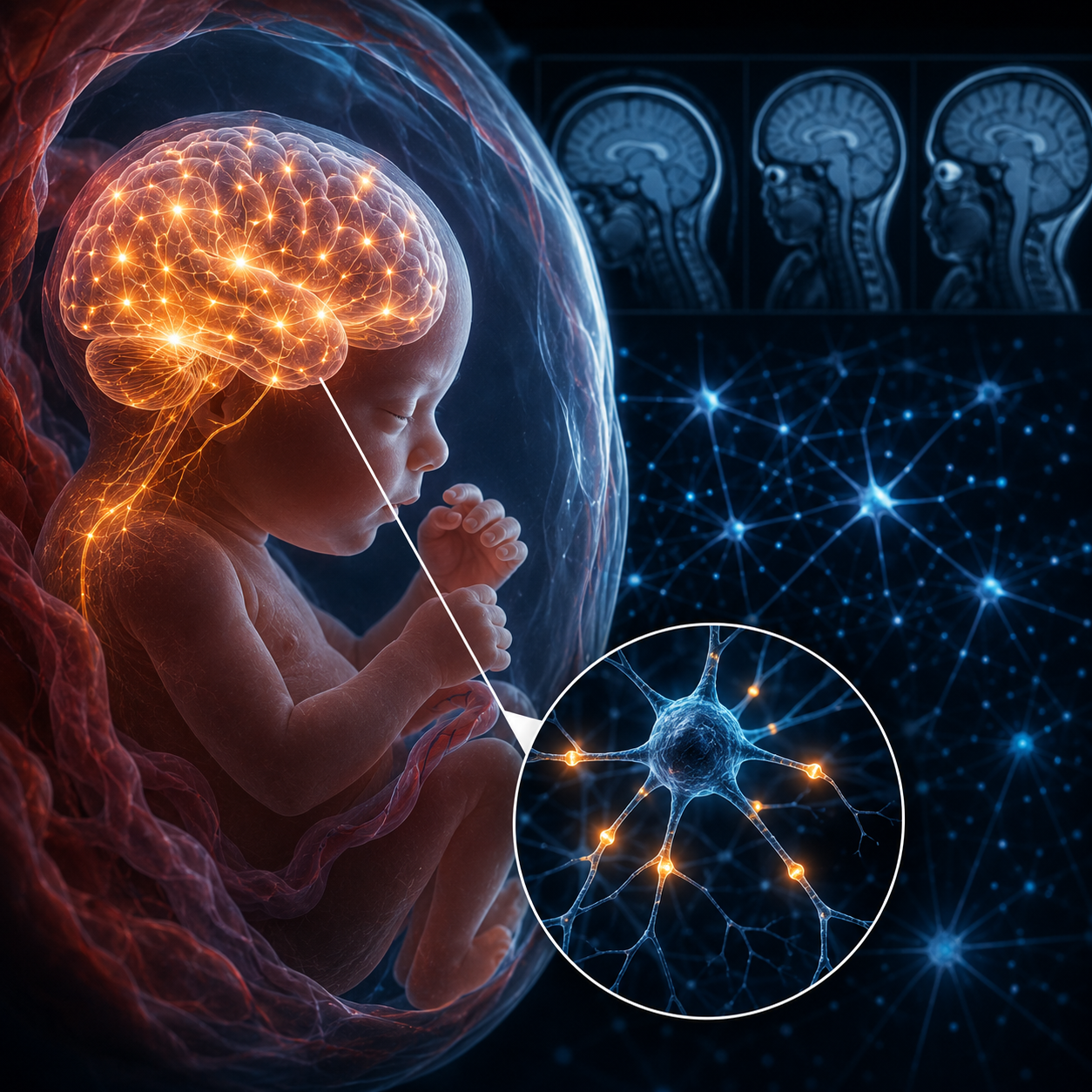
Scientists have uncovered evidence that the brain may begin forming decisions much earlier in its processing system than previously believed, challenging the traditional view that sensory areas merely collect information before passing it to higher regions.
The research, led by Professor Yurii Vlasov at the University of Illinois Urbana-Champaign, suggests that early sensory regions actively participate in decision-making through rapid, two-way communication with other parts of the brain. The findings were published in the journal Proceedings of the National Academy of Sciences.
For decades, scientists generally pictured brain processing as a largely one-directional hierarchy. Under this model, information gathered by the senses moves through increasingly complex regions until it reaches areas such as the frontal cortex, where a final decision is produced.
This understanding also influenced the development of many artificial-intelligence systems, including convolutional neural networks, which typically process information layer by layer in a forward direction.
However, the Illinois researchers found evidence that the biological brain operates in a more interconnected and dynamic way. Rather than waiting for sensory information to reach the highest levels, decision-related signals may appear within some of the earliest stages of cortical processing.
To examine this process, researchers recorded neural activity in mice navigating a virtual-reality corridor. The animals used sensory information from their whiskers to decide whether to turn left or right.
During the task, scientists detected strong decision-related activity in the primary somatosensory cortex, known as S1. This region is among the earliest cortical areas responsible for processing touch and other physical sensations.
The results indicate that S1 does more than simply receive information and forward it elsewhere. Its activity appears to be continuously influenced by signals travelling back from higher-level brain regions through feedback loops.
This top-down regulation means that perception and decision-making may develop through ongoing communication between multiple brain areas. Information can move both upwards and downwards through the system rather than following a single, fixed route.
The discovery challenges the idea that the brain operates like a simple processing chain in which sensation, interpretation and decision occur as separate steps. Instead, these processes may overlap, with early sensory regions already reflecting the animal’s developing choice.
Researchers believe this systems-level understanding could eventually influence the design of artificial intelligence. The human brain performs complex reasoning and perception while consuming far less energy than modern computing systems, making its architecture an attractive model for engineers.
Future AI networks inspired by the brain could potentially use interconnected feedback mechanisms instead of relying mainly on sequential, feed-forward processing. Such systems might become more adaptable, energy-efficient and capable of handling complex decisions.
However, the researchers stressed that the study does not provide an immediate blueprint for creating a new AI system. The results instead offer clues about biological intelligence that engineers may explore when designing future computing architectures.
The research team now plans to investigate the precise timing of neural signals and determine how feedback loops form, change and coordinate activity across different levels of the brain.
New measurement technologies will also be developed to capture fast changes in neural activity. Scientists hope this work will help them understand how decision-making signals emerge and how communication between sensory and higher brain regions shapes perception and behaviour.
Although much of the brain’s neural language remains unknown, the study suggests that decisions are not produced by one isolated command centre. They may instead emerge across a broad network, beginning at the earliest moments when the brain receives information from the outside world.
