


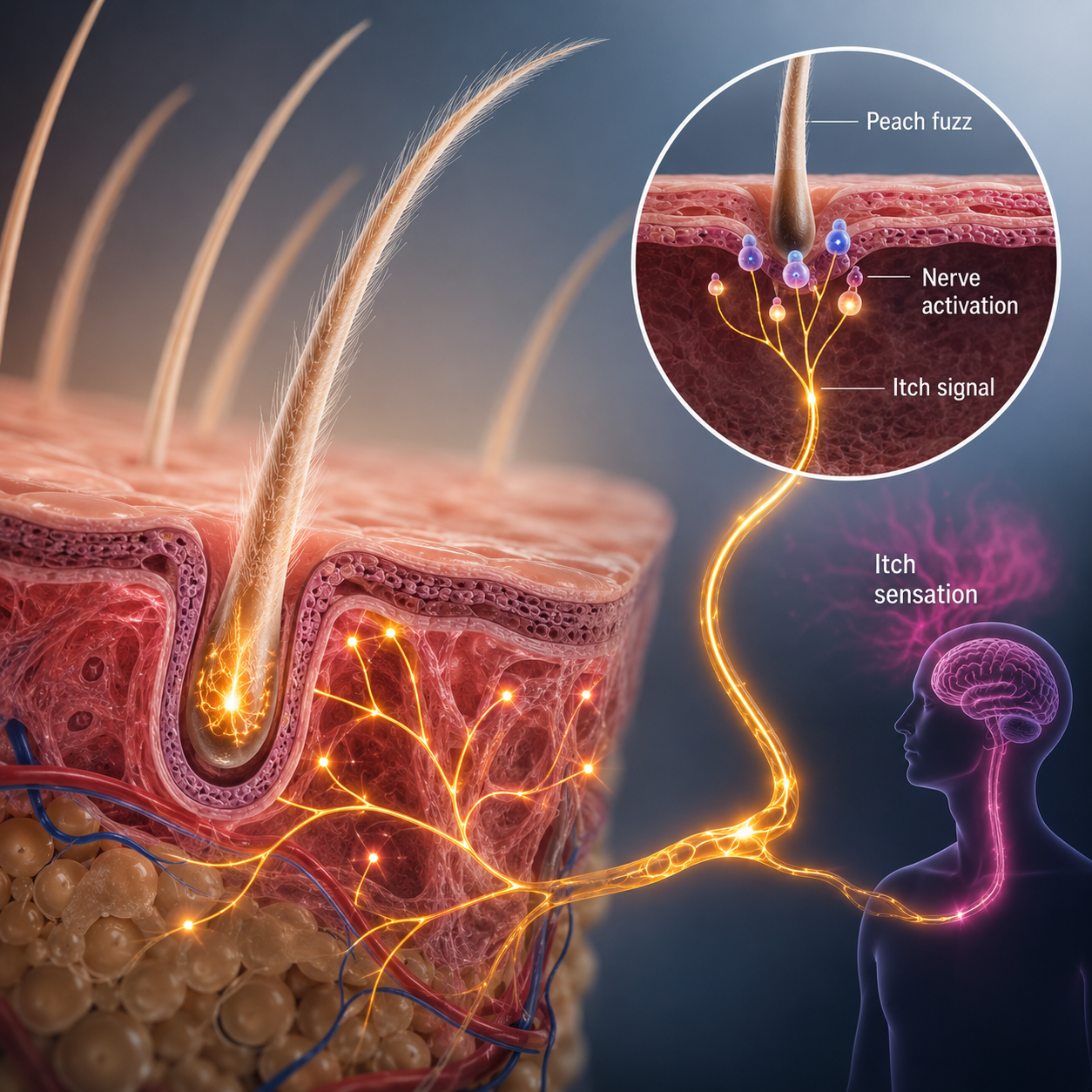
Scientists have discovered a previously unknown sensory pathway that may explain why a light touch against fine body hair can suddenly cause an intense urge to scratch.
Researchers at the University of Michigan identified a specialised network involving extremely fine hairs and touch-sensitive nerve cells that appears to be dedicated to detecting mechanical itch. The discovery could eventually lead to more effective treatments for persistent itching linked to inflammatory skin conditions such as eczema.
The research was conducted primarily in mice and published in the scientific journal Neuron. It focused on a type of fine hair described as “vellus-like,” which closely resembles the soft, short and lightly coloured vellus hair covering much of the human body. This hair is commonly known as peach fuzz.
According to the research team, these hairs are connected to a distinct population of sensory neurons that transmit itch signals when the hairs are lightly disturbed. Until now, scientists did not fully understand the biological mechanism behind this familiar sensation.
Bo Duan, an associate professor at the University of Michigan, said itching is one of the most significant symptoms experienced by people with chronic skin inflammation. The newly identified pathway appears to contribute to both temporary mechanical itch and persistent itching associated with long-term skin disorders.
To test the role of the specialised neurons, researchers examined mice experiencing chronic skin inflammation similar to human eczema. Animals with functioning neurons showed normal scratching responses. However, mice lacking the cells, or whose cells had been experimentally switched off, scratched substantially less.
The results suggest that these neurons are essential for transmitting certain itch signals and may offer a new therapeutic target.
Many existing treatments are designed to reduce chemical itch caused by substances associated with mosquito bites, poison ivy or other irritants. Such treatments often provide less relief for patients suffering from chronic inflammatory itching.
Researchers believe targeting the newly discovered mechanical-itch pathway could offer another way to control symptoms that do not respond well to current medications.
Although the scientists could not directly confirm the complete pathway in living humans, they found several indications that people may possess a similar sensory system. Humans carry genes associated with the production of comparable touch-sensitive neurons.
The team also identified proteins responsible for carrying itch signals from the fine hairs through the sensory neurons and towards the spinal cord. Laboratory-grown human neurons reacted when exposed to those proteins, providing further evidence that a related mechanism may exist in people.
The sensation can be demonstrated by lightly brushing a fine object, such as the pointed corner of a tissue, across the tiny hairs surrounding the lips. Touching those soft hairs rather than the thicker hairs nearby can trigger an immediate itching feeling.
Scientists have long observed this response in humans and animals, but the cells and molecules responsible for producing it had remained unclear.
The vellus-like hairs studied in mice were first described more than a century ago. They are particularly common behind the ears, below the lips and near the base of the paws, but they have received limited attention in sensory research.
Because mice cannot verbally describe itching, the researchers measured scratching as evidence of the sensation. They gently moved the animals’ fine hairs using a small thread loop and monitored their reactions.
After isolating the relevant nerve cells, the team genetically altered them so they could be activated using blue light. When the light stimulated the neurons, the mice began scratching in much the same way as they did after their hairs were physically touched.
This response provided strong evidence that the specialised cells directly transmit mechanical-itch signals.
The researchers believe fine hairs around sensitive areas such as the mouth and ears may have evolved as an early warning system. They could help alert mammals when insects, parasites or other small objects come into contact with vulnerable parts of the body.
However, humans are covered with vellus hair across most of their skin and do not feel continuously itchy. Earlier work by the same laboratory suggests that circuits in the spinal cord normally suppress mechanical-itch signals.
These neurological “gates” may prevent the signals from reaching the brain unless particular conditions are present. Chronic inflammation could interfere with this protective control system, allowing itch messages to pass through more easily.
Further research will be needed to confirm exactly how the pathway operates in humans and whether it can be targeted safely with medication.
The discovery nevertheless provides scientists with a clearer understanding of how fine hairs, sensory nerves and spinal-cord circuits work together to produce mechanical itch. It may also open a new direction for developing treatments for eczema and other conditions in which persistent itching seriously affects patients’ comfort, sleep and quality of life.
