


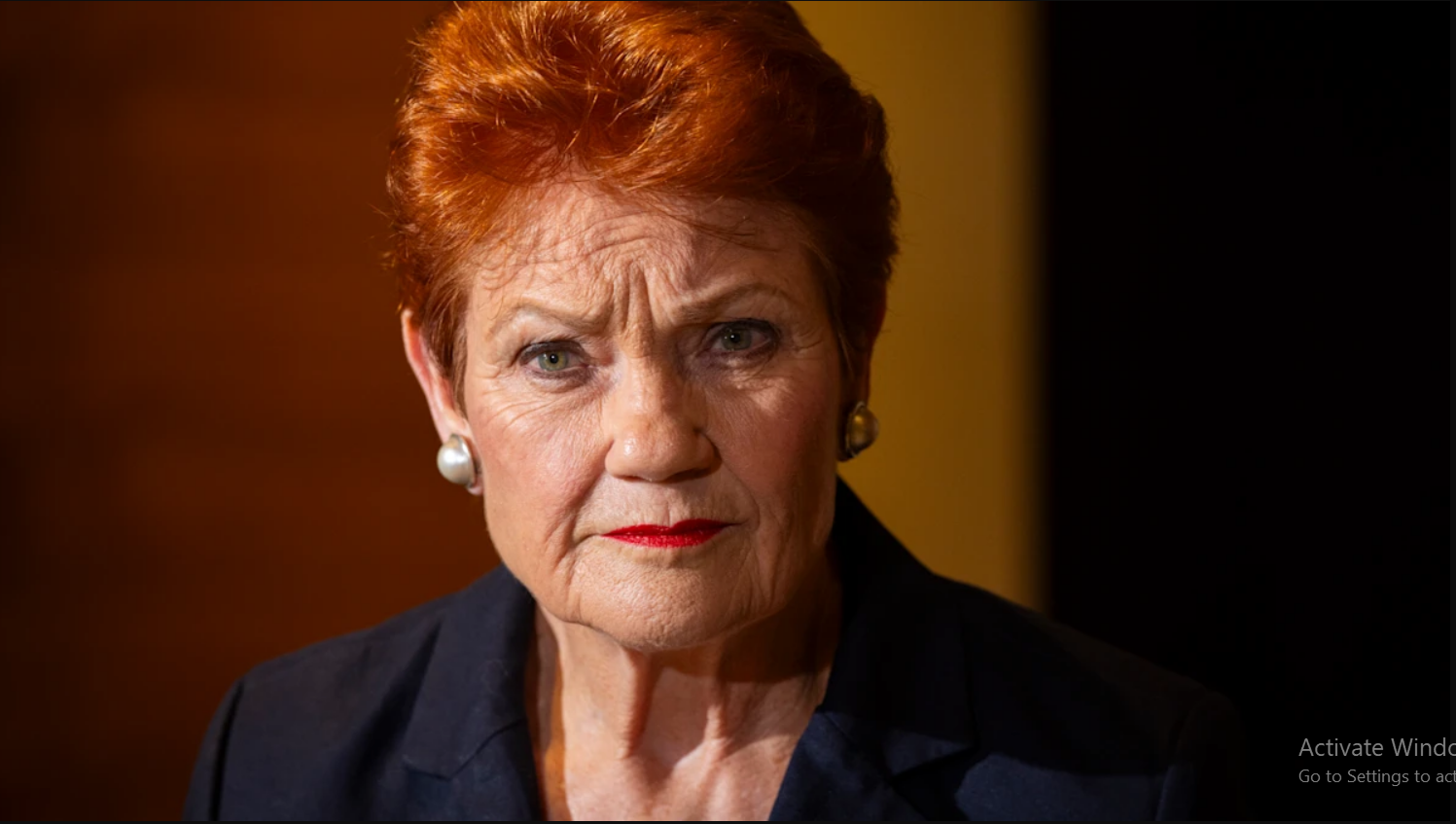
Brittany Higgins and leading family violence advocates have criticised Pauline Hanson after the One Nation leader described domestic violence as a “two-way street” and suggested that women experiencing abuse should leave unsafe relationships.
Hanson made the comments during an appearance on Brisbane radio, where she acknowledged that domestic violence was wrong but argued that both men and women could become violent.
She said social and financial pressures had left many people feeling overwhelmed and claimed modern society was increasingly volatile.
Hanson also disclosed that she had personally experienced domestic and family violence earlier in her life.
The senator said people should not remain in homes where they felt unsafe and urged women being abused by their partners not to tolerate the behaviour.
Her remarks triggered immediate criticism from Higgins, who described the comments as a form of victim blaming.
Higgins argued that phrases such as “mutual abuse”, “two-way street” and “just leave” oversimplified the realities of coercive and violent relationships.
She said such language was especially damaging during a period in which Australia continued to record a high number of women killed in gender-based violence.
Family violence specialists also rejected Hanson’s comments.
Nicole Yade, chief executive of the Women’s and Girls’ Emergency Centre, said the remarks were deeply disappointing, particularly given Hanson’s own experience of abuse.
Yade argued that the senator’s comments failed to show sufficient understanding of the complex reasons many victim-survivors cannot safely leave violent relationships.
She said domestic and family violence is shaped by patterns of power, intimidation, financial control, threats and coercion.
Although people of any gender can experience abuse, advocates say women and children remain disproportionately affected by violence perpetrated by men.
Experts have repeatedly warned that leaving an abusive partner can be one of the most dangerous stages of a violent relationship.
Victim-survivors may face threats to their lives, financial dependence, housing insecurity, concerns about children, social isolation and fear of retaliation.
Some are prevented from leaving because their partner controls access to money, transport, identification documents or communication.
Others may have nowhere safe to go or may fear that police, courts or support services will not adequately protect them.
Yade said telling victim-survivors to simply leave ignored these established patterns and could make people feel responsible for the violence committed against them.
She stressed that those trapped in abusive situations should understand that the abuse is not their fault and that specialist support services are available.
The controversy has also renewed attention on Hanson’s own public accounts of family violence.
In earlier writings about her personal life, Hanson described a relationship affected by alcohol-related aggression and violence.
She recalled leaving after her partner mistreated her children and punched a wall during an argument.
After leaving the relationship, she reportedly worked in low-paid jobs while supporting her family.
Critics said that personal history made her latest comments more difficult to understand because her own experience demonstrated how complicated and financially challenging it can be to escape an abusive household.
Hanson has previously attracted controversy for her comments on domestic violence, family law and allegations made during relationship breakdowns.
Several years ago, she argued that some people misused domestic violence claims during legal disputes and accused some complainants of making false allegations.
She said domestic violence orders could be used unfairly against fathers in family court proceedings and claimed that some men were denied access to their children because of unproven accusations.
Hanson has also frequently highlighted male suicide following family separation and argued that public policy should recognise male victims of domestic violence.
In parliamentary speeches, she has called for support services to be made available to both men and women.
She has maintained that abuse can occur in heterosexual and same-sex relationships and has criticised approaches that focus primarily on male violence against women.
Family violence advocates generally agree that men can be victims and should have access to appropriate assistance.
However, they reject arguments that ignore the gendered nature and statistical patterns of serious domestic violence, coercive control and intimate-partner homicide.
Advocates say policies must recognise both individual experiences and the broader evidence showing that women are more likely to suffer repeated, severe and fatal violence from current or former male partners.
The dispute illustrates the continuing political divide over how domestic violence should be discussed.
One side emphasises that victims can be of any gender and warns against false allegations or unequal treatment in family law.
The other stresses that public discussion must reflect the unequal scale, severity and consequences of violence experienced by women.
Higgins and specialist organisations argue that language used by elected representatives can directly affect whether victim-survivors seek help.
They warn that statements suggesting a person should simply leave can reinforce shame, discourage disclosure and underestimate the danger involved in separation.
The latest controversy has therefore become about more than one radio interview.
It has reopened a broader debate over political responsibility, victim blaming and how Australian leaders should communicate about domestic and family violence.
Advocates say the priority should remain ensuring that victim-survivors are believed, protected and connected with safe housing, legal assistance, financial support and specialist services.
They also argue that public figures should avoid framing abusive relationships as ordinary conflicts between two equal parties when one person may be exercising sustained control and violence over another.
Hanson has presented her comments as an attempt to acknowledge that domestic violence can affect both sexes.
Her critics, however, say the “two-way street” description risks minimising the experiences of people living under coercion and could weaken public understanding of why leaving is often difficult and dangerous.
