


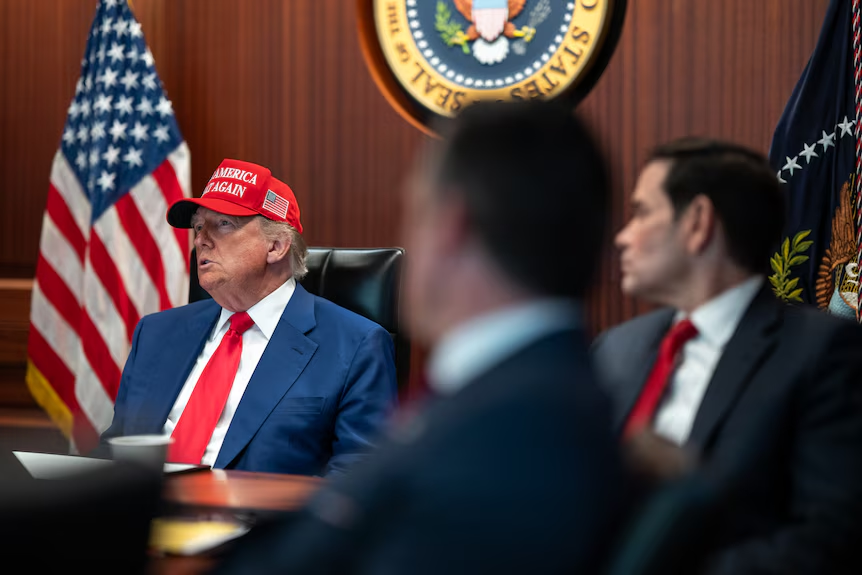
Gathered around a mahogany conference table in the West Wing of the White House, US President Donald Trump and his cabinet convened to discuss the escalating conflict with Iran.
Although Mr. Trump had previously held meetings regarding the growing tensions in the Middle East, this session stood apart.
Thousands of miles away, US-operated B-2 Spirit stealth bombers were carrying out airstrikes on Iranian nuclear facilities, deploying bunker-buster bombs.
The president and his closest advisors assembled to witness the operation unfold.
Scattered binders and disposable cups
The White House released a series of photographs capturing this historic meeting, offering the public a rare view inside the renowned Situation Room.
In one image, Secretary of State Marco Rubio and Secretary of Defense Pete Hegseth appear intently focused on something beyond the camera’s frame.
Wearing his trademark bright red “MAKE AMERICA GREAT AGAIN” cap, Mr. Trump moved around the room with a solemn expression. The conference table was cluttered with colorful highlighters, thick binders, disposable cups, and half-filled water bottles, as cabinet members concentrated on a screen not visible in the photos.
Seated at the head of the table, Mr. Trump had Vice President JD Vance at his right and Secretary of State Marco Rubio to his left—positions that may reflect their significant influence during the president’s prolonged deliberations over military action.
Mr. Trump was not stationary throughout the meeting.
In several moments, he stood behind his top aide Susie Wiles while General Dan Caine, Chairman of the Joint Chiefs of Staff, provided updates. CIA Director John Ratcliffe was seen with blurred documents, likely obscured for security purposes. Defense Secretary Pete Hegseth, National Security Adviser Andy Baker, and White House Counsel David Warrington also appeared in the images.
Senior staff who are not considered principals, such as Deputy Chief of Staff Dan Scavino, were present as well, seen in the background of some shots.
In every photograph, Mr. Trump remained sharply in focus, while other officials like Mr. Hegseth and Mr. Vance appeared slightly blurred.
Noticeably absent?
Political analysts have speculated about who was missing from the gathering. Tensions within the administration had risen over whether the US should support Israel’s strikes against Iran.
In March, Director of National Intelligence Tulsi Gabbard publicly stated that there was no evidence Iran was developing nuclear weapons. When questioned about her remarks, Mr. Trump bluntly said, “She’s wrong.” Ms. Gabbard later posted on X that her comments had been taken out of context to “manufacture division.”
Her absence from the published photos has fueled rumors of a rift with the president, though some journalists, citing White House sources, reported that she was present in the room.
A setting for crucial decisions
The Situation Room, located deep in the West Wing, has been the site of countless pivotal decisions since its creation in 1961, ordered by President John F. Kennedy following the failed Bay of Pigs invasion.
This secure complex serves as the central hub where presidents meet with intelligence and military advisors to deliberate over classified operations and international security strategies.
Despite its name, it is more of a suite of operational rooms than a single chamber. Former Secretary of State Henry Kissinger once described it as “uncomfortable, unaesthetic and essentially oppressive.” The facility spans much of the lower level of the West Wing and extends beneath the White House’s outdoor pool.
Access is heavily restricted, limited primarily to top military and intelligence officials.
This is where history often unfolds.
Famous moments include President Barack Obama monitoring the mission that killed Osama bin Laden in 2011, President Trump overseeing the operation against Islamic State leader Abu Bakr al-Baghdadi in 2019, and President Lyndon Johnson reviewing Vietnam War plans in the 1960s.
Now, a new chapter has been added to the Situation Room’s legacy: the night the US launched airstrikes on Iran.
