


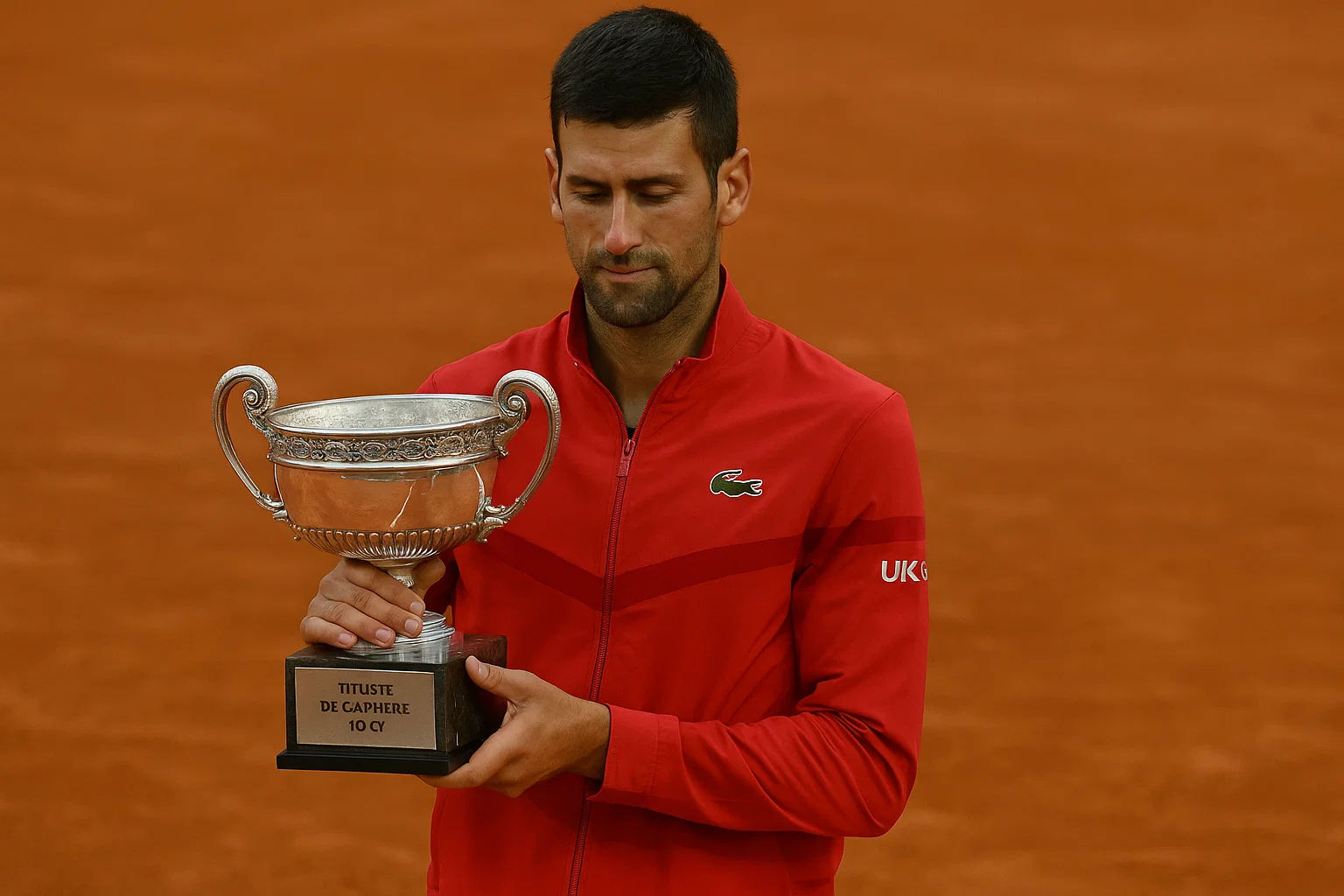
Novak Djokovic thrives on greatness. He feeds off it. And in men’s tennis, he’s long been its most dominant figure.
So dominant, in fact, that his racquet bag reads like a resume. It proudly displays his biggest achievements—an unmistakable psychological message to opponents before the match even begins: Olympic gold, 10 Australian Open titles, 3 French Opens, 7 Wimbledons, 4 US Opens, and 7 Tour Finals wins.
But as he enters the 2025 French Open, Djokovic may need that reminder more than his opponents do.
Despite his extraordinary career, Father Time is closing in on the 38-year-old Serb.
Even his recent triumph at the Geneva Open—a milestone 100th ATP Tour title—was more a testament to longevity than dominance. He became just the third man to hit the century mark and the only player to win a title in 20 separate seasons.
Still, the victory didn’t come easily. Against Poland’s Hubert Hurkacz, ranked 31 in the world, Djokovic was shaky through the first two sets. He racked up 29 unforced errors—17 from his backhand—before finding form in the third.
Hurkacz began the final set strongly, winning 12 straight service points before collapsing under pressure. Unforced errors and a double fault allowed Djokovic back into the match.
Djokovic admitted after the win, “Hubi was probably closer to victory the entire match than I was… He probably broke himself in the third.”
That subdued response spoke volumes about where his game is at.
A Troubling Start to 2025
This year marks the second-worst start of Djokovic’s professional career, with a 16–7 record to date. Only 2018 was worse—his comeback year following elbow surgery—when he went 10–7 entering Roland Garros.
That season saw shock defeats to lower-ranked players like Hyeon Chung, Taro Daniel, and Martin Klizan. Losses to top players like Rafael Nadal and Dominic Thiem were expected. The others weren’t.
In 2025, similar patterns have emerged.
Djokovic began the year with a third-round loss in Brisbane to Reilly Opelka. He then retired during his Australian Open semifinal due to a hamstring injury. His comeback saw early exits in Doha and Indian Wells, followed by a finals run in Miami—only to lose to teenager Jakub Mensik.
Then came a disastrous clay court season.
Alejandro Tabilo dismantled him in Monte Carlo, and Matteo Arnaldi outplayed him in Madrid. The first-round defeats were uncharacteristic—and alarming.
Djokovic was brutally honest after the Monte Carlo loss: “Just awful. Playing like this generates a horrible feeling.”
Even the typically composed Arnaldi appeared stunned after beating Djokovic.
Facing a “New Reality”
“I was hoping to play one more match than I did in Monte Carlo,” Djokovic admitted. “It’s a new reality for me… just trying to win a match or two.”
That shift in mindset—from title favorite to mere contender—is jarring for a player who spent two decades dominating the sport.
Yet, Djokovic is clinging to one consistent goal: peaking at Grand Slams.
Whether he can achieve that remains uncertain.
Roland Garros: One Last Run?
Ironically, the place of his next test—Roland Garros—could become the scene of his final great triumph.
Rafael Nadal’s failed comeback earlier this year and first-round loss to Alexander Zverev was a reminder that even legends can’t script fairy-tale endings.
Djokovic, however, once dominated Nadal and the field here—most memorably winning Olympic gold on the same clay.
He crushed Carlos Alcaraz in straight sets during that tournament, completing the elusive Golden Slam and joining the likes of Nadal and Agassi.
That moment felt like a crowning achievement. But since then, his results have been underwhelming.
2024 saw him go slam-less for the first time since 2017. And although his Geneva win marks a career milestone, critics note the weak field—Hurkacz being the only top contender he faced.
Few Records Left, Fewer Chances
With 100 titles now, Djokovic trails only Federer (103) and Connors (109). Closing that gap at this stage looks unlikely.
Chasing another Grand Slam? That’s even harder. The calendar Slam—winning all four majors in a single year—is now out of reach.
Matching Federer’s 8 Wimbledons remains possible, but even that is uncertain. Federer’s final title came in Basel at age 38.
One realistic milestone? Becoming the oldest Grand Slam champion. Ken Rosewall holds that record, having won the 1972 Australian Open at age 37.
Djokovic, now 38, is technically in the running. But current form casts doubt.
A Shifting Style, A Changing Game
He’s adjusted his game in recent years, becoming more aggressive to shorten rallies. His first serve is now faster (194 kph vs. 185 kph in 2015), and he’s striking the ball earlier, increasing forehand speed and hitting from closer inside the baseline.
But the grind of best-of-five matches is becoming harder.
He withdrew from last year’s French Open quarterfinal with a knee injury. At Wimbledon, he made the final but was defeated by Alcaraz. At the US Open, he was stunned by Alexei Popyrin.
At the Australian Open this year, he retired again—this time in the semifinal against Zverev.
These are signs of a body no longer able to meet the demands of elite tennis.
But That Fear Factor Remains
Still, in Geneva’s final set, flashes of the old Djokovic reappeared—tenacious, mentally unbreakable, refusing to lose.
That’s what Hurkacz saw when he faltered.
That mental edge may be Djokovic’s best weapon heading into Roland Garros, where he has a relatively manageable draw: possibly Medvedev in the fourth round, and an out-of-form Zverev in the quarters.
From there, anything is possible—if he can rediscover his game and tap into his vast experience.
Djokovic has redefined tennis history. But how much more history he can make will depend not just on his will, but whether his body still has enough left.
