
If Iran’s Regime Fell Tomorrow, Unity Over What Comes Next Would Be Unlikely
Between 2015 and 2018, I spent a total of 15 months conducting anthropological research in Mashhad, Iran’s second-largest city. My goal was to understand the everyday lives of Iranians outside Tehran and to explore whether the ideals of the 1979 Revolution still resonated with ordinary citizens—not just with political elites.
I began my stay on a university campus, where I learned Persian, and later lived with Iranian families. Throughout my fieldwork, I interviewed hundreds of people from across the political and religious spectrum, including regime supporters, critics, and many who fell somewhere in between.
What stood out in these conversations was the diversity of views and the difficulty of making broad generalisations about what Iranians think or believe.
Hostility Toward the Regime Is Real—but Complex
When Israeli airstrikes targeted Iran on June 13, killing several senior military leaders, some international and diaspora-run media featured images of Iranians celebrating the deaths. Friends from my time in Iran pointed out these reactions—some supported them, others expressed concern about escalation and war.
Polls like the 2019 GAMAAN survey—which found that nearly 80% of Iranians would reject the Islamic Republic in a free referendum—are often cited to show widespread dissatisfaction. While not inaccurate, such data points risk being oversimplified in media narratives, removing them from the everyday context of life in Iran. They don’t capture the complex interplay between ideology, pragmatism, resistance, and survival.
Blurring the Line Between State and Society
Western reporting tends to portray the Iranian regime as monolithic and ideologically rigid, distinct from its people. But the boundary between the state and the population is not always so clear.
Many Iranians I met worked in state institutions—teachers, bureaucrats, university staff—and held diverse, often contradictory views. Some supported aspects of state ideology, such as sovereignty and independence, while rejecting others, like anti-American slogans.
One Persian teacher, a state employee, refused to attend state-organised revolutionary parades but participated in pro-Palestinian rallies. Another young government worker told me, “We want to be independent, but not like this.”
Institutions Like the IRGC Aren’t Uniform Either
Discussions about “the regime” often focus on entities like the Islamic Revolutionary Guard Corps (IRGC) and its volunteer militia, the Basij. These groups are often seen as deeply ideological and coercive.
However, their makeup is more mixed than assumed. The IRGC includes both committed supporters and conscripts, while the Basij, despite being volunteer-based, attracts members for pragmatic reasons—job opportunities, social mobility, or shortened military service.
During my fieldwork, I interviewed Basij members who viewed participation as a means to an end, not a reflection of deep ideological conviction. For example, one friend said joining the Basij helped reduce his military service.
This isn’t to deny that genuinely ideological and violent actors exist in these ranks. They do. But pragmatism is often as influential as belief.
Ethnic, Religious, and Class Divides Shape Iran’s Future
Iran is a diverse nation of over 90 million people, with Persians making up just over half the population. Other significant groups include Azeris, Kurds, Arabs, Baloch, Turkmen, and others. There’s also a religious mosaic—while Shia Islam is dominant, Sunnis, Christians, Jews, Zoroastrians, Baha’is, and other groups all exist within its borders.
This diversity is often erased by both state propaganda and diaspora opposition groups, who present unified narratives—either in favour of the regime or advocating for a specific alternative, like monarchy or opposition figures such as Maryam Rajavi.
Inside Iran, the regime often dismisses protests as foreign plots, while opposition media abroad often claim to speak for “all Iranians.” Both perspectives flatten a very complex and layered society.
What Comes After the Regime? There Is No Single Answer
In recent years, political polarisation has deepened. Many Iranians—particularly the youth, who make up a large share of the population—feel increasingly disconnected from the regime. Waves of civil disobedience and protests show a widespread demand for change.
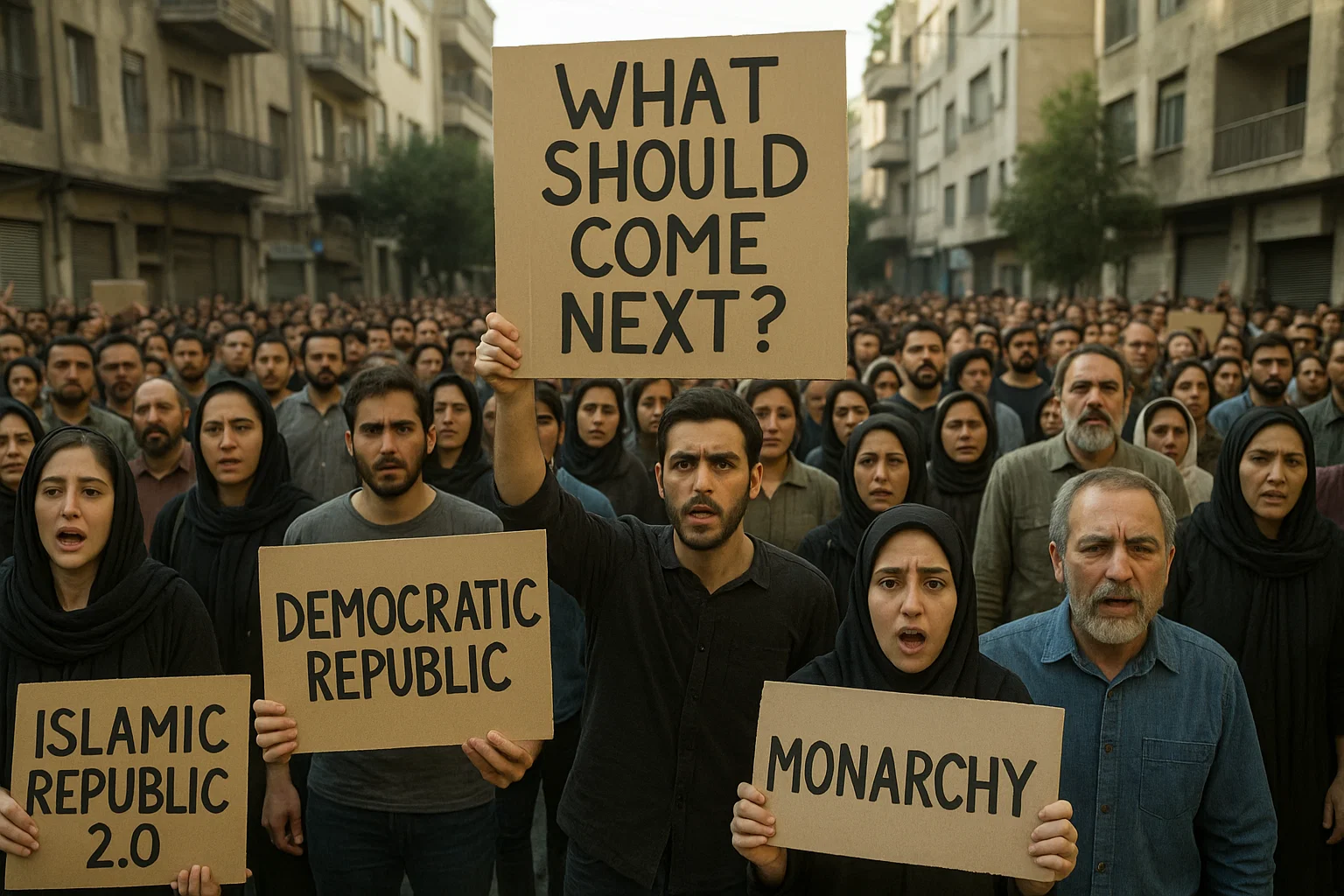
Still, it’s important to resist assuming there’s a shared vision for what should replace the current system. Iran’s diversity of identity, belief, and experience means that any future political order will need to reflect and reconcile those differences.
As an outsider and a researcher, I don’t claim to speak for Iranians. It’s for them to decide their own future. And while the Islamic Republic is brutal and repressive, understanding its complexity is crucial.
If the regime were to collapse tomorrow, there would be no consensus on what comes next. A pluralistic political future, if it is to emerge, will need to grapple with the legacies of the Islamic Republic—and include the full spectrum of Iranian voices, not just those that speak the loudest.
