


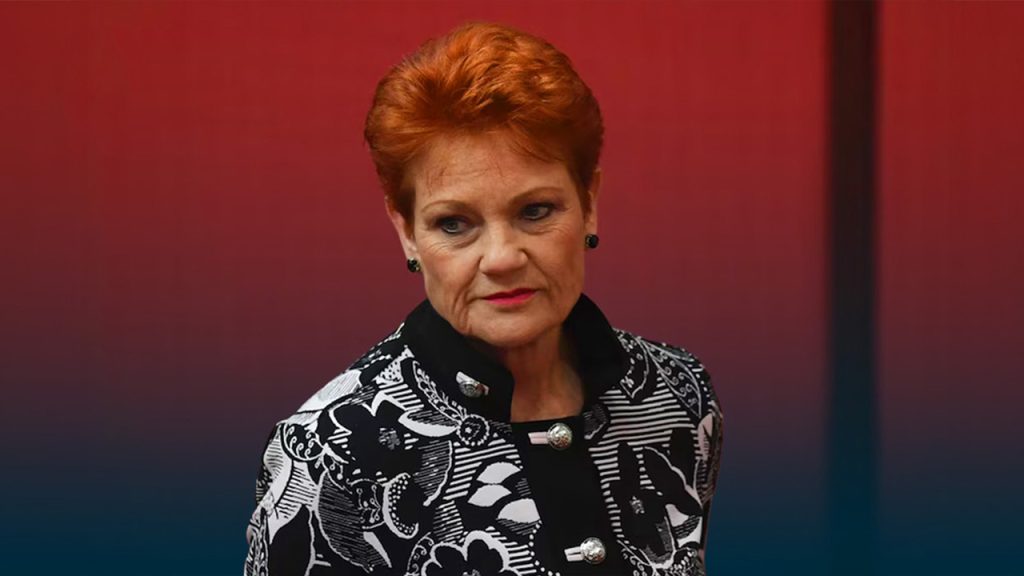
One Nation leader Pauline Hanson has called for a major reduction in the number of international students entering Australia as part of her party’s plan to sharply lower net overseas migration.
Politics (Right)
Hanson has argued that international student arrivals should be significantly reduced, although she has not specified exactly how many students would be prevented from entering the country under the proposal.
The debate comes as One Nation pushes for net migration to be reduced to about 130,000 people a year, substantially below the current level of around 300,000.
International students account for a significant proportion of Australia’s net migration, meaning the sector would likely face some of the largest cuts if One Nation’s migration target were implemented.
That possibility has raised concerns about the potential impact on Australia’s international education industry, which is worth an estimated $55 billion and ranks among the country’s largest export sectors.
Speaking about the issue, Hanson criticised the way universities have expanded their reliance on overseas students.
Study Abroad
She alleged that some people were using student visas as a pathway to remain in Australia rather than primarily coming to study, though she did not provide evidence to substantiate that broader claim.
Hanson also raised concerns about the effect of international students and accompanying family members on housing availability.
She argued that universities bringing large numbers of overseas students into Australia should take greater responsibility for providing suitable accommodation.
According to Hanson, universities should ensure adequate housing is available rather than allowing increased student demand to place additional pressure on the broader residential property market.
However, when asked exactly how many international students One Nation would allow into Australia, Hanson declined to nominate a figure.
Her comments come amid a wider national debate about migration, housing availability, infrastructure and Australia’s reliance on international education revenue.
Education
The Albanese government has already moved to reduce net migration from the unusually high levels recorded after Australia’s borders reopened following the pandemic.
Net overseas migration reached approximately 550,000 in 2023, before falling significantly in subsequent years.
The federal government is now targeting a level of around 220,000, while also making changes to visa processing priorities.
Home Affairs Minister Tony Burke recently introduced changes designed to give greater priority to certain skilled migrants who are already in Australia.
Under the revised processing system, onshore applicants working in areas such as law enforcement and the defence industry have been given higher priority.
Offshore applicants outside priority fields such as healthcare, teaching and construction have been placed further down the processing order.
Mathematics
The government is also reportedly considering additional changes to the migration system, including tighter family visa arrangements, possible limits affecting working holiday makers and stricter rules surrounding work rights and appeal processes for asylum seekers.
Migration has also become a contentious issue within the Coalition.
Opposition housing spokesman Andrew Bragg recently suggested Australia should aim for net migration of around 180,000 people annually.
His proposed target attracted attention within Coalition ranks, with some colleagues stressing that the figure represented Bragg’s personal position rather than settled party policy.
Bragg has nevertheless continued to argue that migration levels cannot be separated from Australia’s housing affordability problems.
He has linked population growth to pressure on housing supply and argued that lower migration would form part of any effort to close the gap between housing demand and the number of homes being built.
Visa & Immigration
Like Hanson, however, Bragg has not specified exactly how many international student places would need to be reduced to achieve a lower migration target.
He said the Coalition would need to carefully examine the economic consequences before determining how any migration reductions should be distributed.
Bragg acknowledged that international education makes a substantial contribution to the Australian economy and said any policy changes would require extensive consultation.
The debate highlights the difficult balance facing policymakers.
Reducing international student numbers could ease some pressure on migration totals, rental markets and infrastructure, but a significant reduction could also have major financial consequences for universities, education providers and businesses that rely heavily on international students.
International education supports thousands of jobs across universities, vocational education, accommodation, hospitality and other industries.
Politics (Right)
The sector also generates billions of dollars in export income, making any proposal for substantial cuts economically significant.
At the same time, growing public concern over housing affordability and population growth has increased pressure on political parties to explain how migration policy will interact with housing construction and infrastructure capacity.
One Nation has positioned lower migration as a central part of its response to those concerns.
However, the absence of a specific international student target leaves uncertainty about how deeply the sector would be affected under the party’s proposed migration settings.
As migration and housing become increasingly prominent political issues, the future size of Australia’s international student population is likely to remain a major part of the national debate.
