


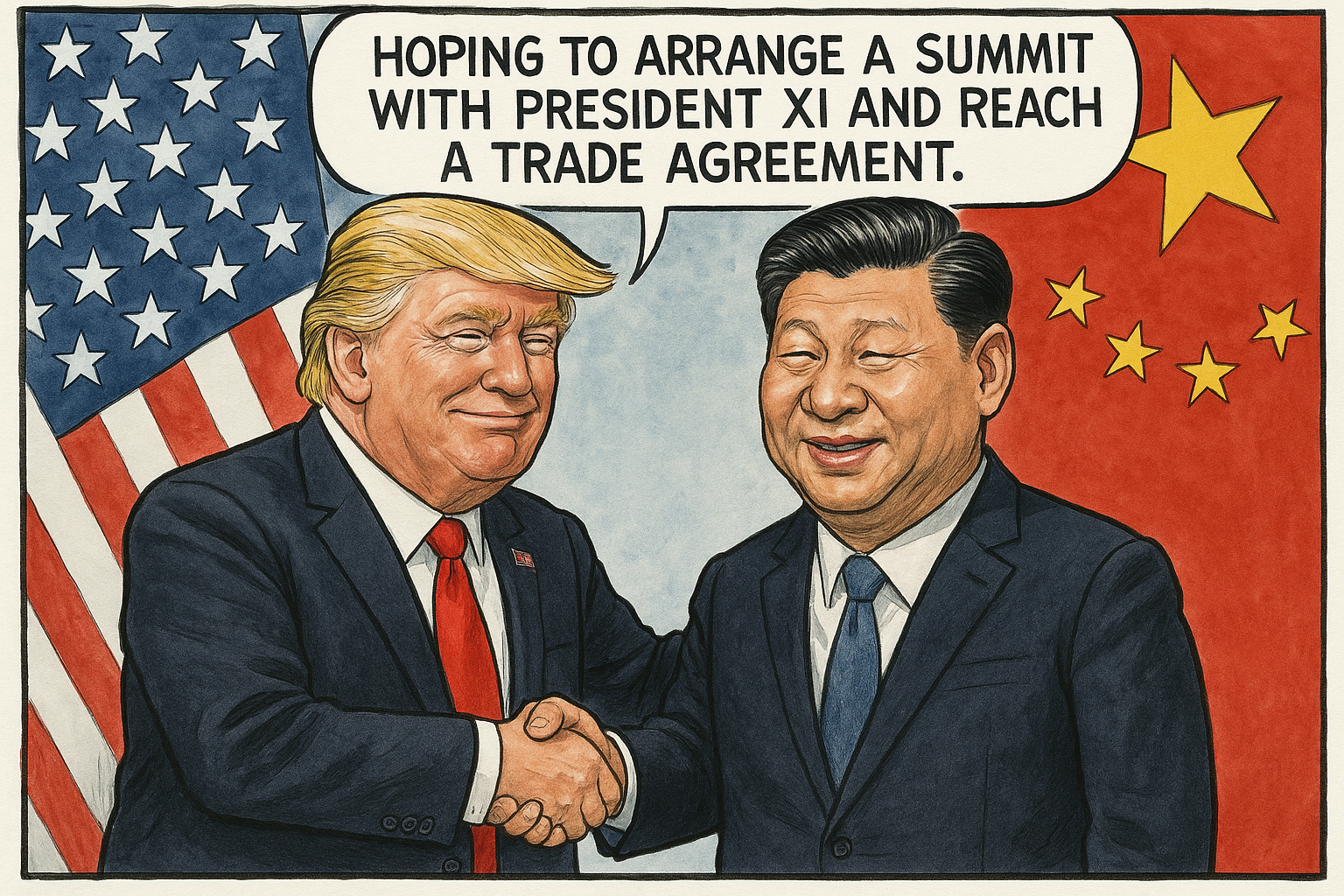
U.S. President Donald Trump has moderated his previously combative rhetoric toward China as he seeks to secure a summit with President Xi Jinping and finalize a trade agreement with the world’s second-largest economy, according to sources familiar with internal discussions.
Six months into his second term, Trump has softened his earlier campaign focus on the U.S.–China trade deficit and its impact on domestic jobs. His current approach contrasts sharply with his aggressive tactics toward other trade partners, where he has threatened punitive tariffs.
Rather than addressing deeper structural issues in the bilateral economic relationship, Trump is now prioritizing transactional deals with China—similar to those struck in his first term—that allow for quick political wins. This shift comes even as China’s trade surplus has reached record levels, bolstered by strong exports.
Speaking on July 15, Trump said he intended to “fight China in a very friendly fashion.” Sources noted that during internal discussions, Trump has often taken a less hawkish stance than many of his advisors.
Officials emphasized that Trump has maintained a personal affinity for Xi, despite having imposed significant sanctions on Huawei and tariffs on most Chinese goods during his previous term. Still, Trump’s unpredictable style and his departure from earlier hardline positions have caused concern among administration insiders and external advisors, many of whom worry that U.S. policy red lines on China are becoming negotiable.
One key example is the administration’s reversal on export restrictions for Nvidia’s H20 chip, which was initially deemed too sensitive to be sold to China. Treasury Secretary Scott Bessent had previously highlighted this restriction as proof of the administration’s firm stance on tech controls. However, the new decision to permit limited sales, while still subject to licensing, has drawn internal objections from those who argue it could bolster China’s tech ambitions.
Advocates for the policy shift, including Nvidia CEO Jensen Huang, argue that competing directly with Huawei in China is critical to maintaining U.S. leadership in AI. That view has gained support within Trump’s team, according to sources.
A White House spokesperson confirmed that Trump ultimately decides all trade matters and said the administration continues “productive discussions” with all trading partners. As part of efforts to reduce tensions, U.S. officials are preparing to extend a 90-day tariff truce with China, originally set to expire on August 12, which would otherwise see tariffs jump to 145%. An extension of up to three months is reportedly under consideration.
Meanwhile, U.S. Secretary of State Marco Rubio, once a vocal China critic, stated that a summit between Trump and Xi appears likely. Rubio recently described a meeting with Chinese Foreign Minister Wang Yi as “very constructive and positive.”
Some Trump officials are focused on securing commitments from Beijing to purchase unspecified volumes of American goods and services—an approach that may help reduce the trade deficit in the short term but does little to address the underlying imbalance.
Trump’s softer stance has created tensions within his administration. Some trade advisors are determined to uphold a firm line on Beijing and oppose including export controls in trade talks. Nonetheless, officials such as Commerce Secretary Howard Lutnick and AI and Crypto Czar David Sacks acknowledged this week that limited Nvidia chip sales are now part of ongoing negotiations.
This shift has sparked debate over whether Trump might be willing to compromise national security measures in exchange for trade concessions. While some advisors argue that the H20 chips are far less sophisticated than Nvidia’s top-tier products and pose limited risk, others worry that more significant rollbacks may follow.
Lutnick summed up one school of thought by stating: “You want to sell the Chinese enough that their developers get addicted to the American technology stack.”
Allies in Europe and Asia, many of whom the U.S. relies on to constrain China’s tech sector, are watching closely. According to sources, government and industry leaders in those regions are beginning to perceive U.S. strategy as increasingly unpredictable.
Tech industry representatives involved in discussions with the Trump administration describe evolving goals and inconsistent decision-making. For instance, recent export restrictions on chip design software were implemented without broader consultation and then abruptly reversed, Bloomberg previously reported.
The approval of Nvidia’s H20 chip sales was similarly handled discreetly, while broader sanctions targeting Chinese tech firms and subsidiaries have been delayed in pursuit of a broader trade agreement.
Trump’s record on China also includes sudden policy reversals, such as his 2018 decision to lift sanctions on telecom giant ZTE following a direct appeal from Xi. Observers note that Trump remains sensitive to criticism and could quickly shift positions again.
Derek Scissors of the American Enterprise Institute cautioned that any deal with China may be short-lived. With the U.S. trade deficit on track to reach a new record by year-end, Trump may ultimately abandon his current conciliatory stance.
Meanwhile, Chinese officials appear confident in their negotiating position. During recent talks in London, U.S. delegates were reportedly taken aback by their Chinese counterparts’ open satisfaction with the current dynamic.
China’s leverage stems in part from its dominance in rare earth materials, which are essential to high-tech manufacturing. It has recently imposed new regulations requiring foreign companies to submit sensitive data and reapply for rare-earth export licenses every six months, reinforcing its strategic upper hand.
